

What if the engine in your driveway is currently operating at only eighty per cent of its true potential, restricted not by its physical components but by a conservative line of factory code? It’s natural to feel a sense of trepidation when you consider altering your vehicle’s software. You’ve likely spent hours navigating conflicting forum advice and wondering, is remapping safe for my engine, or am I simply inviting an expensive repair bill? We understand that your vehicle is a significant investment that requires expert care and technical precision.
This guide dismantles the common myths surrounding ECU tuning by exploring the sophisticated safety margins that manufacturers intentionally build into modern powerplants. You’ll discover how a professional Stage 1 remap unlocks a more responsive, efficient driving experience whilst strictly adhering to these mechanical tolerances. We provide the technical clarity you need to move past the anxiety of voided warranties, offering a definitive checklist for selecting a specialist who prioritises reliability as much as you do. By the end of this article, you’ll understand exactly why a custom-calibrated Stage 1 remap is the sweet spot for performance and peace of mind.
Key Takeaways
- Understand why manufacturers build substantial safety margins into factory software to account for global variations in fuel quality and extreme climates.
- Discover the technical evidence that answers the question, is remapping safe for my engine, by focusing on the conservative parameters of a professional Stage 1 calibration.
- Learn to distinguish between sophisticated software-based optimisation and aggressive tuning levels that could push your vehicle beyond its engineered mechanical limits.
- Identify the specific maintenance adjustments and expert driving habits required to preserve the longevity and reliability of your enhanced engine.
Understanding the Safety of Modern ECU Remapping
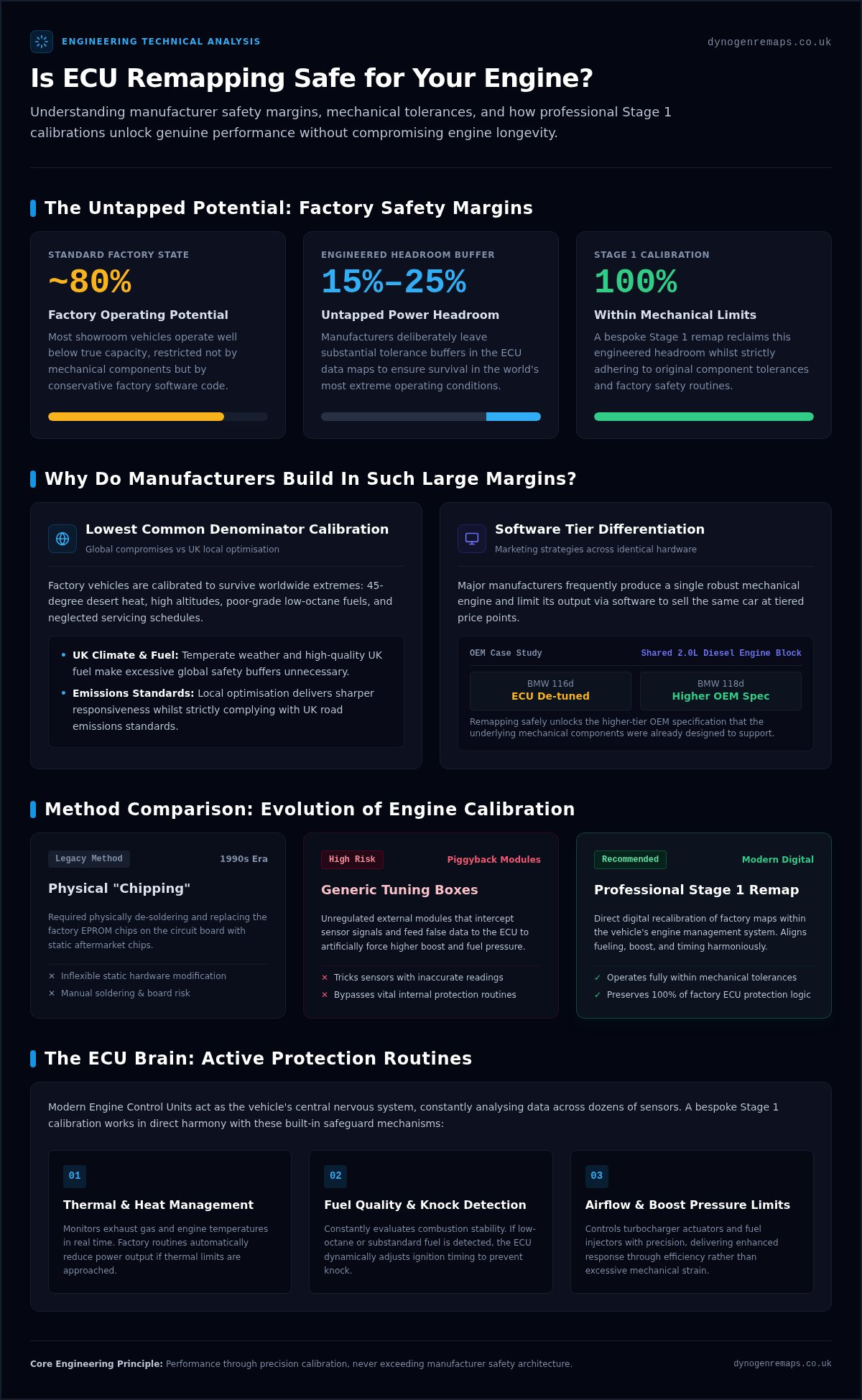
ECU remapping is the sophisticated process of recalibrating the factory-set software within a vehicle’s engine management system. Many drivers still refer to this as “chipping”, a term from the 1990s when physical EPROM chips were manually replaced. Today, the process is entirely digital. It involves modifying the internal data maps that control how your engine breathes and burns fuel. If you’ve been asking yourself, is remapping safe for my engine, the answer depends entirely on the quality of the calibration. A professional Stage 1 remap is designed to work within the existing mechanical capabilities of your vehicle, ensuring that performance gains don’t come at the expense of durability. For a standard, well-maintained car, this software-based optimisation is exceptionally safe because it unlocks potential that the manufacturer has already accounted for in the engine’s design.
The Role of the Engine Control Unit (ECU)
The ECU acts as the central nervous system of your vehicle. It constantly monitors data from dozens of sensors to decide exactly how much fuel to inject and when to fire the spark plugs. These software parameters dictate the physical behaviour of engine components like the turbocharger and fuel injectors. Remapping simply updates these instructions. By refining these maps, we can achieve smoother power delivery and improved responsiveness without exceeding the hardware’s design limits. It’s a precise adjustment of the engine’s “brain” to ensure every component operates at its most efficient level. This bespoke approach is why professional remapping is vastly superior to generic, unregulated tuning boxes that often bypass these vital internal controls.
Why Safety is the Top Priority for Specialists
A reputable specialist always prioritises engine longevity over chasing the highest possible BHP figure. This professional approach centres on engine control unit calibration and safety margins, ensuring that all factory-installed protection routines remain fully operational. Modern ECUs contain complex “component protection” features. These routines automatically reduce power if they detect excessive heat or poor fuel quality. A safe remap respects these boundaries. Our clients often ask, is remapping safe for my engine, and the answer is a definitive yes, provided the software respects mechanical limits. Unlike generic “black box” tuning modules that trick sensors with false data, a bespoke remap works in harmony with the engine’s original safety architecture. We focus on performance through precision, not pressure, ensuring your car remains reliable for daily use whilst delivering a significantly more engaging driving experience.
The Secret of Manufacturer Safety Margins
Engine manufacturers calibrate factory ECUs to a “lowest common denominator” standard. A vehicle sold in the UK must be identical to one sold in regions with extreme 45-degree heat or poor-quality, low-octane fuel. To ensure survival in these harsh environments, they leave a substantial amount of untapped power headroom, typically between 15% and 25%. If you’re questioning, is remapping safe for my engine, the answer lies in this engineered buffer. You aren’t forcing the engine to do something it wasn’t designed for; you’re simply removing the artificial restraints intended for global markets. In reality, is remapping safe for my engine depends on staying within the manufacturer’s generous safety net.
Software differentiation is also a common marketing strategy amongst major brands. For instance, the BMW 116d and 118d often share the same 2.0-litre diesel engine block. The manufacturer restricts the lower-tier model via the ECU to justify a different price point. Remapping safely unlocks the higher-tier OEM specification that the underlying hardware was already designed to support, reclaiming the performance you’ve already paid for.
Global Tuning vs. Local Optimisation
UK drivers benefit from high-quality fuels and a temperate climate, meaning the massive safety buffers required for the Sahara are unnecessary. Professional remapping reclaims this lost potential for the local environment. Whilst we refine these parameters, we ensure all calibrations stay within vehicle modification and emissions compliance standards to maintain roadworthiness. This local optimisation provides a more responsive drive without compromising the vehicle’s ability to meet strict UK testing requirements.
Operating Within Mechanical Tolerances
Every component, from the turbocharger to the fuel injectors, has a specific mechanical limit. A properly developed Stage 1 remap respects these boundaries by staying well within the physical tolerances of the hardware. We ensure boost pressure increases are modest, usually between 0.2 and 0.4 bar, keeping the turbo within its efficiency island. This prevents excessive heat soak and protects the longevity of your drivetrain. By maintaining active software monitoring, the ECU can still intervene if it detects temperatures exceeding safe thresholds. If you want to see how these margins apply to your specific vehicle, you can discover how our bespoke calibrations respect your car’s unique architecture.
Stage 1 Remapping vs. Aggressive Tuning: Where the Risks Lie
Not all calibrations are created equal. When evaluating is remapping safe for my engine, it’s vital to distinguish between a conservative software enhancement and an aggressive, hardware-dependent build. Stage 1 tuning represents the absolute gold standard for daily-driven reliability because it works in harmony with the vehicle’s factory hardware. In contrast, Stage 2 and Stage 3 tuning require significant mechanical upgrades, such as high-flow downpipes or uprated intercoolers, to manage increased thermal loads. Without these supporting modifications, aggressive tuning pushes components like rods, pistons, and turbo seals beyond their metallurgical limits. This significantly increases the risk of component fatigue and premature failure.
The Reliability of a Stage 1 Performance Remap
A professional Stage 1 remap is developed specifically for standard, unmodified vehicles. It remains the least intrusive method of increasing engine torque and power whilst maintaining, or even improving, factory levels of fuel economy. Because no physical components are changed, the engine operates within a refined version of its original parameters. Our focus remains on achieving a perfect balance; providing a sharper throttle response and a broader power band without compromising the vehicle’s long-term health. It’s the ideal solution for drivers seeking a more aspirational driving experience without the maintenance headaches associated with track-focused builds.
Red Flags: How to Spot an Unsafe Remap
The market is unfortunately flooded with “generic” or “slave” files. These are often sold by mobile tuners who lack a physical premises or the technical depth to perform a proper diagnostic health check. A “canned” tune doesn’t account for your engine’s specific mileage, wear, or current health, which is a significant gamble for any owner. You should be particularly wary of “smoke maps” or calibrations that bypass essential safety sensors like Exhaust Gas Temperature (EGT) monitors. If a tuner doesn’t perform live data logging to monitor fuel trims and boost levels during the process, they aren’t providing a bespoke service. Cheap maps often result in erratic power delivery or frequent “limp mode” events. These are clear indicators that the software is fighting against the ECU’s internal safety logic rather than working with it. True peace of mind comes from a specialist who views is remapping safe for my engine as a technical mandate rather than a secondary concern. We take pride in a methodical approach that ensures every calibration is as reliable as it is powerful.
How to Ensure Your Remap Remains Safe Long-Term
A professional calibration is not a “set and forget” modification. Whilst a Stage 1 remap operates within safe mechanical limits, it inevitably increases cylinder pressures and thermal loads on specific components. It is a fundamental truth in vehicle mechanics that a remap does not cause failure in a healthy engine; instead, it accelerates the wear of components that were already compromised. To preserve the pursuit of perfection in your vehicle’s performance, you must shift toward a more proactive maintenance regime. This transition ensures that the increased responsiveness and efficiency remain consistent throughout the vehicle’s lifespan.
Adopting shorter service intervals is the most effective way to protect a tuned engine. We recommend changing high-grade, fully synthetic oil every 5,000 to 6,000 miles, or every six months, to counter the effects of thermal oil shear. Additionally, running dedicated premium fuel (98 or 99 RON) is non-negotiable for resisting high-load pre-ignition. These simple adjustments provide the necessary protection for your engine’s internal architecture, allowing you to enjoy the enhanced driving experience with total confidence.
The Pre-Remap Health Check
A seasoned specialist will never apply software to a vehicle without first performing a comprehensive electronic diagnostic scan. This process is the only way to truly answer, is remapping safe for my engine, as it identifies hidden faults that could lead to a breakdown under increased load. During this consultation, we evaluate critical components including turbocharger shaft play, clutch health, and DPF soot accumulation levels. We only recommend improving car drivability with remapping once the vehicle has received a clean bill of health. This methodical approach ensures your hardware is physically capable of supporting the new software parameters.
Insurance, Warranty, and MOTs
Transparency with your insurance provider is a legal mandate under the Consumer Insurance (Disclosure and Representations) Act 2012. Failing to declare an ECU remap can result in a voided policy, leaving you personally liable for damages. Most UK insurers are now accustomed to Stage 1 modifications and typically apply only a modest adjustment to your premium. Regarding manufacturer warranties, you should be aware that modern dealer diagnostics (such as the VAG TD1 flag) can detect software changes even if they are reversed. However, a professional remap will not cause an MOT failure. Because we maintain all factory emissions controls, your vehicle will continue to meet UK tailpipe standards. If you are ready to proceed with a reliable, expert-led calibration, you can book your technical diagnostic session here.
Professional Tuning: The Dynogen Commitment to Reliability
At Dynogen, we operate on a singular, unwavering philosophy: performance through precision, not pressure. With over 15 years of industry experience, our seasoned specialists have witnessed the evolution of engine management technology from its early stages to the sophisticated ECU architectures of 2026. This long-standing expertise allows us to provide a level of technical excellence that generic corporate options simply cannot match. We take immense pride in our workmanship, positioning ourselves as the elite alternative for drivers who demand perfection in vehicle performance. When clients ask, is remapping safe for my engine, our answer is rooted in a decade and a half of meticulous software development and a steadfast commitment to the end-user’s experience.
Custom Calibration vs. Generic Software
A generic “black box” or “off-the-shelf” file is a compromise that fails to account for the unique health, mileage, and wear of your specific engine. Dynogen rejects this “one-size-fits-all” approach in favour of custom-calibrated software that is tailored to your vehicle’s exact requirements. This bespoke process ensures that every parameter adjustment remains within the safe mechanical limits of your hardware. Our specialists also utilise this technical depth to provide solutions for complex emissions faults, such as DPF and EGR issues, which significantly improves long-term reliability. You can explore the top 5 ECU remapping benefits to see how our precision-led tuning unlocks your vehicle’s true potential whilst maintaining total peace of mind.
The Dynogen Process: Meticulous and Intentional
Every vehicle that enters our care undergoes a structured, diagnostic-led process that mirrors a professional consultative consultation. We don’t just flash software. We perform a thorough electronic health check to ensure your engine is physically capable of supporting increased performance. This methodical approach allows us to maintain, and often enhance, the factory safety fail-safes that protect your engine from thermal stress and knock. We pride ourselves on being a protective expert, solving modern mechanical problems whilst remaining accessible to our customers across our national UK coverage. By choosing a specialist who prioritises thoroughness over speed, you ensure that is remapping safe for my engine is a certainty rather than a concern. We invite you to experience a more responsive, efficient, and aspirational drive, backed by the certainty of expert software calibration.
Unlocking Your Vehicle’s True Potential with Confidence
Choosing a performance enhancement shouldn’t feel like a gamble with your car’s longevity. We’ve explored how manufacturers intentionally leave untapped headroom to account for global variables, and why a professional Stage 1 calibration remains the most reliable method for reclaiming that lost power. By respecting mechanical tolerances and adhering to proactive maintenance, the answer to is remapping safe for my engine is a resounding yes. Our approach ensures that your vehicle’s software is custom-calibrated and tailored to your specific engine’s health, rather than relying on generic, one-size-fits-all files.
Dynogen brings over 15 years of expert vehicle tuning experience to every calibration, providing specialist solutions for DPF, EGR, and AdBlue reliability to keep your vehicle on the road for longer. Our commitment to technical excellence means you can enjoy a smoother, more responsive drive without the anxiety associated with standard corporate alternatives. We take pride in delivering results that balance aspirational performance with steadfast reliability. Enquire about a safe Stage 1 Performance Remap for your vehicle today and rediscover the joy of driving with a car that truly reflects its engineered potential.
Frequently Asked Questions
Will a Stage 1 remap shorten the life of my engine?
A professionally installed Stage 1 remap will not significantly shorten the lifespan of a healthy engine. These calibrations are specifically engineered to respect the generous safety margins already built into your vehicle by the manufacturer. Whilst the engine operates with increased cylinder pressures, it remains well within its metallurgical limits. To ensure longevity, we recommend adhering to shorter service intervals and using high-quality synthetic oils to manage the slight increase in thermal load.
Can remapping cause my clutch to slip or my turbo to fail?
Remapping itself does not cause failure, but the increased torque can accelerate the wear of components that are already compromised. If your clutch is near the end of its life, the added power might cause it to slip sooner. Similarly, a turbocharger with existing shaft play may struggle with increased boost pressure. This is why we perform a comprehensive diagnostic health check before any tuning to ensure your hardware is physically capable.
Is remapping legal in the UK and will it pass an MOT?
Software-only ECU remapping is entirely legal on UK roads. Your vehicle will pass its MOT because a professional Stage 1 calibration does not remove or disable factory emissions hardware like the DPF or catalytic converter. You are legally obligated to declare the modification to your insurance provider under the Consumer Insurance Act 2012. Most UK insurers accept remapping as a standard modification, often resulting in only a minor adjustment to your annual premium.
What happens if I am not happy with the remap or want to go back to stock?
The remapping process is completely reversible. We store a digital archive of your vehicle’s original factory software, allowing us to restore it to the stock settings at any time. If you decide to sell the vehicle or simply wish to return to the original configuration, the process is straightforward and leaves no physical trace. This flexibility provides total peace of mind for owners who may be concerned about long-term changes to their software architecture.
Why don’t car manufacturers tune the engines to their full potential?
Manufacturers must account for global variables, including poor-quality fuel, extreme temperature swings, and neglected servicing in varied climates. They also use software to differentiate between model trim levels, often detuning the same engine block to sell it at a lower price point. By remapping your vehicle in the UK, we reclaim this untapped potential, optimising the software for our temperate climate and high-quality fuels whilst staying within the engine’s original design parameters.
Do I need to use premium fuel after my engine has been remapped?
We strongly recommend using premium high-octane fuel, such as 98 or 99 RON, after your engine has been remapped. These fuels provide greater resistance to pre-ignition, or “knock”, which is crucial when the engine is operating with increased boost and advanced ignition timing. Whilst the vehicle will still run on standard 95 RON fuel, you may experience reduced performance and efficiency as the ECU pulls back timing to protect the engine from lower-quality combustion.
How can I tell if a remapping company is professional and safe?
A professional tuner will always perform a full electronic diagnostic scan and data logging session before applying any software. You should look for a specialist with a physical premises and a long-standing reputation, rather than mobile operators. When asking is remapping safe for my engine, a safe provider will explain their custom calibration process and demonstrate how they maintain factory safety fail-safes. Avoid companies that offer “generic” files without verifying your vehicle’s health.
Will a remap affect my car’s fuel economy or reliability?
Many owners find that a professional remap actually improves fuel economy, particularly on turbodiesel vehicles. By increasing low-end torque, the engine requires less effort to maintain motorway speeds, often resulting in a gain of 5% to 10% in efficiency. Reliability remains consistent with factory standards provided you adhere to a proactive maintenance schedule. The primary question of is remapping safe for my engine is answered through this balance of improved efficiency and meticulous software calibration that respects mechanical limits.