
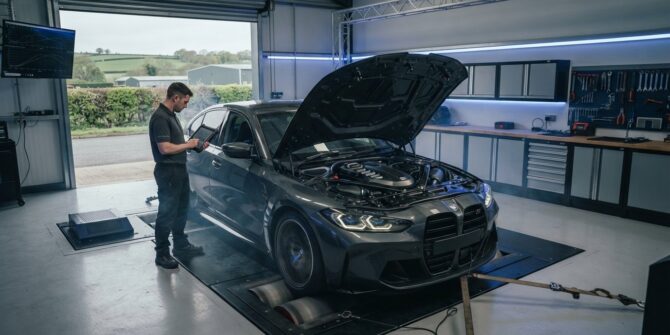
BMW engineered the straight-six B58 as an understressed mechanical masterpiece, leaving vast performance reserves deliberately locked beneath the bonnet. An expertly calibrated BMW B58 remap comfortably delivers 420 to 440 bhp on completely standard hardware, unlocking exhilarating pace without cutting into the engine’s engineered durability.
It’s completely natural to feel cautious before tuning such a precision machine. Worries regarding post-June 2020 Bosch MG1 ECU security bootloaders, water-to-air chargecooler heat soak, and aggressive torque spikes overwhelming the ZF 8HP automatic transmission cause many owners to hesitate. You shouldn’t have to trade factory refinement, daily comfort, and predictable road manners for raw speed.
This guide explains how professional software calibration safely transforms your vehicle whilst preserving factory-smooth throttle modulation and essential mechanical safety margins. We’ll walk through the technical realities of bench unlocks, transmission torque limits, and the rigorous diagnostic roadmap required to enjoy formidable straight-six performance with complete peace of mind.
Key Takeaways
- Discover how a bespoke Stage 1 BMW B58 remap safely unlocks 420 to 440 bhp and over 580 Nm of torque on standard factory hardware.
- Understand why the robust closed-deck block and forged rotating assembly provide the ideal structural foundation for reliable performance gains.
- Demystify modern Bosch MG1 ECU security, clarifying the diagnostic protocols required for both pre- and post-June 2020 bootloader versions.
- Learn how calculated torque delivery protects the internal clutch packs of the ZF 8HP automatic gearbox whilst preserving smooth daily drivability.
- Identify the critical technical advantages of custom rolling-road calibration over generic, off-the-shelf slave files to ensure lasting mechanical integrity.
Understanding the BMW B58 Engine: Factory Engineering and Tuning Potential
The BMW B58 3.0-litre turbocharged inline-six stands as a modern engineering benchmark. BMW engineered this modular powerplant with remarkable structural reserves, deliberately building in tolerances that far exceed standard operational demands. An integrated liquid-to-air chargecooler built directly into the intake manifold delivers ultra-short charge tracts, producing sharp throttle response whilst keeping intake air temperatures stable under sustained boost. Because of this thermal efficiency, executing a BMW B58 remap allows calibrators to release latent performance without fighting immediate heat saturation.
Closed-Deck Design and Forged Internals: Why the B58 Excels
Thermal stability and cylinder rigidity dictate how safely an engine accepts elevated boost pressures. Unlike the earlier N55 engine, which utilised an open-deck configuration, the B58 features a robust closed-deck aluminium block. This architecture surrounds the cylinder bores with solid metal, eliminating bore distortion under intense combustion pressure. BMW complemented this stiff block with a forged steel crankshaft and forged connecting rods as standard equipment. Factory piston skirts also receive specialised anti-friction coatings, ensuring the internal rotating assembly handles sudden torque spikes and thermal expansion without structural fatigue.
Generation Breakdown: Gen 1 (F-Chassis) vs. Gen 2 (G-Chassis)
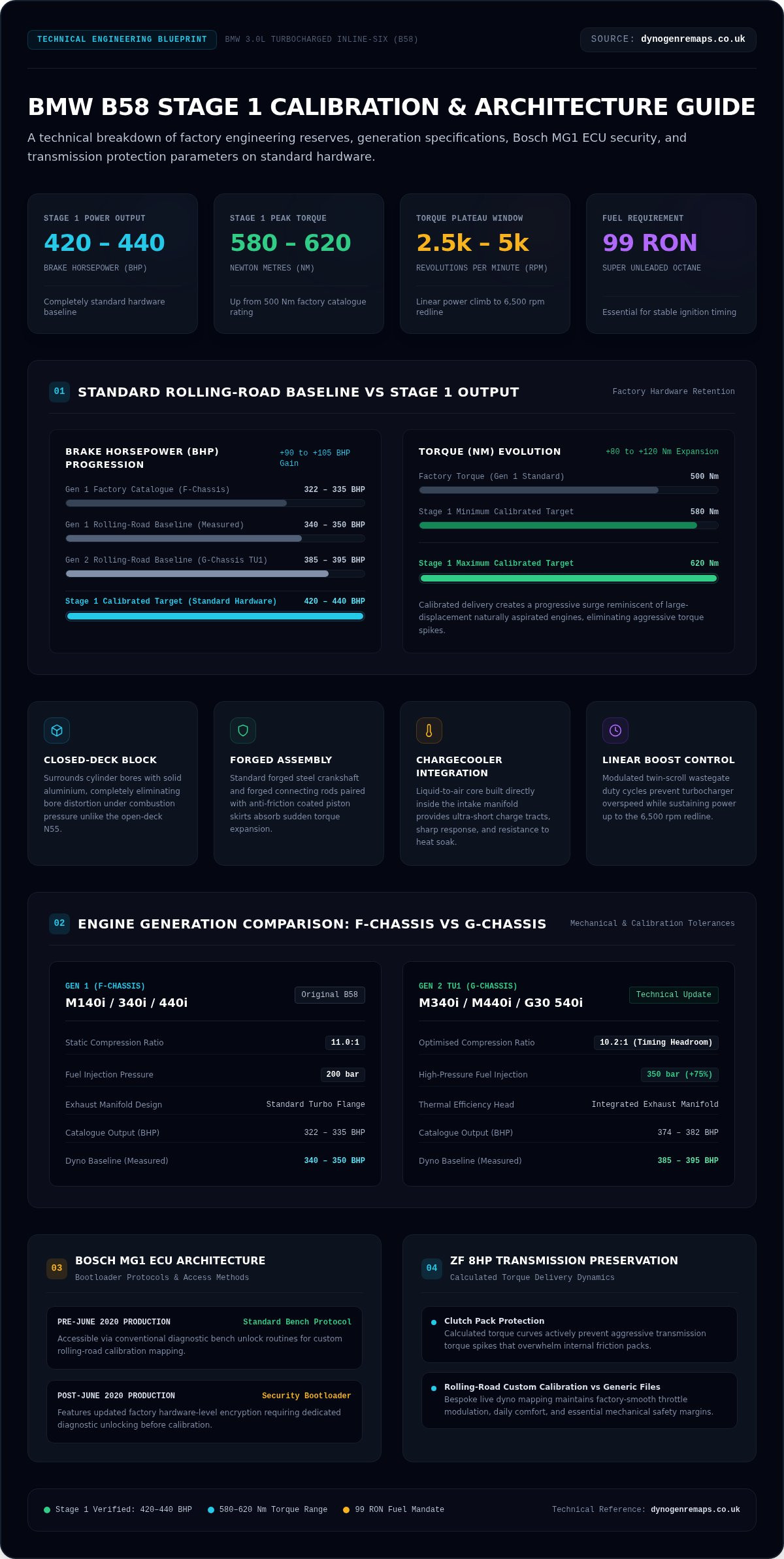
Understanding mechanical differences across vehicle generations ensures appropriate calibration targets. The Gen 1 B58, found in F-chassis models like the M140i and 340i, features an 11.0:1 static compression ratio and a 200-bar fuel injection system. In standard trim, it produces between 322 and 335 bhp through a twin-scroll turbocharger.
The Gen 2 Technical Update (TU1), standard in G-chassis models such as the M340i, incorporates substantial mechanical revisions:
- Optimised Compression: A lowered 10.2:1 compression ratio with revised piston profiles allows for aggressive ignition timing under heavy boost.
- High-Pressure Fuel Injection: Rail pressure increases from 200 bar to 350 bar, improving fuel atomisation across the rev range.
- Thermal Efficiency: A revised cylinder head design with an integrated exhaust manifold accelerates turbocharger spool and enhances heat dissipation.
While baseline figures rise to 374–382 bhp on Gen 2 variants, both generations possess the rugged mechanical foundations necessary to make a tailored BMW B58 remap both remarkably potent and thoroughly reliable.
Stage 1 BMW B58 Remap: Realistic Power, Torque, and Dyno Expectations
Factory rolling-road baseline figures for standard B58 engines frequently measure higher than conservative BMW catalogue claims. Healthy Gen 1 variants routinely produce 340 to 350 bhp in standard trim, whilst Gen 2 engines often record 385 to 395 bhp. A professional Stage 1 remap capitalises on this baseline integrity, lifting Gen 1 power outputs safely to 420–440 bhp and expanding mid-range torque from 500 Nm to a robust 580–620 Nm on standard factory hardware.
Real performance stems from how cleanly that output translates to the road. Precision calibration removes low-end lag whilst actively avoiding aggressive, peaky delivery, creating a progressive surge reminiscent of a large-displacement naturally aspirated engine. Drivers interested in vehicle dynamics can explore the principles behind improving car drivability with remapping to understand how refined throttle mapping transforms everyday usability.
The Anatomy of the B58 Stage 1 Dyno Curve
A rolling-road graph reveals far more than just vanity numbers. Superior calibrations widen the torque plateau between 2,500 rpm and 5,000 rpm, delivering effortless overtaking pace in any gear. Rather than spiking wastegate duty cycles to force peak figures, experienced calibrators modulate boost pressure linearly. This careful wastegate control maintains a progressive power climb right through to the 6,500 rpm redline, shielding the factory twin-scroll turbocharger from mechanical overspeed.
Fuel Quality and Ignition Timing: Why 99 RON is Essential
Achieving stable 420+ bhp outputs relies heavily on fuel stability. The factory Bosch engine management continuously checks acoustic knock sensors across all six cylinders. Running low-grade 95 RON supermarket petrol forces the ECU to detect knock events and aggressively retard ignition timing, causing inconsistent acceleration and elevated exhaust gas temperatures.
- Combustion Stability: Premium 98 or 99 RON Super Unleaded fuels resist pre-ignition, allowing calibrators to advance timing safely.
- Boost Versus Timing: True power gains emerge from optimal ignition timing rather than piling on excessive boost pressure.
- Safety Buffers: Quality fuel preserves factory safety margins under sustained high-load driving.
To safely realise the full potential of your straight-six, consider booking an appointment with Dynogen Remapping Solutions to discuss a tailored calibration built around your specific driving requirements.
ECU Architecture and Access: Unlocking the Bosch MG1 on Modern BMWs
The Bosch MG1 engine control unit serves as the computational nerve centre of the B58 powertrain, running millions of complex instructions every second. It continuously coordinates torque requests, ignition advance, injection quantity, and thermal thresholds across all systems. To successfully apply a BMW B58 remap, calibrators must establish direct communication with this sophisticated module to adjust target operating maps without disabling its vital internal safety safeguards.
The June 2020 ECU Lockdown: What Every Owner Must Know
A vehicle’s exact physical production date determines how the ECU can be accessed. DMEs manufactured before June 2020 (06/2020) can typically be programmed via standard OBD-II port methods or local bench routines. However, Bosch updated its hardware bootloader security on all DMEs produced from June 2020 onward.
This hardware-level security module completely blocks external read and write commands over the vehicle diagnostic port. For these newer post-June 2020 units, applying a BMW B58 remap requires a specialised bench unlock procedure before software flashing can take place. Importantly, a bench unlock simply opens the digital communication gateway to allow custom calibration. It alters no factory safety parameters, leaving knock sensing, oil temperature cutoffs, and component protection routines completely active.
Owners should also remain mindful of dealership servicing and Over-the-Air (OTA) iDrive updates. BMW software updates regularly overwrite custom engine calibrations with factory stock files and re-apply the bootloader lock, requiring another bench unlock to restore the tune.
The Calibration Workflow: Diagnostics, Reading, and Flashing
Professional calibration follows a methodical, step-by-step diagnostic workflow rather than blindly pushing data files into the ECU. The process starts long before writing modified software tables to the microprocessor:
- Pre-Tuning Diagnostic Health Check: Comprehensive electronic scanning assesses existing fault codes, fuel trim deviations, and wastegate actuator behaviour to ensure the engine is fully sound.
- Full Binary ROM Backup: The original factory calibration image is read and permanently archived, ensuring the vehicle can always be returned to stock standard software at any point.
- Bespoke Table Writing: Calibrated boost targets, throttle response curves, and ignition tables are written to the ECU within verified hardware tolerances.
- Post-Flash Road Logging: Live operational telemetry verifies real-world boost tracking, high-pressure fuel rail supply, and knock resistance across full gear pulls.
Following this structured approach aligns with best practice guidelines covered in our comprehensive breakdown of professional performance software, guaranteeing exceptional power delivery alongside unwavering mechanical security.
Safeguarding Reliability: ZF 8HP Transmission, Heat, and Component Longevity
Sustained reliability represents the foremost priority when calibrating any high-output engine. Drivers often worry that elevated power figures will overwhelm drivetrain hardware or accelerate thermal degradation. However, a properly executed BMW B58 remap respects factory mechanical boundaries, synchronising boost and ignition targets with transmission torque capacities to ensure daily dependability. Following established safe engine tuning principles protects your investment whilst delivering exceptional road pace.
ZF 8HP Gearbox Integration and Torque Limits
The ZF 8HP automatic transmission is renowned for rapid shifts, yet its internal components possess clear mechanical thresholds. Gen 1 B58 models pair with the ZF 8HP50, whereas Gen 2 variants utilise the updated 8HP51. Both gearboxes carry a nominal factory torque rating of 500 Nm. Because a Stage 1 tune lifts mid-range output to roughly 580–620 Nm, engine management must communicate seamlessly with the Transmission Control Unit (TCU).
Under heavy throttle, the factory TCU applies torque monitoring limiters between 500 and 550 Nm. If an unrefined calibration commands excessive torque without software harmony, the gearbox triggers timing retards and shift throttling to protect its clutch packs. Custom engine mapping shapes the delivery curve smoothly, avoiding harsh low-rpm spikes that induce clutch slip in third and sixth gears.
Thermal Management and Preventative Maintenance Schedules
Increased boost pressures generate additional combustion heat, placing elevated demands on the ignition system and fluids. Mitigating thermal stress requires sensible adjustments to regular maintenance intervals:
- Spark Plug Service Life: Standard spark plugs experience accelerated electrode wear under tuned boost levels. Halving the replacement interval to roughly 15,000–20,000 miles prevents high-load misfires and spark blowout.
- Engine Oil Preservation: The twin-scroll turbocharger relies on clean lubrication for its journal bearings. Frequent oil changes ensure high-temperature shear stability remains intact under demanding driving conditions.
- Closed-Loop Chargecooling: The B58 relies on a dedicated low-temperature cooling circuit to feed the intake chargecooler. Verifying that this coolant circuit remains fully bled and leak-free keeps intake air temperatures well within target ranges.
- Crankcase Ventilation: Early Gen 1 valve covers contain delicate PCV diaphragms. Inspecting this membrane prevents unexpected vacuum leaks or unwanted oil ingestion.
Prioritising mechanical health guarantees that your tuned straight-six continues to perform effortlessly mile after mile. If you want to protect your drivetrain whilst gaining effortless overtaking speed, book your Stage 1 Performance Remap with Dynogen today.
Choosing Professional Calibration: The Dynogen Engineering Advantage
Precision software calibration demands individualised attention rather than automated flashing. With over 15 years of industry-leading software tuning experience, Dynogen Remapping Solutions approaches every BMW B58 remap as a dedicated engineering consultation. By evaluating live diagnostic parameters and mechanical wear, our custom files achieve safe, high-output performance while keeping standard emissions hardware fully intact and compliant with UK road legislation.
Custom Calibration vs. Generic “Off-the-Shelf” Flashes
Generic handheld slave flash maps apply identical software changes regardless of a car’s mileage or mechanical history. These blanket tunes routinely overlook underlying issues like carbon accumulation on intake valves, lazy oxygen sensors, or minor boost leaks. Dynogen rejects generic slave files, engineering bespoke calibrations built around real-time live telemetry.
Our calibrators evaluate vital parameters under true operational conditions:
- Closed-Loop Lambda: Precision air-fuel ratio targeting ensures clean, efficient combustion across every load cell without excessive exhaust gas temperatures.
- Dynamic Boost Control: Absolute manifold pressure commands are tailored to your turbocharger’s specific mechanical health, avoiding compressor surge.
- Individual Cylinder Timing: Ignition advance is logged across all six combustion chambers to verify that zero acoustic knock activity occurs under sustained wide-open throttle.
- Emissions Preservation: Software adjustments maintain factory Gasoline Particulate Filter (GPF/OPF) regeneration profiles and catalytic converter safety thresholds.
Preparing Your BMW B58 for Calibration Day
Ensuring your vehicle arrives properly prepped guarantees an accurate and efficient dyno session. Before arriving, drivers should complete several straightforward checks:
- Fuel Octane: Arrive with a fresh tank of premium 98 or 99 RON Super Unleaded petrol to enable optimal ignition timing development.
- Mechanical Fluid Levels: Verify engine oil and secondary chargecooler coolant reservoirs sit at their correct maximum operating marks.
- Chassis and Tyres: Ensure tyre pressures match factory specifications and tread depths remain well above legal limits for consistent rolling-road traction.
Upon completing your custom calibration, our team conducts exhaustive post-tuning road logging to verify every real-world operational metric. You receive a complete handover explaining your newly widened torque curve and revised power delivery, giving you total confidence in your vehicle’s refined pace.
Unlocking the True Character of Your Straight-Six
BMW built exceptional mechanical strength into the B58, establishing an engineering foundation capable of handling substantial performance gains without compromising everyday usability. By respecting transmission torque limits, committing to high-octane 99 RON fuel, and navigating Bosch MG1 access methodically, a bespoke BMW B58 remap comfortably releases up to 440 bhp whilst preserving factory-smooth road manners.
True performance enhancements shouldn’t come at the expense of mechanical longevity. Backed by over 15 years of technical calibration experience, Dynogen Remapping Solutions crafts custom software within strict hardware tolerances. We pair bespoke file engineering with rigorous pre-tuning diagnostic health checks and comprehensive live operational logging, ensuring your vehicle remains responsive, efficient, and thoroughly protected under sustained boost.
Ready to experience the effortless mid-range surge and refined power delivery your straight-six was designed to deliver? Consult Our Specialist Team to Transform Your BMW B58 and take the first step towards unlocking your vehicle’s full potential.
Frequently Asked Questions
How much horsepower does a Stage 1 remap add to a BMW B58?
A Stage 1 remap typically adds between 80 and 100 bhp to a Gen 1 B58, elevating output from standard baseline figures of roughly 340 bhp to 420–440 bhp. Gen 2 variants often reach 430–470 bhp. Torque climbs significantly as well, rising from 500 Nm to a muscular 580–620 Nm across the rev range, representing an approximate 20% to 28% increase in overall performance.
Will a Stage 1 remap cause my BMW to fail UK MOT emissions tests?
No, a properly developed Stage 1 calibration will not cause an MOT emissions failure. Stage 1 software retains all standard emissions control hardware, including factory catalytic converters and Gasoline Particulate Filters. Because closed-loop lambda control and regeneration protocols remain active, your car continues to comply with UK Road Vehicles Regulation 61a and easily clears standard tailpipe gas analyser checks at an approved testing centre.
Do I need to upgrade any hardware components for a Stage 1 B58 remap?
You do not need any hardware upgrades to safely run a Stage 1 BMW B58 remap. The factory closed-deck block, turbocharger, and intake chargecooler easily accommodate the higher output. However, we advise fitting a fresh set of OEM spark plugs gapped correctly for elevated boost, alongside verifying that your engine oil and secondary cooling fluids are in peak mechanical condition before tuning.
Can my BMW B58 ECU be remapped if my car was built after June 2020?
Yes, vehicles manufactured after June 2020 can be remapped, but they require a specialised bench unlock rather than standard OBD-port flashing. Bosch introduced an updated hardware security bootloader at that point that locks out standard diagnostic writing. Once the ECU completes this initial bench unlock procedure, custom performance software can be flashed directly onto the DME without disabling any built-in safety parameters.
Will remapping my B58 put excessive strain on the ZF 8HP automatic gearbox?
A professionally calibrated remap will not harm the ZF 8HP automatic transmission. While factory torque ratings sit at 500 Nm, bespoke engine files deliberately shape delivery to avoid aggressive low-rpm torque spikes that stress internal clutch packs. Companion TCU software can also be applied to elevate internal line pressure, eliminate torque throttling, and ensure rapid, slip-free gear engagement under sustained load.
What petrol should I use after my BMW B58 has been remapped?
You should run high-octane premium fuel, such as 98 or 99 RON Super Unleaded, after your vehicle is tuned. Calibrated ignition advance relies on the anti-knock properties of higher-octane fuel to generate sustained power safely. Using standard 95 RON supermarket petrol causes the Bosch knock sensors to detect combustion instability, forcing the ECU to pull timing and reducing engine output.
Can the ECU software be reverted back to standard factory settings?
Yes, custom software can be reverted to original standard specifications at any time. Before writing any modified software, a thorough calibration process creates a complete binary backup of the factory software image. If you decide to sell the vehicle or return it to stock configuration, technicians simply flash your original software back into the Bosch MG1 controller.