
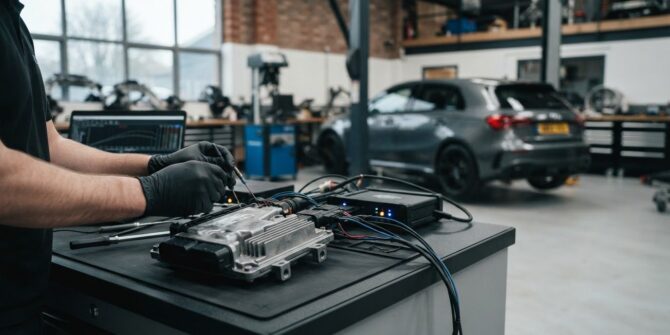
Could the same performance tune need two different routes into a vehicle’s ECU? If you’re wondering what is bench remapping, the key difference is how the ECU is accessed, not the purpose of the calibration. Bench remapping involves connecting directly to the ECU, often after removing it from the vehicle. OBD remapping uses the vehicle’s diagnostic port.
It’s understandable to have questions about ECU removal, possible damage and why a diagnostic-port connection isn’t always suitable. Bench access isn’t automatically a different kind of tune, and it isn’t needed for every vehicle. The appropriate method depends on the ECU’s requirements and the access it supports.
This guide explains the bench-remapping process, compares it with OBD access and outlines the practical trade-offs to consider. Dynogen Remapping Solutions provides ECU remapping and performance tuning, including its Stage 1 Performance Remap. First, let’s look at what happens when an ECU is accessed on the bench and why that method may be selected.
Key Takeaways
- What is bench remapping? It describes accessing the ECU directly rather than through the vehicle’s normal OBD connection. It isn’t a separate tuning stage or a guaranteed result.
- The vehicle and ECU determine the suitable access method. Identification and diagnostics help establish what the work requires.
- Compare bench and OBD access by how the ECU is reached, whether it needs to be removed and whether its diagnostic port supports the required communication.
- Before tuning, consider the vehicle’s condition, the correct ECU procedure, stable power during programming and whether original data can be retained.
- Post-work checks help assess normal operation, but results depend on the vehicle, ECU, calibration and mechanical condition.
What is bench remapping, and what happens to the ECU?
Bench remapping accesses a vehicle’s Engine Control Unit (ECU) directly, outside its normal connection through the vehicle’s OBD diagnostic port. The ECU is the electronic controller that manages engine operation and related systems. For a plain-English introduction to its role, see Engine Control Unit (ECU). Depending on the ECU design and the access method required, a technician may remove it from the vehicle before connecting to it.
So, what is bench remapping in practical terms? “Bench” describes how the technician communicates with the ECU, not a separate performance stage or a promise of a particular result. The calibration is a separate decision, shaped by the vehicle, ECU and intended use.
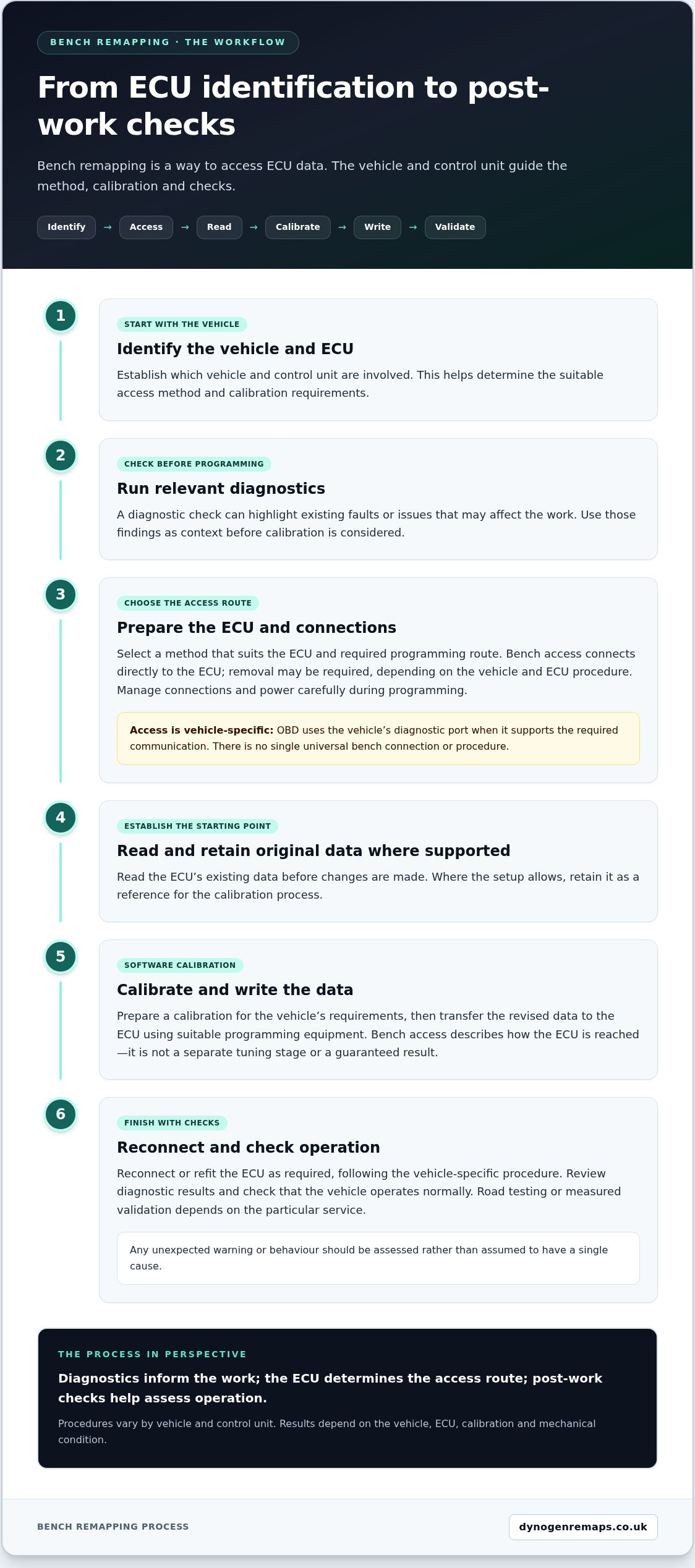
The process can be summarised as identify, access, read, calibrate, write and validate:
- Identify: Establish which vehicle and ECU are involved, then carry out relevant diagnostics.
- Access: Select a connection method that suits the ECU and the work required.
- Read: Retrieve the existing ECU data so the starting point can be assessed.
- Calibrate: Adjust relevant software parameters within vehicle-specific limits.
- Write: Transfer the revised data to the ECU.
- Validate: Check the ECU and vehicle after the work.
What does a technician connect to during bench remapping?
Suitable programming equipment connects to designated electrical terminals on the ECU. This provides a route for reading or writing ECU data without relying on the vehicle’s OBD port. The terminals, equipment and procedure vary by ECU and vehicle, so there isn’t one universal bench connection. The access method needs to match the specific hardware and programming requirements.
Does bench remapping mean changing the engine hardware?
No. Bench remapping changes ECU software calibration; it doesn’t, by itself, involve fitting physical engine parts. A remap may alter control parameters, but those adjustments must suit the particular vehicle and its limits. Bench access is simply the route to the ECU data. It doesn’t guarantee extra power, better reliability or any other outcome, and it shouldn’t be confused with a hardware upgrade or a tuning stage.
How does the bench remapping process work, step by step?
Understanding what is bench remapping is only part of the picture. The workflow matters too: ECU identification and diagnostic findings guide the access method, data handling and validation. Procedures vary by vehicle and control unit, so there’s no universal equipment list or fixed timeframe for every job.
- Identify the vehicle and ECU. Establish which vehicle and control unit are involved. This helps determine the appropriate access method and calibration requirements.
- Run relevant diagnostics. A diagnostic check can highlight existing faults or issues that may affect the work. Those findings provide useful context before calibration is considered.
- Prepare the ECU and connections. If bench access is required, the ECU may be removed according to the vehicle-specific procedure. Connections and power are managed carefully during programming.
- Read and retain original data where supported. Read the ECU’s existing data before making changes. Where the setup allows, retain it as a reference for the calibration process.
- Calibrate and write the data. Prepare a calibration for the vehicle’s requirements, then write it to the ECU using suitable programming equipment.
- Reconnect and check operation. Reconnect or refit the ECU as required. Post-work checks can include reviewing diagnostic results and confirming normal vehicle operation. Road testing or measured validation depends on the specific service.
How are the ECU and original data prepared?
Identification comes first, followed by relevant checks of the vehicle’s condition and diagnostic information. If the ECU is removed, the technician follows the appropriate procedure for that vehicle and manages the electrical connection and power supply during programming. Original data should be read and retained where the setup supports it. These steps help inform the work, but no process should be described as entirely risk-free.
What happens after the calibration is written?
Once programming is complete, the ECU is reconnected or refitted using the vehicle-specific procedure. The technician can then review diagnostic results and check that the vehicle operates normally. Any unexpected warning or behaviour should be assessed rather than assumed to have a single cause. Further validation, such as a road test, should only be expected where it forms part of the particular service.
A considered remap starts with diagnostics and ends with checks, rather than treating the software write as the whole job. Dynogen’s vehicle-tuning experience and advanced remapping equipment support vehicle-specific tuning, including its Stage 1 Performance Remap.
Bench remapping vs OBD remapping: what is the difference?
Both methods provide a route to the ECU, but the connection point differs. OBD remapping communicates through the vehicle’s diagnostic port when the ECU supports the required programming route. Bench remapping connects directly to the ECU and may involve removing it from the vehicle. Neither approach is universally better: the ECU, software and vehicle configuration determine which method is suitable.
| Comparison | OBD remapping | Bench remapping |
|---|---|---|
| Connection route | Through the vehicle’s OBD diagnostic port. | Directly to the ECU’s electrical connections. |
| ECU handling | The ECU usually remains fitted in the vehicle. | The ECU may need to be removed, depending on its design and access requirements. |
| When it may be used | When the ECU supports the required programming through the diagnostic port. | When ECU-specific access requirements call for a direct connection. |
In practical terms, the distinction is the access method, not the calibration’s intended purpose. Asking “what is bench remapping?” helps explain why a technician might choose direct ECU access, but the method alone doesn’t determine the tune or its results.
When might OBD access be suitable?
OBD access may be appropriate if the particular ECU supports programming through the diagnostic port. This route can avoid removing the ECU, making it a convenient option for that vehicle. However, support varies. The presence of an OBD port doesn’t mean every ECU operation can be completed through it, so the vehicle and ECU requirements should guide the decision.
When might bench access be needed?
Bench access may be selected when the required communication with the ECU isn’t available through the vehicle’s diagnostic port. ECU security, software and vehicle configuration can all influence the route. Direct access isn’t automatically safer, faster or more effective; it’s the suitable method for certain ECU requirements. Identification and diagnostics help establish which approach fits the vehicle.
For drivers, the useful question isn’t which method sounds more advanced. It’s whether the access route matches the ECU and supports the intended calibration. That vehicle-specific assessment is part of a considered remap, including Dynogen’s Stage 1 Performance Remap.
Is bench remapping safe, and what should you check first?
Bench remapping isn’t automatically safe or unsafe simply because the ECU is accessed directly. Risk depends on the vehicle’s condition, the correct procedure for its ECU, suitable equipment and the calibration applied. Careful handling matters, but no ECU programming process should be described as risk-free.
What vehicle checks matter before ECU work?
Before any remap, establish the vehicle’s starting condition. Warning lights, stored fault codes, a weak battery or known running issues may point to problems that should be understood before software changes are made. A remap isn’t a substitute for resolving an existing mechanical or electrical fault. The vehicle’s condition also affects what’s suitable and what outcomes are realistic.
- Note warning lights and explain any known running concerns.
- Review diagnostic results so existing faults aren’t mistaken for effects of the remap.
- Consider battery condition and maintain stable ECU power during programming.
- Keep original data where supported as a reference for the work.
- Be realistic about expectations: vehicle condition and calibration both influence the outcome.
What should owners understand about road use and compliance?
For road use, retain emissions-control equipment and ensure that modifications continue to meet applicable UK roadworthiness requirements. Bench access itself doesn’t confirm that a vehicle meets those requirements, and no general statement can guarantee an MOT result. Check specific MOT or emissions questions against current official UK guidance, including relevant DVSA information, before relying on them.
Ultimately, “what is bench remapping” describes an access route, not a safety guarantee. Informed decisions start with the vehicle’s condition, ECU requirements and a calibration suited to the intended use. For a vehicle-specific performance tuning option, explore Dynogen’s Stage 1 Performance Remap.
What happens after bench remapping, and what is the next step?
Once the ECU work is complete, post-remap checks help confirm that the vehicle is operating normally. These may include reviewing relevant diagnostic results and checking for warning lights or unexpected behaviour. A clear handover also means understanding what was changed and what to watch for during everyday driving.
Expectations should remain vehicle-specific. The result depends on the vehicle’s mechanical condition, its ECU and the calibration applied. Bench access describes how the ECU is reached; it doesn’t guarantee a particular change in power, fuel economy or reliability.
What should owners monitor after a remap?
Pay attention to warning lights, unusual sounds or changes in drivability after the work. If something feels different, don’t assume the software is necessarily responsible. The concern should be diagnosed so its cause can be identified. Existing vehicle issues, driving conditions and the calibration can all affect how the car behaves, which is why clear checks before and after the work matter.
How does bench access relate to a Stage 1 remap?
These terms describe different things. Bench refers to the ECU access method, whilst Stage 1 describes a calibration approach. A Stage 1 calibration may use bench or OBD access, depending on the ECU and vehicle requirements. For more on the calibration itself, read the guide to Stage 1 performance remapping.
Choosing a calibration calls for attention to the vehicle’s condition, intended use and the limits of its systems. Explore further guidance on safe engine remapping and power and professional remapping quality to understand these considerations in more detail.
In short, what is bench remapping? It’s a way of accessing the ECU, not a promise of a particular performance outcome. Considering the access method and calibration separately helps you make a more informed decision about your vehicle’s next step.
Ready to explore a suitable tuning option for your vehicle? Explore Dynogen remapping services.
Choose an approach that suits your vehicle
Bench remapping changes how a technician accesses the ECU, not the purpose or stage of the calibration. OBD access may be suitable when the ECU supports it; bench access may be needed when its requirements call for a direct connection. Neither method is automatically better.
Knowing what is bench remapping helps you focus on the practical questions: does the access method suit the ECU, has the vehicle’s condition been considered, and will the calibration match its requirements? Diagnostics and post-work checks are important parts of a considered approach, whilst results depend on the vehicle, calibration and mechanical condition.
Dynogen Remapping Solutions brings over 15 years of vehicle-tuning experience, supported by advanced software and equipment for remapping. If you’re considering a suitable tuning option, explore Dynogen remapping services and take your next step with greater confidence.
Frequently Asked Questions
What is bench remapping?
Bench remapping is a way of accessing and reprogramming a vehicle’s ECU directly, outside its usual connection through the OBD diagnostic port. The ECU may need to be removed, depending on its design and the access required. “Bench” describes the connection method, not a separate tuning stage or a guaranteed performance result. The calibration and outcome depend on the vehicle, ECU, software changes and mechanical condition.
Is bench remapping better than OBD remapping?
Neither method is universally better; the ECU and vehicle requirements determine the suitable access route. OBD remapping uses the vehicle’s diagnostic port when the ECU supports the required programming. Bench remapping connects directly to the ECU and may involve removing it. Direct access isn’t automatically safer, faster or more effective. The ECU’s capabilities and the work required determine the appropriate method.
Does bench remapping require removing the ECU?
Sometimes, but not in every case. Bench remapping means accessing the ECU directly rather than through the vehicle’s normal OBD connection. Depending on the ECU design and the access procedure, it may need to be removed from the vehicle or accessed while still connected. The steps vary, so there isn’t one removal procedure for every vehicle. ECU identification helps determine the appropriate approach.
Can bench remapping damage an ECU?
Yes, ECU damage is possible if the programming procedure, connections, equipment or power supply are handled incorrectly. That doesn’t mean damage is inevitable, but bench access shouldn’t be described as risk-free. Vehicle condition and calibration quality also matter. Relevant diagnostics, careful power management and retaining original ECU data where supported are sensible parts of a considered process. Post-work checks can help identify faults or abnormal operation.
Does bench remapping give more power than an OBD remap?
No, bench access doesn’t inherently produce more power than OBD access. These terms describe how the ECU is reached, not the performance stage or calibration result. Any change depends on the calibration, ECU, vehicle setup and mechanical condition. If the same suitable calibration can be written through either supported route, the access method alone doesn’t guarantee a different power outcome. Results are vehicle-specific.
How long does bench remapping take?
There isn’t one reliable timeframe for every bench remap. The work can vary with vehicle and ECU identification, diagnostic findings, the access procedure, calibration requirements and post-programming checks. ECU removal, where required, can also affect the process. An estimate without knowing the vehicle and ECU could be misleading. Careful preparation and validation should not be skipped simply to shorten the job.
Is bench remapping legal in the UK?
Bench access itself doesn’t determine whether a vehicle modification is lawful. The relevant considerations are the changes made and whether the vehicle continues to meet applicable UK requirements for roadworthiness and emissions. Don’t assume that a particular access method guarantees compliance or an MOT outcome. Keep emissions-control equipment in place, and check current official UK guidance for rules that apply to your vehicle and any proposed modification.
Does a Stage 1 remap always use bench access?
No. Stage 1 describes a calibration approach, whilst bench describes how the ECU is accessed. A Stage 1 calibration may use OBD access if the ECU supports the required programming route, or bench access if the ECU’s requirements call for a direct connection. The appropriate method depends on the vehicle and ECU, not simply on the “Stage 1” label. Neither access route guarantees a particular result.