
What if the cheapest remap quote isn’t the best value for your car? It’s natural to want a clear figure, but the answer to “how much does a remap cost UK 2026” depends on more than the headline price. Your vehicle, ECU access and tuning goals all affect the work involved, so quotes may cover different things.
A Stage 1 tune is a vehicle-specific software adjustment. A clear quote should explain its scope, from the calibration to any checks or follow-up included. Comparing those details makes it easier to see whether a lower price reflects a narrower service rather than better value.
This guide explains what affects a UK remap quote and how to compare the work behind each figure. You’ll also find out what details to prepare before discussing a Stage 1 remap. Dynogen Remapping Solutions has over 15 years of remapping experience and uses advanced software and equipment to tune vehicles to their specifications.
Key Takeaways
- The answer to “how much does a remap cost UK 2026” depends on the vehicle and requested work, so compare quotes on a like-for-like basis.
- Consider your engine type and performance or economy goals when describing the Stage 1 calibration you’re looking for.
- Compare the quote scope, including diagnostics, calibration and aftercare, rather than judging by the headline figure alone.
- Prepare your car’s make, model, year and engine details, along with any known ECU issues or warning lights, before discussing a quote.
- Dynogen’s Stage 1 performance remapping draws on over 15 years of experience and advanced software and equipment.
UK Remap Costs 2026: What Does the Quote Cover?
There is no single UK remap price that suits every vehicle. A quote depends on the ECU and how it can be accessed, the vehicle’s condition and the calibration requested. So, the answer to how much does a remap cost UK 2026 starts with the car’s precise specification and the work proposed, not a universal figure.
A vehicle-specific remap quote sets out the software calibration and related work planned for a particular vehicle and tuning brief. It should explain what the estimate covers, what falls outside it and whether any separate work is involved. Chip tuning, another term for ECU remapping, adjusts engine-control software. Chip tuning offers a useful overview of the process and its purpose.
Why one fixed remap price cannot cover every vehicle
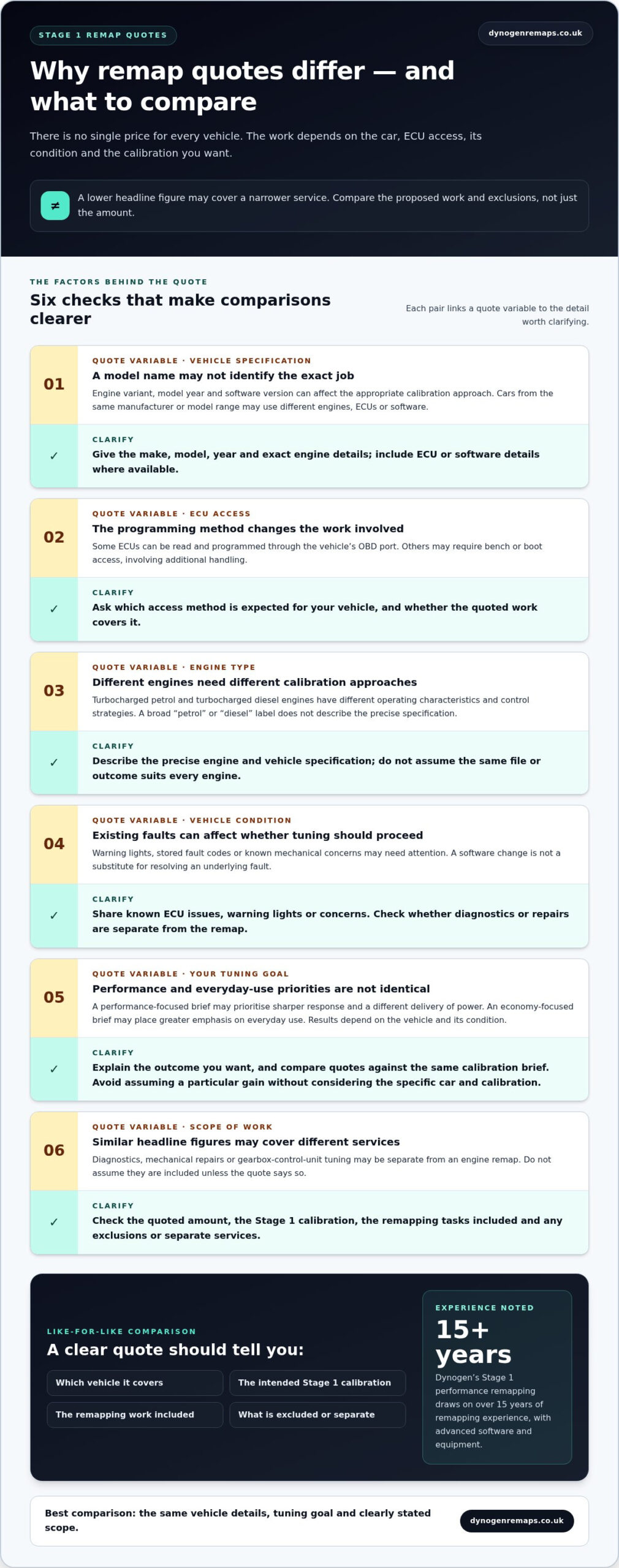
ECU access is one practical variable. Some units can be read and programmed through the vehicle’s OBD port, whilst others may require bench or boot access, which involves additional handling. Make and model alone may not identify the exact job: engine variant, model year and software version can affect the appropriate calibration approach.
The vehicle’s condition matters too. Share details of existing warning lights or known ECU issues, as these may need attention before a tuning decision can be made. Your desired outcome also shapes the calibration brief. Someone seeking stronger response may have different goals from a driver looking for a measured change in everyday drivability. Discuss the intended Stage 1 remap in relation to your vehicle rather than assuming every model uses identical software or delivers identical results.
What a Stage 1 remap quote should make clear
A clear quote gives you enough detail to understand the proposed work before deciding. Check that it identifies your vehicle and describes the intended Stage 1 calibration in plain language. It should set out the quoted amount and distinguish the remapping work from optional or separate services.
- Vehicle covered: Make, model, year, engine and, where available, ECU or software details.
- Calibration scope: The Stage 1 tuning brief and the vehicle it’s intended for, without implying every car gets the same file or outcome.
- Work included: The specific remapping tasks covered by the quoted amount, described plainly.
- Exclusions: Any diagnostics, repairs or other services not included, so separate work isn’t mistaken for part of the remap.
Diagnostics, mechanical repairs or gearbox-control-unit tuning may be separate from an engine remap, so don’t assume they’re included unless the quote says so. A well-defined scope makes comparisons meaningful and shows what’s proposed for your car. Dynogen’s vehicle-specific Stage 1 performance remapping draws on over 15 years of experience, supported by advanced software and equipment.
What affects the cost of a Stage 1 remap?
A Stage 1 remap quote reflects the work required for a particular vehicle and calibration brief, not simply the badge on the bonnet. Vehicle age, engine specification, ECU software and access method all influence the technical process. The car’s condition and your desired outcome matter too. Together, these factors help explain how much does a remap cost UK 2026 for your vehicle, without relying on a one-size-fits-all figure.
Vehicle, engine and ECU complexity
Two cars from the same manufacturer can use different engines, ECUs or software versions, even within one model range. The vehicle’s year and exact engine variant help identify the control system and relevant calibration. ECU access is another consideration: programming through the OBD port differs from a process requiring bench access, and the method affects the work involved. These details guide the tuning approach, rather than forming a simple price formula.
Engine type also shapes the calibration brief. A turbocharged petrol engine and a turbocharged diesel have different operating characteristics and control strategies, so adjustments considered for one aren’t automatically suitable for the other. The precise engine and vehicle specification matter more than a broad label such as “petrol” or “diesel”. A vehicle-specific approach avoids treating every engine of one type as interchangeable.
Vehicle condition and the result you want
Consider a remap alongside the car’s current condition. Existing warning lights, stored fault codes or known mechanical concerns can affect whether it’s sensible to proceed and whether diagnostic work or repairs should be considered separately. A software change isn’t a substitute for resolving an underlying fault. Sharing what you know about the vehicle helps define the work to discuss.
Your goal matters as well. A performance-focused calibration may prioritise sharper response and a different delivery of power, whilst an economy-focused brief may place greater emphasis on everyday use. These aims aren’t interchangeable, and results depend on the vehicle and its condition. Don’t assume a particular power, torque or fuel-economy gain without considering the specific car and calibration.
A Stage 1 remap quote is shaped by the vehicle’s age and specification, ECU software and access, current condition, and the driver’s calibration goals. Use this as a checklist when describing your car and comparing proposed work. For general UK information about vehicle safety standards, consult the government’s UK Vehicle Safety Standards information. It provides context, not a vehicle-specific remapping assessment.
Dynogen’s Stage 1 performance remapping draws on over 15 years of vehicle remapping experience, with advanced software and equipment supporting a vehicle-specific approach. Explore Dynogen Stage 1 remapping to learn more about the service.
How to compare UK remap quotes beyond the headline price
A headline figure tells you the amount quoted, not the work or support it covers. To compare remap quotes fairly, line up the vehicle details and service scope first. If you’re asking “how much does a remap cost UK 2026?”, compare like-for-like proposals for your car rather than simply choosing the lowest figure on the page.
Use a checklist or table to record what each quote says. Mark unclear details as unclear instead of assuming they’re included. Different services may take different approaches, so one provider’s process isn’t a universal standard.
| What to compare | What to look for in the quote |
|---|---|
| Vehicle coverage | Does it identify your make, model, year, engine and relevant ECU or software details? |
| Calibration scope | Does it describe the intended Stage 1 tune and connect it to your vehicle, rather than making a broad, generic claim? |
| Diagnostics | Does the quote explain whether diagnostic checks are included, separate or outside its scope? |
| Software handling | Does it outline how the original software and revised calibration are handled, where relevant to the stated process? |
| Verification and aftercare | Does it say what checks, handover information or post-remap support are included, and what isn’t? |
What to compare in the remapping process
Look for a clear explanation of the steps, not just reassuring labels. Vehicle-specific calibration should refer to your car’s specification and intended use. The quote should make the diagnostic process and software handling understandable, and explain what happens at handover. If checks or aftercare aren’t described, don’t assume they’re included. Recording each item side by side reveals where apparently similar offers differ.
For more background on the terminology and decisions involved, Performance Software: Buyer’s Guide to ECU Remapping can help frame your comparison. A detailed scope doesn’t prove a particular result, but it makes the proposed work easier to understand.
How to judge performance claims responsibly
Advertised power or torque gains are vehicle-dependent, not guaranteed outcomes for every car. Engine specification, condition and calibration all matter. Compare the stated aim with your requirements: stronger response for everyday driving is a different brief from an economy-focused tune, and neither should be judged on a headline figure alone.
How a Stage 1 Remap Increases BHP and Torque Safely provides technical context for considering performance claims. Use it to understand the factors behind a claimed change, then assess whether the stated goal suits your engine and driving needs. A careful comparison centres on scope, process and realistic expectations, not the boldest promise.
Before paying for a remap: checks that protect your decision
A little preparation can make a Stage 1 remap discussion more precise. Before settling on a quote, gather the details below and consider how you use the vehicle. This connects the proposed work to your car, rather than a generic description, when weighing up how much does a remap cost UK 2026.
Information to have ready for a vehicle-specific quote
Use this checklist before discussing your vehicle. Accurate information helps establish its specification, your goals and any issues that may affect suitability.
- Record the vehicle details: Make, model, year, engine size and fuel type. Have the registration available to help identify the exact vehicle.
- Describe your goal: Note whether you’re seeking stronger throttle response, a performance-focused change or an economy-oriented calibration.
- List known issues: Mention warning lights, diagnostic fault codes, unusual behaviour or mechanical concerns, even if they seem unrelated.
- Note existing modifications: Record changes to the engine or related components, as these can affect the vehicle’s current configuration.
- Review the quote scope: Keep a copy of what the proposed work covers, what is excluded and any separate services identified.
Be specific. “It’s a 2.0-litre diesel” may not identify the precise engine variant or software, so include the model year and registration details too. If you don’t know the ECU version, say so rather than guessing. Clear information makes for a more useful technical discussion.
Insurance, warranty and reliability considerations
Before modifying the vehicle, review your insurer’s requirements and explain the proposed change directly to them. Insurance terms and the effect of a modification depend on your individual policy, so don’t assume another driver’s experience applies to you. Keep a record of the guidance you receive.
Warranty conditions also vary. Read the relevant manufacturer or extended-warranty documents to understand how an ECU modification may affect your cover. Roadworthiness depends on the vehicle and its circumstances. Don’t treat a remap as a repair for existing faults or a substitute for maintaining the car in sound condition. Where a requirement is unclear, use the relevant policy or official guidance rather than relying on a general claim.
For further context on the relationship between tuning, power and vehicle condition, consult Is a Stage 1 Remap Safe? Balancing Power and Reliability. A considered decision starts with a clear brief and realistic expectations, not a promised outcome detached from the car itself.
Dynogen’s Stage 1 performance remapping is supported by over 15 years of vehicle remapping experience and advanced software and equipment. Discuss your Stage 1 remap requirements with your vehicle details and checklist ready.
Getting a Stage 1 remap quote from Dynogen
Once you’ve compared quote scopes and considered your vehicle’s needs, the next step is a vehicle-specific discussion. Dynogen provides Stage 1 performance remapping to customers across the UK, drawing on over 15 years of remapping experience and advanced software and equipment. The focus is on understanding the car and your objectives, rather than treating every Stage 1 request as the same job.
A useful quote reflects the ECU requirements and calibration requested. That’s why the answer to how much does a remap cost UK 2026 is best considered in the context of your vehicle and the work involved, rather than assumed from a broad headline figure.
Why vehicle-specific expertise matters
Vehicle age, engine specification, ECU type and software can all affect the technical considerations behind a remap. Experience helps inform the assessment and calibration approach for the particular vehicle. Your intended outcome matters too: a driver seeking sharper response may have a different brief from someone prioritising a more measured performance change. Share your vehicle details and goals so the proposed work can be aligned with them.
For a deeper overview of the process and what a Stage 1 tune involves, explore The Ultimate Guide to Stage 1 Performance Remapping. It can help you prepare for a quote discussion, from identifying your vehicle’s specification to describing the result you want from everyday driving.
Take the next step with Dynogen
To make your enquiry useful, include the make, model, year, engine and registration, along with any known ECU details. Describe the outcome you’re aiming for, such as improved response or a performance-focused calibration. Mention warning lights, existing modifications or mechanical concerns as well. These details give Dynogen a clearer starting point for considering the vehicle and requested work.
The quote should reflect those specifics: ECU complexity, vehicle requirements and the calibration brief, not an assumed universal fee. If some details are unknown, share what you do have rather than guessing. A clear conversation helps establish what’s proposed before you decide whether to proceed.
Dynogen’s specialist focus on Stage 1 performance remapping combines technical experience with advanced software and equipment. Share your vehicle details and request a Stage 1 remap quote to discuss a calibration suited to your car and objectives.
Make your next move with confidence
Think beyond the figure on the quote. Decide what you want to feel behind the wheel, then consider whether the proposed Stage 1 calibration supports that priority and suits your plans for the car. For example, sharper response is a more useful aim to discuss than a vague promise of “more performance”.
That clarity makes the question of how much does a remap cost UK 2026 more meaningful: you can weigh the work against what matters to you, rather than treating cost as the only measure. Dynogen focuses on Stage 1 performance remapping, drawing on over 15 years of experience and serving customers across the UK. Share what you want from your vehicle and take a considered step towards a calibration that fits your priorities. Start your Stage 1 remap enquiry with Dynogen.
Frequently Asked Questions
How much does a Stage 1 remap cost in the UK in 2026?
There isn’t one fixed UK price for every Stage 1 remap. The practical answer to how much does a remap cost UK 2026 is that the quote depends on your vehicle, ECU and requested calibration. Dynogen’s remapping fees are tailored to ECU complexity and whether your aim is performance or economy. Share the registration and exact engine details to help establish a quote for your car, rather than relying on a general online figure.
Is a remap a one-off cost?
The initial remapping fee generally covers the software work carried out on the vehicle at that time. It doesn’t automatically cover later changes, a different calibration brief or work required if the vehicle’s setup changes. If you’re considering hardware modifications in future, mention them before the remap so the intended use is understood. Keep the quote and any service documentation to clarify what the original work covered.
Can the cost of a remap differ between petrol and diesel cars?
Yes, engine type can affect the calibration work, but petrol or diesel alone doesn’t determine the fee. Two diesel cars can differ in engine variant, ECU software and condition, just as two petrol models can. Compare vehicles with similar specifications and requested outcomes. Include the exact model, year and engine when seeking a quote, rather than giving only the fuel type.
Does a remap cost more for an automatic car?
Not necessarily. An automatic gearbox doesn’t by itself establish the cost of an engine remap. Some vehicles may have the option of separate transmission control unit (TCU) calibration, which is additional work rather than an automatic part of an ECU tune. If you’re interested in changing gearbox behaviour as well as engine performance, say so and check how the quote separates those services.
Will a remap quote include diagnostics?
That depends on the scope set out in the quote. A diagnostic check may be included, itemised separately or excluded, so look for a clear explanation rather than assuming it forms part of the remapping fee. If a warning light is showing on the dashboard, mention it before agreeing to the work. A fault may need investigation in its own right, and a remap shouldn’t be treated as a repair for an underlying problem.
Can I get a remap quote without giving my registration number?
You can start a discussion with the make, model, year, engine and fuel type, particularly if you don’t have the registration to hand. The registration can help identify the exact vehicle specification, so an initial estimate based on limited details may need refining. Don’t guess the engine variant or ECU version. Where appropriate, clear vehicle document details can help resolve uncertainty about the specification.
Does a remap affect car insurance in the UK?
A remap may affect your insurance terms or premium, so speak to your insurer before proceeding and follow the requirements in your policy. Don’t assume a modification is covered simply because the car remains driveable. Ask how the proposed ECU change should be recorded and keep a note of the insurer’s response. The effect depends on your individual policy and circumstances, so your insurer is the right source for guidance about your cover.
Is the cheapest remap quote always the best value?
No. A low headline figure doesn’t show what calibration, checks or support the quote covers. One offer may describe a vehicle-specific tune, whilst another gives little detail about the software work. Compare the written scope, exclusions and any separately charged services on the same basis. Value comes from understanding what’s being done for your vehicle and whether the process fits your needs, not from choosing a figure without its context.