

A remap can be detectable, but that doesn’t mean every dealer checks for one at every visit. If you’re asking, “can a remap be detected by a dealer?”, the practical answer depends on your vehicle’s systems and how closely its ECU is examined. Diagnostic tools may reveal clues such as a software checksum mismatch or programming history, particularly during an investigation into an engine, gearbox or turbocharger fault.
It’s understandable to wonder whether a routine service could uncover a modification, or whether a remap automatically puts your whole warranty at risk. A standard service may involve different checks from a complex warranty investigation. The outcome depends on the vehicle, the checks performed and the relevant warranty terms.
This guide explains how dealers may identify ECU software changes, why detection isn’t the same as routinely checking, and what to consider around warranty claims, servicing and insurance. Dynogen Remapping Solutions has over 15 years of vehicle tuning experience. Remapping is a technical decision, not a way to conceal a modification. Understanding the practical implications can help you make an informed choice.
Key Takeaways
- Can a remap be detected by a dealer? It may be, but the vehicle’s ECU and the diagnostic checks performed affect the likelihood.
- Software identifiers and recorded programming data may prompt further investigation.
- Checks can differ between routine servicing, fault diagnosis, warranty investigations and software updates.
- Use a practical checklist to prepare for a dealer visit and make informed decisions about your warranty and insurance.
- Treat a Stage 1 remap as a considered software change, not a promise of being undetectable.
Can a dealer detect a remap? The short answer for UK drivers
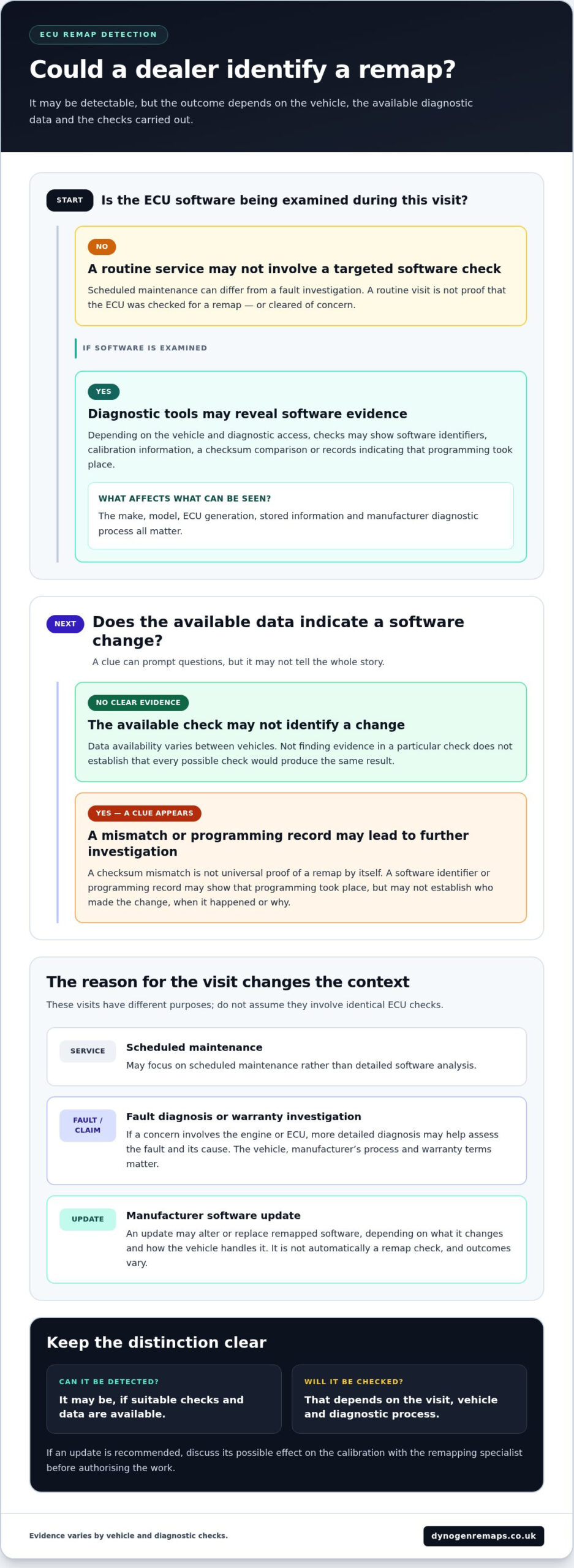
Yes, a dealer may detect an ECU remap, but discovery isn’t guaranteed. What can be found depends on the vehicle, its electronic control unit and the diagnostic checks carried out. A car’s age, make and model can affect what information is stored and what the dealer’s equipment can access. There is no single answer for every vehicle or visit.
Separate two questions: could suitable diagnostic checks identify a remap, and will those checks be performed during a particular appointment? Technical detectability doesn’t mean a dealer routinely looks for modified software at every service. The reason for the visit and the diagnostic process matter.
What does it mean for a dealer to detect an ECU remap?
Detection means identifying evidence that the ECU’s software or calibration has changed from its original specification. The ECU, or engine control unit, is the vehicle computer that manages engine operation. For a foundational explanation of its role, see Engine Control Unit (ECU) Explained.
A diagnostic check may reveal an inconsistency or record that software has been programmed. That is evidence of a change, but it may not establish who made it, when it happened or why. A dealer may flag a concern without the available data showing the car’s complete history. The strength and detail of the evidence vary with the manufacturer, model and ECU.
Does every dealership check for remaps during servicing?
No single procedure applies to every dealership or vehicle. A standard service focused on scheduled maintenance differs from a targeted investigation into a fault. Checks and equipment vary between manufacturers and models, so a routine visit shouldn’t be treated as proof that the ECU has either been examined for a remap or cleared of concern.
The reason for the service can influence how deeply the vehicle is investigated. Routine maintenance may not call for the same software analysis as a complaint about engine operation. If a warranty claim concerns the engine or ECU, more detailed diagnosis may help assess the fault and its cause. The vehicle, manufacturer’s process and information available all matter.
In brief: remap detection means identifying evidence that ECU software or calibration has changed. It doesn’t guarantee that a dealer will find it on every visit. Keeping those issues separate gives you a more realistic basis for deciding what to disclose and what to expect during a service or investigation.
How can a dealer identify remapped ECU software?
A dealer may look for differences between the ECU software installed in the vehicle and the manufacturer’s expected software data. The available evidence depends on the make, model, ECU generation and diagnostic access. Some systems can read software identifiers or compare a software checksum, a value used to check whether data matches an expected version. A mismatch may prompt further investigation, but it isn’t universal proof of a remap by itself.
ECU evidence varies between vehicles because manufacturers store different information and diagnostic checks can access different levels of detail. No single clue, or assumption about what a dealer can see, applies to every car.
What can diagnostic tools reveal about ECU software?
Manufacturer diagnostic equipment may display ECU software identification and related calibration information. Depending on the vehicle, records or counters may also indicate that programming has taken place. These features aren’t guaranteed: data availability and how it is interpreted vary between systems.
A software mismatch or programming record can flag a change, but may not establish who made it or when. Any diagnostic result needs to be understood in the context of the vehicle and the reason for the investigation. This matters if a software finding is considered alongside a fault or warranty claim. For general background on warranty concerns, see ECU Remapping and Car Warranties. Warranty terms and consumer protections can differ by country, so this shouldn’t be treated as UK-specific guidance.
Can a software update expose or overwrite a remap?
It can, depending on the vehicle and the update. A manufacturer update may change ECU calibration and, in some cases, replace or alter existing remapped software. The effect depends on what the update changes and how the vehicle’s systems handle it. An update isn’t automatically a remap check, and not every update has the same outcome.
If a dealer recommends a software update, discuss it with the remapping specialist beforehand. This can help you understand whether the update may affect the calibration and what to consider before authorising the work. It’s a sensible step for any remapped vehicle, particularly if the update relates to engine or ECU operation.
Don’t assume a remap will be invisible because the car has been updated or returned to standard software. Equally, a diagnostic flag alone may not tell the full story. Dynogen Remapping Solutions uses specialist software and equipment for remapping. If you’re considering a remap, learn more about Stage 1 remapping as a considered software modification, not a way to conceal changes.
Routine service, warranty investigation or software update: what changes?
The reason for a dealership visit can shape the checks carried out. A scheduled service, fault diagnosis, warranty assessment and software update have different purposes, so don’t assume they involve identical ECU checks. The make and model, manufacturer procedures and concern being investigated all influence what happens.
| Type of visit | What may be relevant | What to keep in mind |
|---|---|---|
| Routine servicing | Scheduled maintenance and checks related to the service plan. | A standard visit may not require detailed analysis of ECU calibration. |
| Fault diagnosis | Tests directed at the reported symptom, which may involve engine or ECU operation. | The scope depends on the fault and the diagnostic process for that vehicle. |
| Warranty investigation | Assessment of the affected component and possible causes of its failure. | A remap may be relevant if it could have contributed to the fault, but decisions are case-specific. |
| Software update | Changes to vehicle software, potentially including ECU calibration. | The effect on an existing remap depends on the update and vehicle systems. |
Is a remap more likely to be noticed during a warranty claim?
It may be, particularly if the claim concerns a component whose operation is managed by the ECU. A dealer or manufacturer assessing an engine-related fault may examine relevant systems to understand what caused it. That differs from automatically cancelling every part of a vehicle’s cover because a remap exists.
The decision depends on the fault, evidence and warranty terms. Read your warranty wording and seek current guidance from the manufacturer before assuming either that a claim will be refused or that a modification has no bearing on it.
Can a dealership software update affect a remapped car?
A manufacturer update can change ECU software and may replace or alter an existing calibration. The outcome depends on the vehicle and the particular update. Before authorising work involving the ECU, tell the dealer the vehicle has been remapped and discuss the planned update with the remapping specialist.
This helps you make an informed decision before software is changed, rather than discovering afterwards that the vehicle behaves differently or the calibration needs attention. Keep the discussion factual and ask what the proposed work covers.
So, can a remap be detected by a dealer during any of these visits? The possibility and depth of checks vary. A routine service isn’t equivalent to a targeted fault investigation, and a warranty outcome can’t be predicted from the presence of a remap alone. Consider the visit’s purpose, your vehicle’s warranty wording and whether ECU software work is planned.
What should you do before visiting a dealer with a remapped car?
Some preparation can make a dealer visit clearer and help you make informed decisions about diagnostic work. Be accurate about the modification, keep a record of what was done and check the documents that apply to your car. If you’re wondering “can a remap be detected by a dealer?”, plan on the basis that ECU evidence may be found rather than relying on assumptions about what will be checked.
- Note the remap details. Record the provider, date of the work and vehicle details, including its make, model and registration. Keep relevant paperwork or communications with your vehicle records.
- Read your warranty wording. Check what the terms say about modifications and claims involving affected components. Don’t assume a remap automatically cancels all cover, or that it can never affect a particular claim.
- Review your insurance policy. Check how your insurer requires modifications to be disclosed. In the UK, drivers must inform their insurer about vehicle modifications, including an ECU remap. Failing to disclose one could affect cover or a claim.
- Clarify the planned dealer work. Ask whether the appointment involves ECU diagnosis, programming or a software update, especially if the reported fault relates to engine operation.
- Explain the modification accurately. If it’s relevant to the fault or requested work, tell the dealer what has changed and share the details you have. Don’t conceal it or guess about the technical history.
How should you discuss a remap with a dealer?
Keep the conversation factual and focused on the visit. Explain that the vehicle has an ECU remap, when it was completed if you know, and what symptom or service you’re bringing it in for. Ask what diagnostic or ECU work is proposed and whether a software update is planned. This helps you understand the work before authorising it, without making assumptions about the checks a dealer will perform.
Good records also help you describe the car consistently to the dealer, insurer and remapping specialist. For broader reading, look for guidance on safe engine tuning and reliability and a Stage 1 performance remapping guide. Warranty outcomes depend on the wording of your cover, the fault, the evidence and the manufacturer’s assessment. A modification alone doesn’t establish that it caused a failure, but a claim involving a related component may be assessed on its specific facts.
What about insurance and manufacturer warranty terms?
Contact your insurer through its stated process to disclose the remap and understand how it affects your policy. Keep a record of the update to your policy details. For warranty questions, read the current terms and seek guidance from the manufacturer about how a modification may affect a claim. Avoid relying on general claims that a remap always voids a warranty or can never influence cover.
Dynogen Remapping Solutions has over 15 years of vehicle tuning experience. Professional remapping is a considered technical change, not a way to hide modifications. For informed support with a Stage 1 performance remap, explore Dynogen’s remapping expertise.
How Dynogen approaches remapping with informed ownership in mind
Dynogen Remapping Solutions is a UK vehicle tuning specialist with over 15 years of experience. An ECU change has implications beyond how a vehicle drives. A Stage 1 remap changes the engine’s software calibration, and it shouldn’t be presented as guaranteed to escape dealer detection. The diagnostic evidence available depends on the vehicle and the checks performed.
For Dynogen, informed ownership means discussing the vehicle, the driver’s aims and the practical considerations that come with modified software. Addressing the right questions beforehand can help you decide whether a remap suits your circumstances.
What should a professional remapping conversation cover?
Start with the vehicle’s make, model, year and current condition, then explain what you want from it. You may be seeking sharper performance for everyday driving, for example. Consider that goal alongside the vehicle’s use and relevant manufacturer information.
A clear discussion should also cover what an ECU software change means in practice. Ask about potential dealer checks, warranty wording and insurer notification requirements, and take time to understand the answers. These points don’t mean a remap will have a particular outcome. They help you weigh the decision with realistic expectations. Treat a remap as a modification to own responsibly, not something to conceal.
Explore Stage 1 remapping with Dynogen
Dynogen provides Stage 1 performance remapping for cars and vans, using specialist software and equipment. The service is for drivers considering a software change to their vehicle, not a promise that the change will be undetectable. Understanding that distinction helps you make a considered choice and prepare for the responsibilities of ownership.
Before proceeding, compare your driving goals with the practical implications, including how you’ll discuss the modification during relevant dealer visits and what your warranty and insurance documents say. A performance software buyer’s guide can provide broader context for assessing remapping options. Read it alongside the vehicle-specific information that applies to you.
If you’re weighing up a Stage 1 change, explore Dynogen’s Stage 1 performance remapping service and consider whether it aligns with your vehicle and ownership plans. A professional remap calls for clear expectations, sound technical understanding and a willingness to disclose the modification where relevant.
Make your next remapping decision with confidence
The useful question isn’t only “can a remap be detected by a dealer?” It’s whether the change is right for your vehicle, your driving needs and the responsibilities you’re prepared to manage as an owner. Treat ECU tuning as a considered technical decision, not a way to avoid scrutiny. Clear expectations can help you make confident choices, whether you’re planning a modification or reviewing one already in place.
Before taking the next step, consider what you want from your vehicle and how a software change fits with your ownership plans. For drivers seeking instant performance without aftermarket ECU modifications or dealer warranty concerns, exploring factory-fast pre-owned vehicles from specialist dealerships such as Auto Sale Newport offers an alternative route. A professional discussion can help you understand the options and decide based on your priorities, rather than assumptions about detectability.
Dynogen Remapping Solutions provides Stage 1 performance and economy remapping for cars and vans. Explore professional Stage 1 remapping with Dynogen to take the next step with informed expectations and a focus on the driving experience you want.
Frequently Asked Questions
Can a dealer tell if a car has been remapped during a routine service?
Possibly, but a routine service doesn’t necessarily include a detailed ECU software check. Whether a remap can be detected by a dealer depends partly on the diagnostic checks carried out and the information available for that vehicle. If your booking is for scheduled maintenance, ask what electronic checks are planned. A warning light or engine-related concern may lead to diagnostic work beyond the usual service tasks.
Can a dealer detect a remap after the car has been returned to standard software?
It may still be possible, depending on the vehicle and the records or software information its systems retain. Returning a car to standard software doesn’t guarantee that evidence of earlier programming has disappeared. A dealer’s findings may show an inconsistency or programming history without establishing exactly who changed the software or when. Keep records of the remap and any subsequent changes rather than relying on a return to standard as proof there’s no trace.
Will a dealer automatically void my warranty if they find a remap?
No, finding a remap doesn’t automatically void the entire vehicle warranty. A manufacturer may assess whether a modification caused or contributed to a failure, and may reject a claim for an affected component if that connection is established. For example, a claim involving an engine component may be assessed differently from an unrelated electrical fault. Check your warranty documents and ask the manufacturer how its terms apply to the specific claim.
Can a dealer software update remove or overwrite my remap?
Yes, an update may replace or alter remapped ECU calibration, although the effect depends on the vehicle and the software being installed. An update aimed at engine management, for example, could change the same ECU software area that was modified. Before agreeing to an update, tell the dealer the car has been remapped and ask what systems will be updated. Discuss the planned work with the remapping specialist so you understand possible effects beforehand.
Do I have to tell my insurer about an ECU remap?
Yes. UK drivers must inform their insurer about vehicle modifications, including an ECU remap. Check your policy’s notification process and tell the insurer the relevant details, such as when the modification was made and what type it is. Don’t assume a remap is too minor to declare or that a renewal conversation can wait. Undisclosed modifications may affect cover or a claim, so keep a record of your notification and any response.
Can an MOT test identify an ECU remap?
An MOT test doesn’t check ECU software itself, so it isn’t a remap-detection scan. It assesses emissions and other test items, meaning a remap could still be relevant if it affects emissions performance or causes another test failure. A professionally completed, emissions-compliant remap should not cause an MOT failure simply because the calibration has changed. Passing an MOT, however, doesn’t confirm that a dealer’s diagnostic system can’t identify software changes.