
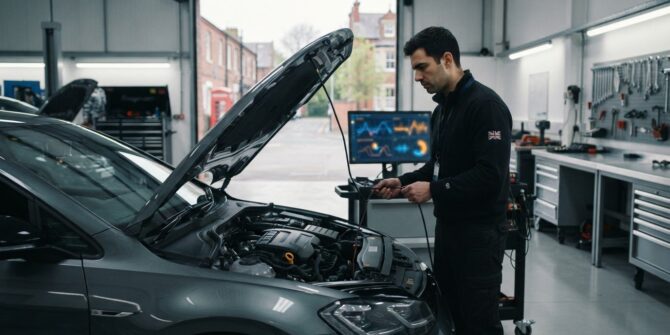
What if the best remap isn’t the one with the biggest headline power figure? With custom ECU mapping UK drivers should look beyond generic software and consider how a calibration suits their vehicle, its condition and the way it’s used. A vehicle-specific approach starts with the car or van and the driver’s objective, whether that’s sharper performance or a focus on efficiency.
It’s reasonable to want clear answers before changing engine software. You may be weighing up whether custom mapping is meaningfully different from an off-the-shelf file, and what a remap could mean for reliability, insurance and emissions compliance. Those practical considerations matter as much as the potential change in how your vehicle drives.
This guide explains what vehicle-specific mapping involves, what information can shape a calibration and how to define the right objective for your car or van. It also covers the checks to consider before commissioning a remap, including vehicle suitability and your responsibilities around insurance and road use. With over 15 years of tuning experience, Dynogen Remapping Solutions approaches performance and economy mapping with care, precision and attention to the driver’s priorities.
Key Takeaways
- Custom ECU mapping UK should be shaped around your vehicle and driving objective, not just a headline performance claim.
- Understand how your vehicle’s specification, existing software and condition influence whether a calibration is suitable.
- Choose between performance, economy and drivability priorities, and treat Stage 1 as a category rather than a promised result.
- Before commissioning a remap, organise your vehicle details and maintenance history, consider how you use the vehicle, and notify your insurer about modifications.
- See how Dynogen’s advanced software and over 15 years of tuning experience inform custom-calibrated performance and economy mapping.
What custom ECU mapping in the UK means for your vehicle
Custom ECU mapping is the adjustment of a vehicle’s engine-control software to suit its specification, condition and intended use. Rather than applying identical settings to every car or van, the calibration is shaped around the particular vehicle and a stated objective, such as performance or economy. The software can influence how the engine responds, but what’s achievable depends on the vehicle itself. Customisation isn’t a promise of a specific gain or a guarantee of reliability.
What does the engine control unit do?
The engine control unit, or ECU, is the electronic controller that uses information from vehicle sensors to manage aspects of engine operation. Depending on the vehicle, this can include fuel delivery, ignition timing and, on a turbocharged engine, boost control. A useful introduction to its role is this overview of the Engine Control Unit (ECU).
Think of the ECU as coordinating how the engine responds to changing conditions. Software settings can affect how quickly the engine reacts when you press the accelerator, for example. Remapping changes those settings; it doesn’t physically replace engine components. Any change in behaviour depends on the vehicle’s design, condition and calibration.
What makes an ECU map custom?
A custom map is developed with a particular vehicle’s specification and intended use in mind, rather than assuming one file and set of settings will suit every example of a model. The make, model, engine and existing software all help define the starting point. The driver’s priorities then shape the objective, whether that’s performance, efficiency or a particular feel behind the wheel.
The word “custom” describes the approach, not a guaranteed outcome. Two vehicles with the same model name may differ in specification, software or condition, so the same calibration shouldn’t automatically be assumed suitable for both.
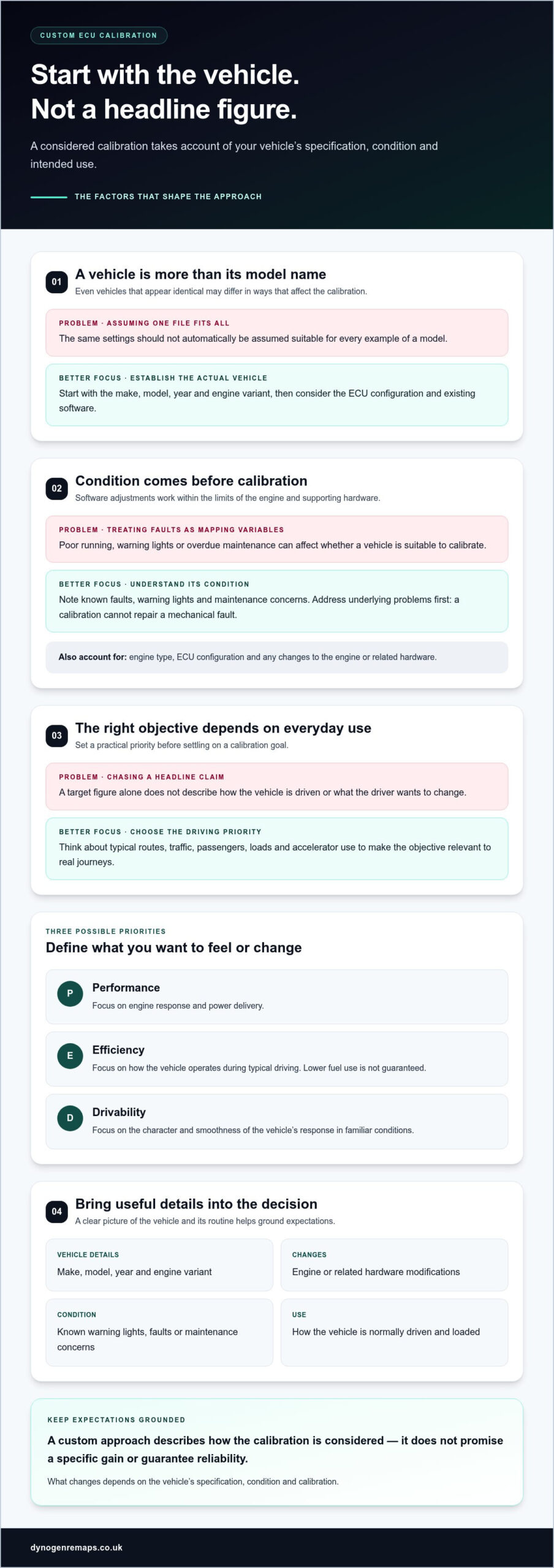
That vehicle-specific thinking matters because an ECU map works within the limits of the engine and its supporting hardware. A software adjustment can’t turn a component into a different one, nor can it compensate for an underlying mechanical fault. If a vehicle has a warning light, poor running or overdue maintenance, those issues are relevant to its suitability for calibration and should be addressed rather than treated as mapping variables.
For that reason, custom ECU mapping UK drivers consider should begin with a clear picture of the vehicle, not just a target figure. The intended use matters too: a daily-driven van carrying loads has different priorities from a car used mainly for commuting. A considered objective helps focus the calibration on the response the driver wants, whilst keeping expectations grounded in the vehicle’s actual specification and condition.
What should shape a custom ECU calibration?
A sound calibration starts with the vehicle in front of the tuner, not a generic target figure. Make, model and engine identify the basic platform, but the ECU configuration and current software also matter. Even vehicles that appear identical can have differences that affect how a calibration should be approached. That’s why custom ECU mapping UK should be considered in the context of the individual vehicle and the driver’s priorities.
How do vehicle specification and condition affect mapping?
Engine type, ECU configuration and relevant modifications help establish what the vehicle can support. The calibration needs to take account of the actual specification, rather than assuming every version responds in the same way. Existing faults and maintenance history matter too: poor running or an unresolved warning may indicate an issue that should be addressed before changing engine software.
Useful details to have ready include:
- The vehicle’s make, model, year and engine variant.
- Any changes to the engine or related hardware.
- Known warning lights, faults or maintenance concerns.
- How the vehicle is normally driven and loaded.
A calibration can’t repair a mechanical fault or make every vehicle suitable for the same settings. Resolving problems first gives a more considered basis for deciding whether to proceed. Drivers considering a Stage 1 option can explore what the category involves in this Stage 1 performance remapping guide.
How do you define the right remapping objective?
Be specific about what you want to change in everyday use. A performance-led objective centres on engine response and power delivery. An efficiency-led objective focuses on how the vehicle operates during typical driving, without assuming that fuel use will necessarily fall. Drivability is a separate consideration: it’s about the character and smoothness of the vehicle’s response in familiar conditions.
Your routine helps clarify the priority. A van regularly carrying equipment on mixed roads may call for a different focus from a lightly loaded car used mainly for short urban journeys. Think about typical routes, traffic, passengers, loads and how you use the accelerator. These details make the objective practical, rather than simply chasing a headline claim.
There’s no universal outcome. Actual changes depend on the vehicle’s specification, condition and calibration, so a clear objective helps set sensible expectations without promising a particular gain. Dynogen Remapping Solutions provides custom-calibrated performance and economy software for cars and vans. If either objective matches your needs, explore Dynogen’s remapping services, informed by over 15 years of tuning experience and advanced software and equipment.
Custom ECU mapping options: compare goals, not headline claims
A useful comparison starts with what you want the vehicle to do differently, not a single power figure or broad promise. Performance, economy and drivability describe distinct priorities, though they can overlap. The right direction for custom ECU mapping UK depends on the vehicle, its condition and the way you use it.
| Objective | What it prioritises | Useful question |
|---|---|---|
| Performance | Engine response and power delivery within the vehicle’s specification. | Do you want more responsive acceleration for your usual driving? |
| Economy | Calibration with efficiency as the central aim. | Do your regular journeys and driving habits suit this priority? |
| Drivability | The way the vehicle responds and feels in everyday use. | Are you seeking a different response in traffic, on hills or with a load? |
These are objectives, not guaranteed results. A vehicle’s condition, hardware and typical use all influence its real-world behaviour, as can driving style and road conditions. A calibration focused on one priority shouldn’t be assumed to deliver the same outcome for every driver or vehicle.
Performance mapping versus economy mapping
Performance mapping focuses on how the engine delivers response and power; economy mapping places efficiency at the centre. Neither description guarantees a particular change. For example, a driver covering steady routes may have different priorities from someone regularly carrying tools in a van. Consider your normal journeys and load before deciding which objective matters most. For a related comparison of everyday response, see how remapping can affect drivability.
Stage 1 is a remapping category, not a universal output. The label alone doesn’t establish what a particular vehicle will achieve, nor does it guarantee suitability. Vehicle specification and condition still matter. Treat headline claims as a starting point for understanding an option, not as a substitute for vehicle-specific context.
How should you assess claims about gains and reliability?
Look for a clear explanation of how a claim relates to the vehicle in question. Broad figures without the engine, specification or relevant conditions tell you little about your own car or van. Maintenance matters too: existing faults and the way the vehicle is used can affect its behaviour. For more context on reliability considerations, read about safe engine remapping considerations.
Before settling on an objective, compare the claim with your own priorities:
- Decide whether response, efficiency or everyday feel matters most.
- Consider regular routes, traffic and whether the vehicle carries passengers or equipment.
- Factor in the vehicle’s condition rather than judging a calibration by a headline alone.
Dynogen’s performance and economy remapping is shaped around the vehicle and the driver’s stated aim. Explore Dynogen remapping options as you consider which objective best fits your car or van.
UK checks to make before commissioning custom ECU mapping
Preparation helps you make a considered decision and avoid overlooking practical responsibilities. Before arranging custom ECU mapping UK, gather the information that describes your vehicle, how it’s used and any ownership conditions that may apply. Use this checklist to organise the key points.
- Record the vehicle details. Note the make, model, year, engine variant and any existing modifications. Accurate details help establish which vehicle and software configuration are being discussed.
- Review its condition. Make a note of warning lights, running issues and recent or outstanding maintenance. Address known faults before treating a remap as the next step.
- Define the intended use. Consider your regular journeys, driving conditions and whether you often carry passengers or loads. This helps clarify whether your priority is performance, economy or everyday response.
- Check ownership requirements. If the vehicle is leased, financed or belongs to someone else, review the relevant agreement and establish what approval or notification it requires before changing its software.
What should you check about insurance and vehicle records?
Tell your insurer about the proposed modification and check how it affects your individual policy. Insurers’ terms and responses can differ, so don’t assume another driver’s experience applies to your cover. Ask what information they need and keep a note of their response alongside your policy documents.
Keep relevant service and maintenance records together with paperwork describing the modification. A clear record of the vehicle’s condition and changes can be useful when dealing with ownership, insurance or future servicing questions. Review your policy wording directly, and revisit it if the vehicle or its modifications change.
How do MOT and emissions considerations affect a remap?
A remap doesn’t remove the vehicle’s applicable roadworthiness or emissions obligations. Requirements can depend on the vehicle and the changes made, so consult current official GOV.UK guidance for the rules relevant to your circumstances, including MOT and emissions information. Don’t rely on a general online claim as a substitute for guidance that applies to your vehicle.
Emissions-control equipment and its intended operation must be treated responsibly. Software changes shouldn’t be presented as a means of bypassing applicable requirements. If a proposed modification could affect emissions compliance or roadworthiness, establish its implications before proceeding and keep the vehicle’s legal use in view.
These checks help set clear expectations before any calibration begins. Dynogen Remapping Solutions provides custom-calibrated performance and economy software for cars and vans, shaped around the vehicle and the driver’s stated objective. Explore Dynogen’s remapping services to take the next step with your vehicle details and priorities in hand.
Choosing Dynogen for custom ECU mapping in the UK
The right remap begins with a clear objective and a considered approach to the vehicle. Dynogen Remapping Solutions provides custom-calibrated ECU software for cars and vans, with performance and economy options shaped around the vehicle and the driver’s priorities. This is the focus of custom ECU mapping UK: matching the calibration direction to the intended use, rather than relying on a headline figure to make the decision.
What to expect from a specialist remapping service
Dynogen has over 15 years of vehicle tuning experience and uses advanced software and equipment for remapping. Its service involves the professional installation of custom-calibrated ECU software, with the chosen objective guiding the direction. A driver seeking a performance focus may consider a Stage 1 Performance Remap, whilst someone prioritising efficiency may consider an Economy Remap. The appropriate category depends on the vehicle and its intended use; neither name guarantees a particular result.
Specialist work should be grounded in the vehicle and the driver’s priorities. A car used mainly for commuting may have different requirements from a van that regularly carries equipment. Sharing that context helps make the objective clear and keeps expectations realistic. Calibration can influence engine behaviour, but outcomes vary, and no remap can promise a specific change or replace good maintenance.
How to take the next step with Dynogen
Before discussing a remap, gather a few practical details. Clear information helps frame the conversation around your vehicle rather than a generic example:
- Make, model, year and engine variant.
- Any relevant modifications, warning lights or known running concerns.
- How you typically use the vehicle, including regular routes and whether it carries loads.
- Your main priority, such as performance or economy, and what you’d like to feel change in everyday driving.
It’s also sensible to have your maintenance history and any ownership or insurance considerations in mind. These details help you approach the decision with a complete picture, and make it easier to describe what matters most without assuming a particular outcome in advance.
Dynogen’s experience, specialist focus and advanced remapping equipment provide a considered foundation for performance and economy mapping. The aim is to align the software calibration with the vehicle and your stated objective, with a clear understanding that real-world behaviour depends on the individual vehicle and how it’s driven.
Ready to discuss your car or van and the remapping objective you have in mind? Talk to Dynogen about custom ECU mapping and share your vehicle details and driving priorities.
Make your next move with a clear objective
The most useful next step is to define what “better” means for your own driving. Is it a response you’d prefer on familiar roads, or a calibration direction that better reflects how you use your vehicle? A clear personal benchmark helps keep the conversation practical and the decision focused on your priorities, not a headline claim.
With custom ECU mapping UK, a considered discussion can connect your vehicle’s details and intended use to an appropriate remapping objective. You don’t need to arrive with technical language or a target figure. Start with what you drive, how you use it and what you’d like to change. That gives Dynogen a clear basis for discussing the options without treating a particular result as guaranteed.
When you’re ready to take that step, discuss your vehicle and remapping goals with Dynogen. A thoughtful approach can help you move towards a calibration that feels relevant to your needs and gives you confidence in the decision.
Frequently Asked Questions
What is custom ECU mapping?
Custom ECU mapping adjusts the engine control unit’s software to suit a particular vehicle and a chosen objective. In practical terms, that might mean calibrating a car for a performance focus or prioritising efficiency in a van. The ECU still operates within the limits of the engine and its components, so the vehicle’s specification and condition matter. A tailored map is an approach, not a promise of a particular result.
Is custom ECU mapping different from a generic remap?
Yes. Custom mapping is developed with a specific vehicle’s details and intended use in mind, whereas a generic remap uses software designed for a broader group of vehicles. For example, two cars with the same model name may have different engine variants or existing software. A generic file may not account for those distinctions. The label “custom” alone doesn’t prove quality, so consider how the calibration relates to your vehicle.
Can ECU mapping improve fuel economy?
It can be calibrated with efficiency as the priority, but lower fuel use isn’t guaranteed. Results depend on the vehicle, route, traffic, load and driving style. A van used for frequent short, stop-start journeys may behave differently from one covering steady longer routes. If economy is your main goal, consider how you actually drive and track fuel use across comparable journeys after the change, rather than relying on a predicted saving.
Will a custom remap affect my insurance?
It may affect your policy, so tell your insurer about the modification and ask how it applies to your cover. Insurers can set different terms, and the effect may depend on the vehicle and the change made. Don’t assume a remap is too minor to disclose or that another policyholder’s experience applies to you. Keep a written record of the insurer’s response and review your policy documents.
Can a remapped car still pass its MOT?
Yes, a car with an emissions-compliant remap can still pass its MOT, but passing depends on the vehicle meeting the applicable test requirements at the time of testing. A remap cannot guarantee a pass or compensate for a defect. Before making changes, consult current GOV.UK guidance on MOT and emissions requirements for your vehicle. Keep emissions-control equipment and roadworthiness obligations in view when considering any software modification.
How much power will custom ECU mapping add?
There isn’t one reliable figure for every vehicle. Any change depends on factors such as engine type, existing software, vehicle condition and the calibration objective. A figure quoted for another car may not apply, even if the model appears similar. Treat a claimed gain as vehicle-specific information to assess, not a guaranteed outcome. Ask for the context behind the figure, including which engine and specification it relates to.
How much does custom ECU mapping cost in the UK?
The cost varies according to the vehicle’s ECU complexity and whether the objective is performance or economy. Dynogen’s remapping fees are assessed per vehicle, so a single price wouldn’t accurately represent every calibration. To make a useful enquiry, have your make, model, year, engine variant and intended outcome ready. This gives the discussion a clear starting point without assuming that every vehicle requires the same work.