
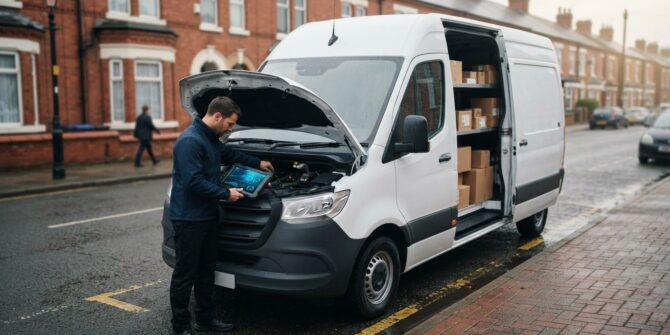
The most powerful remap on paper may be the wrong choice for a courier van. With repeated stops, changing traffic and varying loads, van tuning for couriers should be judged by how the vehicle is used, not by headline gains.
It makes sense to weigh engine response against fuel-use priorities, while also considering the van’s condition and your insurance and compliance responsibilities. An Economy Remap and a Stage 1 Performance Remap have different aims. The right direction depends on your routes, workload and priorities.
This guide compares those options in the context of courier work. You’ll find practical factors to consider before booking, how vehicle condition affects suitability, and how to discuss realistic aims without relying on one-size-fits-all claims. Dynogen Remapping Solutions offers ECU remapping for cars and vans, including economy and performance options, and has over 15 years of experience in vehicle tuning.
Key Takeaways
- Understand how ECU software changes differ from mechanical repairs, and why that distinction matters for courier work.
- Learn how torque and engine response relate to loaded starts, junctions and changing traffic.
- Compare an Economy Remap with a Stage 1 Performance Remap by considering the goal each is designed to prioritise.
- Use a practical checklist to assess your van, workload and tuning objective, and remember to notify your insurer about modifications.
- Make van tuning for couriers a decision based on the vehicle and route profile, then discuss realistic aims with Dynogen Remapping Solutions.
Van tuning for couriers: what does it change in everyday delivery work?
Van tuning usually means changing the engine control unit (ECU) software that manages how the engine operates. It differs from mechanical repair: a remap revises engine calibration, while servicing or replacing a faulty component addresses the vehicle’s physical condition. General background on engine tuning includes software-based changes, but suitability depends on the van’s specification and condition.
A suitable remap is one whose calibration goals reflect the van’s workload, route pattern and condition, not simply its headline figures. That matters because delivery work places varied demands on an engine throughout the day.
How courier routes shape the tuning question
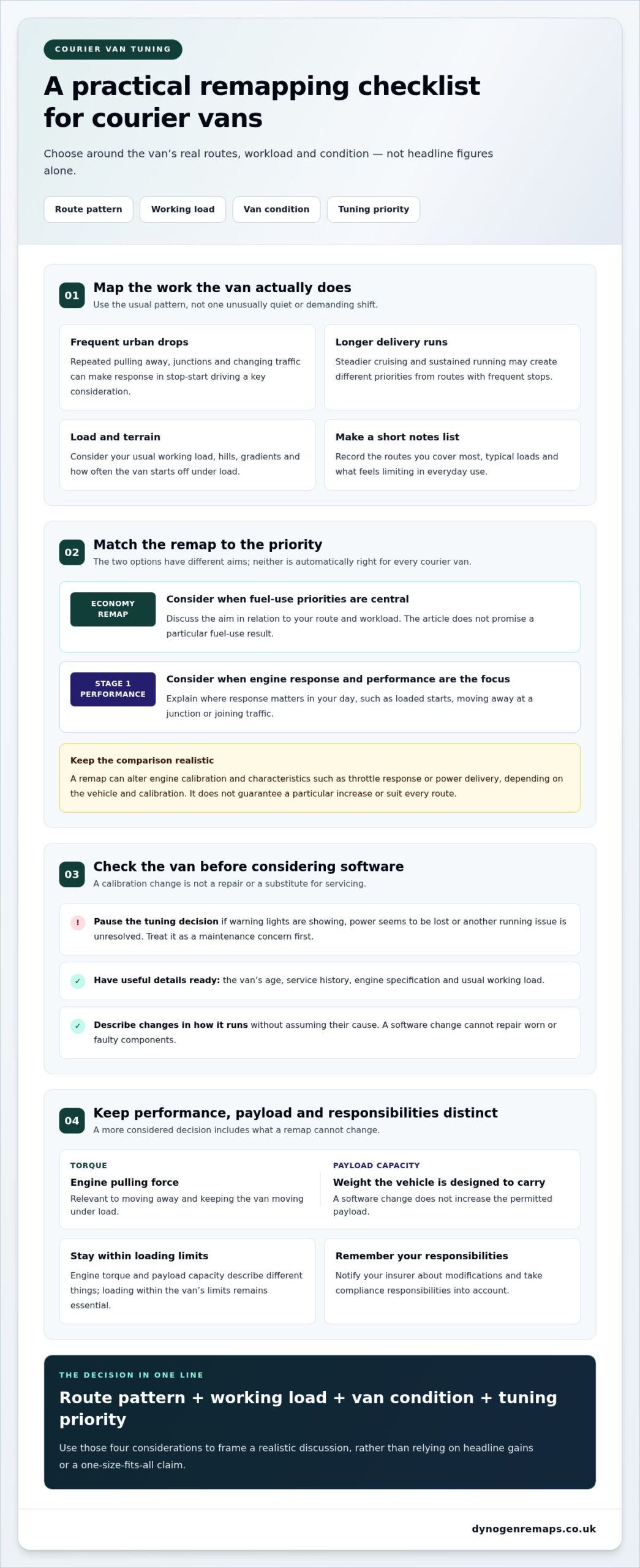
A van making frequent urban drops may spend much of the day pulling away, slowing for junctions and moving through changing traffic. A longer delivery journey may involve steadier cruising, with fewer stops but sustained running over a greater distance. Neither pattern automatically makes one remap the right choice. Each creates different priorities to consider.
Load and terrain add further variables. A van carrying parcels close to its usual working load faces different demands on starts and gradients than the same vehicle travelling lightly loaded. Congestion, hills and the spacing of delivery stops also affect how often the engine responds to changing conditions. Since courier routes can vary day to day, assess the typical pattern rather than basing your decision on one unusually quiet or demanding shift.
Before considering a remap, note the routes you cover most often, the loads you typically carry and what feels limiting in everyday use. These details help frame the decision around practical priorities rather than an abstract promise of more power or lower fuel use.
What ECU remapping can and cannot address
An ECU remap changes the software calibration that influences engine behaviour. Depending on the vehicle and calibration, it can alter characteristics such as throttle response or how power is delivered. It does not repair a mechanical fault, replace routine servicing or change the effect of driving style. Suitability needs to be considered against the van’s specific engine and overall condition.
If the van has warning lights, an apparent loss of power or another unresolved running issue, treat it as a maintenance concern, not a tuning objective. A software change is not a fix for worn or faulty components. Nor can a remap eliminate the demands of stop-start traffic, heavy loads or steep gradients. It can only adjust engine calibration where appropriate for the vehicle.
For general context on what a Stage 1 calibration involves, Dynogen’s Stage 1 remapping guide explains the approach. For courier use, relate that background to your van’s condition, regular workload and operating priorities.
How van remapping relates to torque, response and delivery demands
Torque is the engine’s pulling force. In practical terms, it helps move a vehicle away from a standstill and keep it moving under load. Power describes how quickly work can be done as engine speed rises. For a courier, this distinction can make engine response relevant during loaded starts, joining traffic or moving away at a junction. It doesn’t mean every van needs more torque, or that a remap will produce a particular increase.
Engine torque is the engine’s turning force; payload capacity is the weight the vehicle is designed to carry. They relate to different parts of driving. A software change does not increase the van’s permitted payload, and loading within its limits remains essential.
Why usable response matters more than headline figures
Courier driving often involves repeated acceleration, braking and gear changes. A van that feels slow to respond when pulling away with a load may be frustrating in stop-start work, while a driver on steadier runs may value composed progress at cruising speed. These are useful observations to bring into a tuning discussion, not proof that a remap will improve the experience.
Drivability describes how the engine’s delivery feels in real use, rather than a single peak power or torque figure. Calibration choices can affect engine behaviour, but the result depends on the van, engine, mechanical condition and calibration itself. Frequent stops and loaded starts present a different use case from longer stretches with fewer interruptions. Dynogen’s guide to torque and power remapping provides broader technical context for understanding how those measures relate to engine performance.
For van tuning for couriers, describe the moments that matter in your working day: pulling away on an incline, accelerating into a gap, or maintaining a steady pace between drops. That gives a more practical basis for discussing a remap than focusing on headline figures alone.
Why van condition comes before calibration
A remap changes calibration; it isn’t a substitute for maintenance. If warning lights are showing or the van has an unresolved running issue, address the underlying concern before considering software changes. A calibration cannot repair worn components or correct a mechanical fault, and changing settings should not be used to mask symptoms.
Useful details for a suitability discussion include the van’s age, service history, engine specification and typical working load. Be ready to describe any changes in how it runs without assuming their cause. This helps distinguish a tuning objective from a maintenance need and keeps expectations realistic.
- Note the driving situations where response matters most.
- Have the van’s service history and usual payload in mind.
- Separate desired engine behaviour from any current running concern.
Discussing these details can help match the objective to the vehicle without promising a particular result. Dynogen Remapping Solutions offers both a Stage 1 Performance Remap and an Economy Remap. Explore Dynogen’s remapping options in light of your van’s use and priorities.
Economy remap or Stage 1 remap: which suits a courier van?
The choice depends on what you want from the van during its working day. An Economy Remap has an efficiency-focused objective, while a Stage 1 Performance Remap prioritises performance characteristics. Neither is automatically better for courier work. Your route pattern, load, operating priorities and the van’s suitability should guide the discussion.
Use this comparison to define your objective and consider how it fits your delivery duties. It’s a starting point, not a promise of a particular change in fuel consumption or performance.
| Option | Intended goal | Courier-use considerations | Useful question |
|---|---|---|---|
| Economy Remap | Prioritise efficiency-focused engine calibration. | Consider regular mileage, stop-start traffic, typical payload and how consistently the van is driven. | Does an efficiency-led objective suit my usual routes and vehicle condition? |
| Stage 1 Performance Remap | Prioritise performance characteristics and engine response. | Consider whether response under your normal workload is a key operating priority, alongside vehicle suitability. | What performance objective is appropriate for this specific van? |
When an Economy Remap may be the more relevant discussion
If managing fuel use across regular delivery mileage is a priority, an Economy Remap may be the more relevant option to explore. Real-world consumption depends on more than calibration: route length, congestion, payload, gradients and driving behaviour all play a part. The van’s condition matters too. For more on these factors, Dynogen’s van remapping and MPG guide offers further efficiency-focused context.
When a Stage 1 Performance Remap may better match the brief
A Stage 1 Performance Remap may suit an operator whose priority is engine response or other performance characteristics, rather than an efficiency-led objective. That doesn’t make performance tuning automatically more useful for courier work. The specific van, engine and existing condition matter, as does whether the intended change addresses a genuine operating priority.
Before choosing either option, describe a typical working week: the kinds of roads covered, how often the van carries a working load, and what you want to improve in its behaviour. This makes the discussion more specific and helps set realistic expectations. If the vehicle has unresolved running concerns, address those as a maintenance matter before treating remapping as the answer.
For van tuning for couriers, matching the objective to the vehicle is more useful than choosing by label alone. Dynogen Remapping Solutions offers both Economy Remap and Stage 1 Performance Remap options, with suitability considered in relation to the van and your priorities. Explore Dynogen’s remapping services as part of your decision.
Courier van remapping checklist: suitability, insurance and compliance
A careful pre-remap review starts with facts about the van and the work it does. Gathering those details makes the suitability discussion more specific and keeps the objective grounded in real courier use. It also gives you a chance to consider insurance and ongoing vehicle responsibilities before making a software change.
Information to gather before arranging a remap
Prepare the vehicle details, a clear description of its working pattern and any concerns about how it runs. This helps distinguish a tuning priority from a maintenance issue and supports a realistic discussion about whether a remap suits the van.
- Record the van’s identity. Note the make, model, year and engine specification. Use the vehicle documents or handbook if you’re unsure of a detail.
- Describe its condition. Note warning lights, changes in drivability or other running concerns. Include relevant service history and mention existing modifications.
- Summarise its workload. Outline typical routes, including stop-start driving or longer runs, and describe usual payload patterns. Mention regular gradients or other conditions that shape the van’s working day.
- Set a clear objective. Decide whether your priority is efficiency-focused calibration or performance characteristics. Be specific about what you’d like the van to do differently, without assuming a particular result.
- Consider the operating context. If the van is part of a business or fleet, consider how any change fits its day-to-day role and relevant policy requirements.
Insurance, roadworthiness and emissions responsibilities
Tell your motor insurer about an ECU remap and follow the notification requirements in your policy. A modification can affect how your cover is assessed, so don’t assume a software change is immaterial. Keep a record of what was changed and when, alongside the vehicle’s other relevant documentation.
Remapping does not transfer responsibility for the van’s roadworthiness or applicable emissions requirements. Those obligations remain relevant to the vehicle and how it is used on UK roads. Requirements can depend on the vehicle and circumstances, so consult current official UK guidance for the rules that apply to your van rather than relying on general assumptions.
A remap changes engine calibration, not the vehicle owner’s responsibility to maintain compliance. Keep this in view alongside your tuning objective. If the vehicle has an unresolved warning light or running issue, treat it as a condition concern to address, not something a remap will repair.
For van tuning for couriers, start with an honest picture of the vehicle, its workload and your priorities. Dynogen Remapping Solutions offers Economy Remap and Stage 1 Performance Remap options for vans, with suitability considered in relation to the vehicle and your aims. Discuss your courier van remapping requirements with Dynogen.
Discuss van tuning for couriers with Dynogen Remapping Solutions
The right remap starts with a clear picture of the van and its working day. A delivery vehicle covering short drops with frequent stops has a different use profile from one spending longer periods on steadier routes. Your decision should reflect that pattern, the van’s condition and your main operating priority, rather than a generic claim about fuel economy or performance.
Dynogen Remapping Solutions offers two distinct options for vans: an Economy Remap, with an efficiency-focused objective, and a Stage 1 Performance Remap, focused on performance characteristics. Dynogen has over 15 years of experience in ECU remapping and vehicle tuning. That experience supports a considered discussion, not a guarantee of a particular result. The suitable goal depends on the individual vehicle and how it is used.
What to include in a useful remapping brief
A concise, practical brief helps keep the discussion relevant to courier work. Share the van’s make, model, year and engine details, then describe a typical working week rather than an exceptional day. Include the usual route type, how often the vehicle carries a load and any driving situations where you want different engine behaviour.
- State your priority. Explain whether efficiency-focused calibration or performance characteristics matter most to your operation.
- Give condition context. Mention the service history, warning lights, drivability concerns and any existing modifications.
- Describe the work. Note regular stop-start driving, longer runs, gradients and typical payload patterns.
Specific details are more useful than a broad request to “make it better”. For example, explain whether you want to prioritise fuel-use management across regular mileage or are more concerned with how the engine responds during loaded starts. That clarity keeps the conversation focused on an objective that fits the van’s role.
Set realistic expectations for a working van
Remapping outcomes vary with vehicle specification, condition, use and calibration. A delivery van’s route, load and driving behaviour also shape day-to-day operation, so avoid treating a figure from another vehicle as a prediction for yours. A goal-focused discussion is a stronger basis for setting expectations than relying on generic claims or headline numbers.
Be open about any unresolved running concerns. A remap changes engine calibration; it isn’t a substitute for maintenance or repair. Sharing the van’s history and intended use gives Dynogen useful context for discussing Economy Remap and Stage 1 Performance Remap options without promising a result that may not reflect your vehicle.
If you’re weighing up van tuning for couriers, bring your vehicle details, route profile and priorities into the conversation. Discuss your van remapping requirements with Dynogen to explore which objective best fits your courier work.
Make your next tuning decision work for the van
Before deciding, turn your day-to-day experience into a clear brief. Think about what would make the van better suited to its role: a different performance feel, an efficiency-led objective, or a clearer understanding of what is realistic for its age and condition. That focus keeps the decision practical instead of chasing a result that may not match the way you work.
For van tuning for couriers, the most useful next step is a conversation grounded in your vehicle and operating priorities. Share the details that shape its working life, including route pattern, typical load and any concerns about how it runs. A specialist discussion can help you explore the appropriate direction without treating an outcome as guaranteed.
Dynogen Remapping Solutions offers both Stage 1 Performance Remap and Economy Remap services for vans, supported by over 15 years of experience. Bring your courier use case into the discussion and identify an objective that makes sense for your vehicle.
Discuss your courier van remapping requirements with Dynogen and take a considered next step towards a tuning choice that fits your work.
Frequently Asked Questions
Is van tuning suitable for courier work?
It can be suitable, but the answer depends on the van’s specification and condition, the routes it covers and what you want to achieve. A van used mainly for short drops with frequent stops has a different working pattern from one doing longer runs. Before considering van tuning for couriers, identify your priority, such as efficiency-focused calibration or engine response, and discuss whether that objective fits your vehicle.
Can a van remap improve fuel economy for couriers?
An Economy Remap is designed around an efficiency-focused objective, but it can’t guarantee lower fuel use or a particular saving. Day-to-day consumption is also affected by payload, traffic, hills, route length and driving behaviour. For a fair comparison, record fuel consumption over familiar routes before any change, then compare similar journeys and loads afterwards. Different conditions can make direct comparisons misleading.
What is the difference between an Economy Remap and a Stage 1 Performance Remap?
An Economy Remap prioritises efficiency-focused calibration, while a Stage 1 Performance Remap focuses on performance characteristics. Neither label alone determines which is right for a courier van. Consider how the vehicle is used: an operator prioritising fuel-use management may want to discuss the economy objective, while one focused on engine response may explore the performance option. Suitability depends on the particular van, its condition and its workload.
Will remapping affect my courier van insurance?
Tell your motor insurer about an ECU remap and follow the notification terms in your policy. Insurers may treat modifications differently, so don’t assume a software change is irrelevant to your cover. Before arranging tuning, check your policy wording and ask your insurer how to declare the modification. Keep a record of the information you provide and any response, so your vehicle details and policy records remain accurate.
Can a remap fix an engine warning light or mechanical fault?
No. An ECU remap changes software calibration; it doesn’t diagnose or repair the cause of a warning light or running problem. If a light appears or the van behaves differently, treat it as a vehicle condition issue first. For example, don’t use a remap to try to mask a loss of power or unusual running. Resolve the mechanical concern before considering whether revised calibration is suitable.
Is a remapped van still subject to UK roadworthiness and emissions requirements?
Yes. A software change doesn’t remove the owner’s responsibility to keep the vehicle roadworthy and meet the emissions requirements that apply to it. The details can depend on the vehicle and its use, so don’t rely on a general statement as a decision about your own van. Check current official UK guidance, including relevant government information, and keep required maintenance and vehicle records up to date.
What information should I provide before discussing a courier van remap?
Give the make, model, year and engine details, along with the service history and any warning lights or drivability concerns. Describe a typical route, including whether it involves frequent stops or longer runs, and explain the usual payload pattern. Then state your main objective clearly, for example whether fuel-use priorities or performance characteristics matter more. Mention existing modifications too, so the discussion reflects the van as it is used.