

Could an engine remap make one car more responsive but push another beyond what its condition can comfortably handle? That’s the central question behind the engine tuning risks and benefits. Results depend on the vehicle, its maintenance history and how it’s driven, not simply the figures advertised.
It’s understandable to want stronger performance or better fuel economy while worrying about extra strain, existing mechanical weaknesses or unexpected ownership complications. No gain is guaranteed, and a change that suits one vehicle may not suit another.
This guide explains the potential benefits and trade-offs of engine tuning, including its possible effects on performance, efficiency and component wear. It also covers insurance disclosure, warranty and finance considerations, and UK road-use responsibilities. You’ll find practical points to weigh up before deciding, why vehicle condition matters, and how a professional, vehicle-specific approach to remapping can help set realistic expectations.
Key Takeaways
- Learn how an ECU remap can alter torque delivery, throttle response and power characteristics, with results shaped by the vehicle.
- Understand why improved fuel economy is possible but not an automatic outcome of performance tuning.
- Assess your car’s condition first: a remap won’t fix mechanical faults, and added load may affect components.
- Weigh the engine tuning risks and benefits alongside insurance disclosure, warranty, finance and UK road-use responsibilities.
- Use a four-step assessment to clarify your goals and expectations, then learn how Dynogen’s vehicle-tuning experience informs its approach to Stage 1 remapping.
Engine tuning risks and benefits: what the decision really involves
Engine tuning changes how an engine is managed to alter the way a vehicle delivers performance. This article focuses on ECU remapping, which revises the software calibration held by the engine control unit. It doesn’t cover every form of tuning, such as fitting different engine components or making other mechanical modifications. This distinction helps clarify what a remap can change and what it can’t.
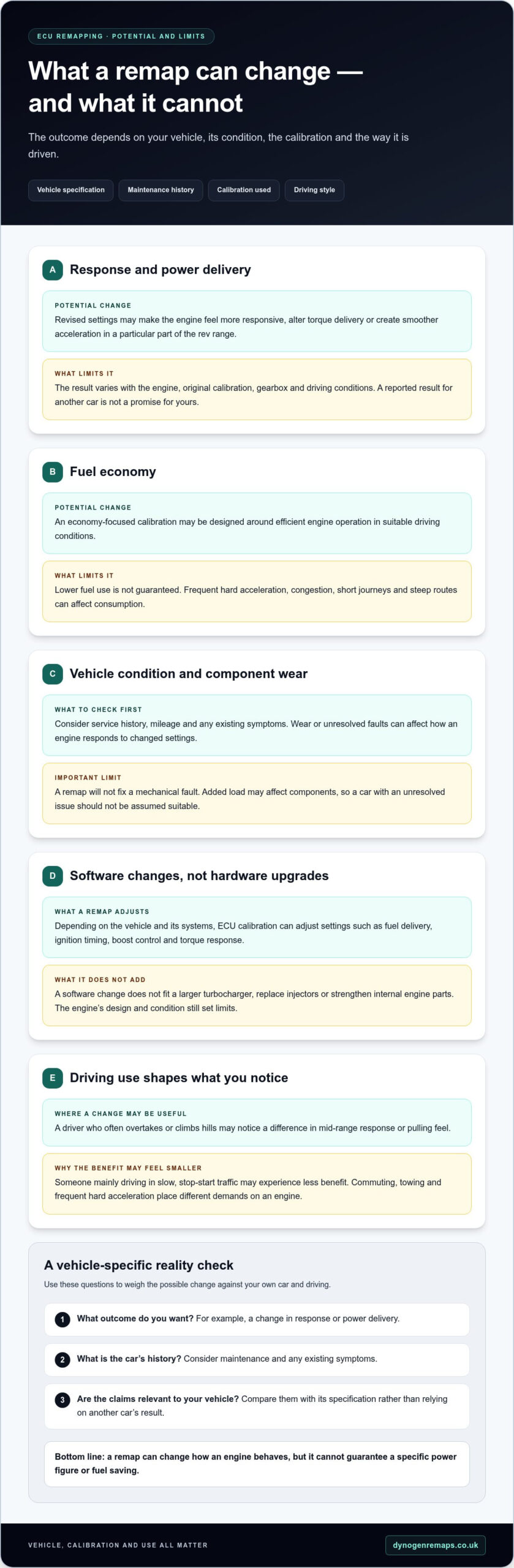
The engine tuning risks and benefits depend on more than the software alone. Vehicle specification, engine type, existing condition, the calibration used and the way the car is driven all influence whether a change is suitable and what you may notice. A remap can’t guarantee a particular power figure or fuel saving, and broad claims don’t account for every vehicle.
A sound decision starts with a balanced view. The aim is to explain the possibilities and trade-offs, not to promise gains or suggest that every remap is inherently harmful. For a wider overview of tuning methods and their potential effects, Engine tuning provides useful background; the focus below is ECU remapping.
What does an engine remap change?
The ECU uses software calibrations to manage engine operating parameters. Depending on the vehicle and its systems, these can include fuel delivery, ignition timing, boost control and torque response. Remapping adjusts relevant settings to change how the engine behaves, while respecting the technical limits of the vehicle and its components.
A remap is a software change, not a hardware upgrade. It doesn’t, by itself, fit a larger turbocharger, replace injectors or strengthen internal engine parts. A vehicle may feel more responsive because its control settings have changed, but the remap doesn’t remove the limits imposed by the engine’s design or condition.
Why can the same tune affect cars differently?
Two vehicles that appear similar can have different engine specifications, software versions, mileages and service histories. Existing faults or wear may also affect how an engine responds to altered settings. A car with an unresolved issue shouldn’t be treated as a suitable candidate simply because a software change is available.
Remap results vary by vehicle and calibration. The same adjustment can produce a different driving feel across vehicles, and the outcome also depends on how the car is used. Regular commuting, towing and frequent hard acceleration place different demands on an engine. Suitability should be judged in context, not assumed from another owner’s experience.
- Identify the outcome you want, such as a change in response or power delivery.
- Consider the vehicle’s maintenance history and any existing symptoms.
- Compare claims with your own car’s specification, rather than relying on a result reported for a different vehicle.
This vehicle-specific perspective is the starting point for weighing possible advantages against mechanical and ownership considerations. The following sections look at what may change in everyday driving and which trade-offs deserve attention before you decide.
How engine tuning can improve performance, and where gains vary
A remap may change how readily an engine responds and how it delivers torque and power across the rev range. The practical effect could be smoother acceleration or stronger pulling response in a particular part of the rev range, rather than a dramatic change in every driving situation. What’s achievable depends on the engine’s design, original calibration and the scope of the revised settings.
That difference matters on the road. A driver who often overtakes or climbs hills may notice a change in mid-range response, while someone who mainly drives in slow, stop-start traffic may experience less benefit. These are possibilities, not model-specific promises. A result reported for one engine or software version can’t be assumed for another.
Performance, torque and everyday drivability
Torque describes the engine’s turning force, and its delivery can shape how easily a car gathers speed without frequent gear changes. A suitable calibration may make power delivery feel more immediate or better suited to a driver’s needs, but it won’t change the vehicle’s fundamental design. The effect also depends on the gearbox and how the car is driven.
For a closer look at the software-only performance approach, Dynogen’s Stage 1 performance remapping guide explains the topic in more detail. Numerical claims are most useful when they relate to the exact vehicle specification and calibration, rather than a broad figure applied to every car. The Institute of the Motor Industry provides wider context on professional practice across the UK automotive industry.
Fuel economy: when might tuning help?
Economy-focused calibration has a different priority from a tune aimed chiefly at performance. It may be designed around efficient engine operation in relevant driving conditions, while a performance-focused setup prioritises response or power characteristics. Neither approach can promise lower fuel use in every situation. The engine, vehicle condition and journey pattern all influence the result.
Driving behaviour matters, too. Frequent hard acceleration can use more fuel, even if a remap has changed how the engine responds. A steady run on open roads differs from repeated short journeys, congestion or steep routes. To make a fair comparison, consider similar journeys and driving habits before and after tuning instead of relying on a single trip or dashboard reading.
A remap may support better efficiency in suitable conditions, but it can’t guarantee a fuel saving. If fuel economy is your priority, make that clear when considering a calibration. A performance-led setup may not align with that goal. A useful assessment connects the intended outcome to the vehicle and its everyday use, rather than assuming that more power and lower consumption arrive together.
Dynogen’s vehicle-specific approach to Stage 1 performance remapping is relevant for drivers considering how a performance-focused calibration might suit their car. Before deciding whether the potential changes are worthwhile, weigh the trade-offs, including mechanical condition and ownership responsibilities.
Engine tuning risks: reliability, insurance, warranty and UK compliance
Engine tuning isn’t risk-free. A remap changes engine management, but it can’t repair a worn clutch, diagnose a developing fault or restore neglected maintenance. Weigh any potential benefit against the vehicle’s condition and how it will be driven. This is a practical part of understanding the engine tuning risks and benefits, not a reason to assume every remap will cause a problem.
Could tuning affect reliability or component wear?
Changing calibration can alter the demands placed on the engine and drivetrain. The effect depends on the vehicle’s condition, the settings used and the load placed on it in everyday driving. A clutch or transmission that’s already showing symptoms deserves attention before tuning, as does an engine with warning lights, unusual noises or unresolved faults.
That doesn’t mean a remap will cause a particular component to fail. It means existing wear and mechanical limits matter when assessing suitability. A vehicle-specific approach should account for the car’s specification and condition, rather than treating a generic file as appropriate for every example. Dynogen’s guide to safe engine remapping explores the relationship between torque, power and responsible calibration in more detail.
What should UK drivers know about insurance and compliance?
Tell your insurer about an engine remap before it’s carried out, and establish how the modification affects your policy. Insurers set their own terms, so don’t assume a change is acceptable just because the car remains roadworthy. Failing to disclose a modification could affect cover or a future claim. Keep a record of the information you provide and the insurer’s response.
Warranty outcomes depend on the warranty terms and the circumstances of a claim. A modification doesn’t automatically mean every part of a manufacturer’s warranty is void, but a claim connected to altered engine management may be treated differently. Read the relevant terms and get the position explained before proceeding, especially if the vehicle is still covered.
Road use brings separate responsibilities. The vehicle must remain roadworthy and meet applicable emissions requirements. A compliant remap that retains functioning emissions-control equipment is different from removing or disabling a system such as a diesel particulate filter. Tampering with or removing emissions controls for road use can make a vehicle unlawful and lead to MOT problems. A standard MOT checks emissions under the test applicable to the vehicle; passing an MOT doesn’t make emissions-system tampering acceptable.
Before deciding, use this short checklist:
- Resolve existing faults and assess the condition of the engine, clutch and transmission.
- Disclose the planned modification to your insurer and understand the policy response.
- Review warranty terms and any relevant finance-agreement restrictions.
- Keep emissions equipment operational and ensure the vehicle continues to meet road-use requirements.
These checks won’t remove every uncertainty, but they help make the decision informed and specific to your car. A careful assessment is more useful than blanket claims that tuning always improves performance or inevitably harms reliability.
How to decide whether engine tuning suits your car and driving
A useful decision is based on four things: the car’s health, the outcome you want, the ownership implications and your expectations. Working through them in order helps you decide whether tuning fits your situation instead of relying on another driver’s results. It also brings the engine tuning risks and benefits into focus for your vehicle and everyday use.
Check vehicle health before considering a remap
Start with the service history, dashboard warning lights and any known mechanical issues. Unusual noises, inconsistent running or a warning light deserve attention before calibration is changed. A baseline diagnostic assessment can help identify existing faults and provide a clearer picture of the vehicle’s condition. Remapping isn’t a substitute for maintenance or mechanical repair. Address problems first, then reassess suitability.
Match the tuning goal to real driving needs
Be clear about what you want to change. Is your priority sharper response, stronger performance or the possibility of improving fuel efficiency? These aims may call for different calibration priorities, and your driving habits influence whether a potential benefit is noticeable. Someone who regularly accelerates briskly may value response, while a driver focused on economy needs to consider whether their routes and habits support that aim.
The Stage 1 versus standard driving comparison offers practical context for thinking about how remapping may affect everyday drivability. Treat it as a way to clarify your priorities, not as a promise that your vehicle will deliver the same result.
Use this four-step assessment before making a decision:
- Assess vehicle health. Review servicing records, warning lights, symptoms and known faults. Resolve issues before considering a calibration change.
- Choose your main outcome. Decide whether response, performance or fuel economy matters most. Don’t assume a single remap will maximise every goal.
- Consider ownership implications. Think about insurer disclosure, warranty terms and, if relevant, restrictions in a finance agreement. These responsibilities can affect whether tuning is right for you.
- Set realistic expectations. Base expectations on your specific vehicle and intended use. Don’t treat figures or experiences from a different car as a prediction for yours.
Be honest about the kind of driving you do. Short urban journeys, steady motorway travel, carrying loads and frequent spirited acceleration place different demands on a vehicle and can shape what you notice after a change. If fuel efficiency is your principal aim, consider whether your normal driving behaviour supports economical use. A performance-first priority may not suit that objective.
If your vehicle is in sound condition and your goal is clear, a vehicle-specific discussion can help you weigh the options without assuming a guaranteed result. Dynogen’s Stage 1 performance remapping is one option to consider when assessing whether a considered calibration suits your car and driving priorities.
How Dynogen approaches engine tuning with a vehicle-specific focus
Engine tuning is most useful when the proposed change reflects the vehicle and the driver’s priorities, rather than relying on a generic promise. Dynogen Remapping Solutions is a UK vehicle-tuning specialist with over 15 years of experience. Its specialist team uses advanced software and equipment, providing Stage 1 performance remaps and economy remaps for cars and vans.
Potential outcomes need to be considered in the context of the vehicle, its condition and how it’s used. A driver seeking stronger response may have different priorities from someone focused on economy. Neither goal should be treated as a guaranteed result. Understanding the engine tuning risks and benefits means matching expectations to the individual vehicle.
What a considered remapping service should focus on
A remapping conversation should begin with the vehicle and the owner’s intended outcome. Its specification and condition matter alongside the desired change, because software calibration works within the limits of the existing engine and components. Consider these factors together: a performance aim can’t be separated from mechanical health, and an economy goal needs to reflect real driving habits.
Calibration quality matters, too. A carefully considered, vehicle-specific approach is more meaningful than assuming one calibration suits every car or van. Dynogen’s experience and advanced equipment support its remapping work, while realistic expectations remain essential. The suitability and effect of a change depend on the individual vehicle, so a universal figure shouldn’t be treated as a promise.
Take the next step with Dynogen
Before proceeding, bring together three points: the outcome you want, the vehicle’s condition and your ownership responsibilities. Consider whether you’ve addressed warning lights or known faults, whether you understand your insurer’s position and warranty terms, and whether your expectations fit the way you use the vehicle. This gives you a sound basis for deciding whether a performance-led or economy-focused remap is appropriate to explore.
Dynogen’s Stage 1 performance and economy remapping services give drivers of cars and vans options to consider in relation to their individual goals. The right choice depends on the vehicle and intended use, not a blanket claim about what every remap will achieve. Find out more about Dynogen’s remapping services and the factors to consider for your vehicle.
Make your next tuning decision with confidence
Turn your expectations into a clear, vehicle-specific objective. Before choosing a remap, note what you want to feel or achieve in everyday driving and what would make the change worthwhile to you. That gives the discussion a practical starting point, rather than relying on headline figures or someone else’s experience.
Weighing the engine tuning risks and benefits is ultimately about deciding whether a proposed change fits your car, priorities and ownership plans. Dynogen’s remapping services can help you explore that question with a focus on your vehicle and intended outcome.
Explore Dynogen’s remapping services and take the next step towards a considered choice for you and your vehicle.
Frequently Asked Questions
Can an engine remap be reversed?
In many cases, the original software calibration can be restored, but the process depends on the vehicle and the work already carried out. Before any change, ask for clear records of the original and revised files where available. Restoring factory software won’t undo mechanical wear or fix faults that arose for other reasons. Check the implications for your warranty and insurance before proceeding, and keep relevant records with the vehicle’s service history.
Is engine tuning suitable for a high-mileage car?
High mileage alone doesn’t determine whether a car is suitable for tuning. A well-maintained vehicle and one with the same odometer reading but unresolved symptoms may present very different considerations. Look at servicing records, warning lights and known issues, not just the mileage figure. If the car has rough running or a slipping clutch, address those concerns first. A remap isn’t a remedy for age-related wear; base the decision on the vehicle’s actual condition.
Can a remap cause warning lights or limp mode?
A warning light or limp mode can be associated with a remap, but those symptoms can also stem from a pre-existing fault, a component issue or an incompatible calibration. Don’t assume the cause without diagnosis, and don’t ignore a warning because the vehicle has been tuned. Note when the behaviour began and what the car was doing. If it loses power, overheats or shows a serious warning, avoid driving it normally until the issue has been assessed.
Does engine tuning affect resale value?
There’s no consistent effect on resale value. Some prospective buyers may appreciate a documented modification, while others may prefer an unmodified car or want to understand its history before deciding. Keep records of the calibration and any related work with the service paperwork, and describe modifications accurately when selling. The vehicle’s condition, model, maintenance history and a particular buyer’s expectations can all influence how the change is viewed.
Can a remap be detected during vehicle diagnostics?
Detection depends on the vehicle’s ECU, its software and the diagnostic method used. A basic fault-code scan may not show a complete calibration history, but that doesn’t mean a modification can’t be identified through other checks or retained vehicle information. Don’t rely on assumptions about detectability when considering disclosure, insurance or warranty terms. If a technical claim matters to your decision, make sure it relates to your specific vehicle and the relevant organisation’s requirements.
Is engine tuning suitable for a naturally aspirated petrol engine?
Some naturally aspirated petrol engines can be recalibrated, but the potential changes differ from those typically associated with turbocharged engines. Without forced induction, the scope for changing how power is delivered may be different, so don’t apply turbo-engine claims to a naturally aspirated car. The engine’s design, factory calibration, condition and your intended outcome all matter. A vehicle-specific assessment is the sensible way to judge whether a remap fits your expectations.
What should I do if the car feels different after tuning?
Record what feels different, when it happens and whether a dashboard warning appears, then contact the specialist responsible for the calibration. For example, note whether the change occurs during acceleration, at idle or after the engine warms up. Avoid hard driving if there’s unusual noise, overheating, a warning light or a substantial loss of power. A proper diagnosis can help distinguish calibration behaviour from a mechanical issue; don’t try unverified software changes.