
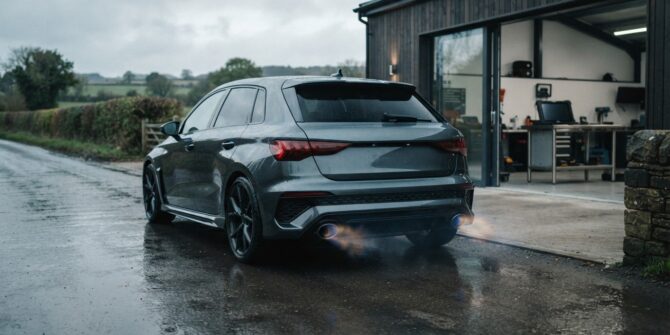
A louder exhaust isn’t automatically a better one. If you’re searching for how to make my car exhaust pop, an exhaust-tip alteration might seem like a tempting shortcut. But the distinctive crackle usually comes from what the engine does on overrun, not the shape of the tailpipe.
It’s understandable to want a sharper sound without risking damage or trouble on the road. The key is knowing the difference between an improvised modification and a carefully calibrated ECU map. Changes to fuelling and ignition can create pops, but poor calibration can place added strain on engine and exhaust components. Even a professionally developed map needs to be considered alongside noise, MOT and insurance implications. No particular sound or outcome should be assumed for every vehicle.
This guide explains what causes pops and bangs, why DIY shortcuts can bring unwanted consequences, and what to weigh up before choosing a pop and bang map. Dynogen Remapping Solutions offers a Pop & Bang / Crackle Map, drawing on over 15 years of vehicle-tuning experience. We’ll look at the trade-offs so you can make an informed decision, rather than treating exhaust noise as a quick modification.
Key Takeaways
- Learn how combustion on throttle lift-off can create exhaust pops, and why natural overrun sounds differ from a calibrated crackle.
- Understand how ECU software can influence exhaust sound without relying on improvised exhaust-tip modifications.
- Before deciding how to make my car exhaust pop, weigh the desired sound against potential heat, component, noise and emissions trade-offs.
- Use a realistic assessment of your vehicle and driving needs to decide whether a pop and bang map is suitable for you.
- Explore Dynogen’s Pop & Bang / Crackle Map as a professionally calibrated option backed by over 15 years of vehicle-tuning experience.
How to make your car exhaust pop: what actually creates the sound?
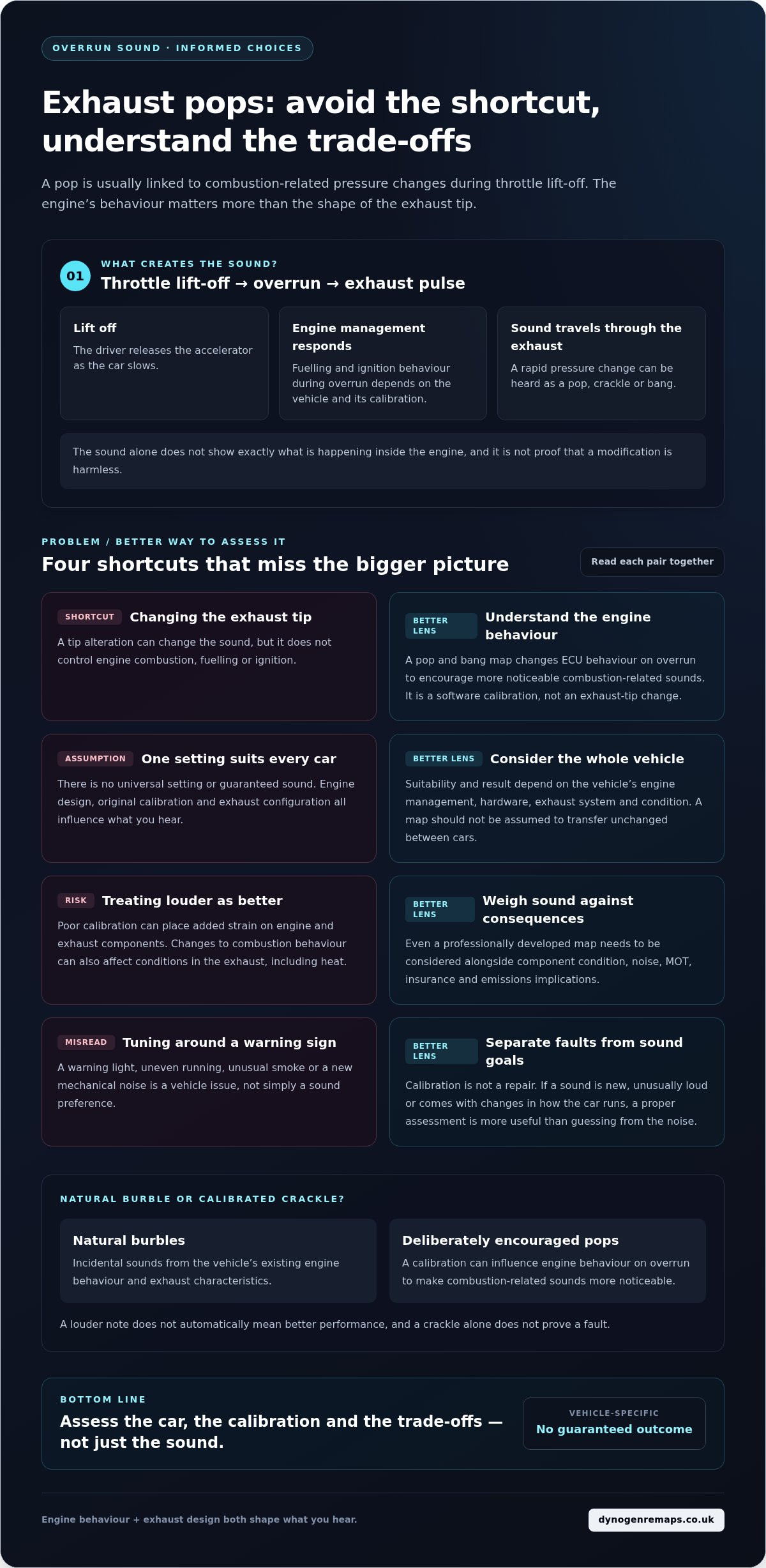
Exhaust pops can result from combustion events during throttle lift-off, when the driver releases the accelerator and the engine moves into overrun. In some conditions, fuel and ignition behaviour allow combustion to continue or occur in the exhaust rather than being fully contained within the cylinders. The resulting pressure pulse travels through the exhaust and is heard as a pop, crackle or bang.
An exhaust pop is a brief sound caused by a rapid pressure change, often associated with combustion in the exhaust during overrun. It isn’t proof that a modification is harmless, and not every pop has the same cause. The exhaust system carries gases away from the engine and helps shape the sound heard at the tailpipe. Both engine behaviour and exhaust design matter.
Why do some cars pop when the driver lifts off?
During deceleration, the car slows whilst the wheels continue turning the engine through the transmission. This state is called overrun. Engine management controls fuelling and ignition as the driver lifts off, and the exact response depends on the vehicle and its calibration. Some systems reduce or cut fuel during overrun, whilst other conditions may allow combustion-related sounds to reach the exhaust.
There’s no universal rule that a particular engine type will naturally pop. Engine design, its original calibration and exhaust configuration all influence what you hear. A quieter exhaust may soften a sound, whilst a different system may make similar pulses more noticeable. The sound alone doesn’t reveal exactly what’s happening inside the engine.
Natural exhaust burbles versus deliberately tuned pops
Natural burbles are incidental sounds produced by a vehicle’s existing engine behaviour and exhaust characteristics. Deliberately encouraged pops are different: an ECU calibration can influence how the engine behaves on overrun to produce more noticeable combustion-related sounds. That’s a software change to engine management, not simply a change to the exhaust tip.
A louder note doesn’t automatically mean better performance. Nor should every crackle be treated as evidence of a fault. Context matters, including whether the sound is new, unusually loud or accompanied by changes in how the car runs. If the sound changes unexpectedly, a proper assessment is more useful than guessing from the noise alone.
Forum advice sometimes suggests altering or fitting an exhaust tip to create pops. That doesn’t control the engine’s combustion, so it can’t provide the same measured approach as calibration. An improvised change may alter the sound without addressing what is happening upstream. If your question is how to make my car exhaust pop, start by understanding the source of the sound, not by attempting a physical exhaust-tip hack.
How a pop and bang map changes exhaust sound on overrun
A pop and bang map is a software calibration that influences how the engine behaves as you lift off the accelerator. Rather than changing the shape of the exhaust tip, it alters engine-management behaviour during overrun, which can encourage combustion-related sounds to travel through the exhaust. The exact effect depends on the vehicle and its hardware. There is no universal setting that produces the same result in every car.
The Engine Control Unit, or ECU, is the vehicle’s electronic controller. It manages aspects of engine operation, including fuelling and ignition, in response to operating conditions. When the driver releases the accelerator, the engine enters overrun as the car slows. A calibration can influence how the ECU responds during this phase, but a professionally developed map is vehicle-specific. It isn’t simply a file to apply unchanged across different cars.
What happens inside the ECU during throttle lift-off?
Lift-off changes the engine’s operating conditions, and the ECU manages that transition according to the vehicle’s systems and existing calibration. A pop and bang map modifies that behaviour to encourage a more pronounced exhaust sound. The aim is controlled calibration, not guesswork. Vehicle design, existing software and hardware all affect what may be appropriate and how the result sounds.
For drivers asking how to make my car exhaust pop, this distinction matters. An ECU map works with engine management; an exhaust-tip alteration doesn’t manage fuelling or ignition. A Stage 1 remapping guide offers broader context on how ECU calibration can change vehicle behaviour, although a pop and bang map has a different, sound-focused purpose.
Why the exhaust system and vehicle condition matter
The exhaust carries gases away from the engine, and its components influence how sound travels. A catalytic converter also plays a role in emissions control. Changes to combustion behaviour can affect conditions in the exhaust, including heat, so hardware and vehicle condition matter when considering a calibration. The same map cannot be assumed to suit every car or exhaust configuration.
Pre-existing faults shouldn’t be disguised by tuning. A warning light, uneven running, unusual smoke or a new mechanical noise deserves attention as a vehicle issue, not treatment as a sound preference. Calibration is not a repair, and adding a map won’t establish the cause of a fault.
- Vehicle: its engine management and general condition shape suitability.
- Hardware: exhaust components affect the sound and the context in which the map operates.
- Expectations: describe the sound character you want without assuming a guaranteed result.
A considered calibration starts with the vehicle, not a one-size-fits-all file or a physical hack. Dynogen Remapping Solutions brings over 15 years of tuning experience to its Pop & Bang / Crackle Map. It’s a professional route to consider after weighing up your vehicle and the sound you want.
Are exhaust pops safe, legal and suitable for everyday driving?
A pop doesn’t prove that a modification is safe. Deliberately encouraging combustion-related sounds can bring trade-offs, including additional heat in the exhaust and stress on components. The effect depends on the vehicle, its condition and the calibration, so risk shouldn’t be judged by listening to the sound alone. Changes to engine behaviour may also affect emissions, whilst a louder exhaust can be intrusive during everyday driving.
That’s why a sound-focused modification needs a broader assessment than “does it pop?” Consider the car’s condition, exhaust hardware, intended use and applicable UK requirements before deciding. A map that sounds appealing during a brief demonstration may feel very different on regular journeys, particularly if the noise is frequent or conspicuous.
What could go wrong with DIY exhaust-pop hacks?
Don’t glue, screw, nail or otherwise obstruct the exhaust to try to create a pop. Don’t use improvised ignition methods either. These approaches don’t provide controlled engine calibration. Obstructing exhaust flow or introducing uncontrolled combustion can create unpredictable heat and hazardous operating conditions. Potential consequences include damage to exhaust components, although the outcome depends on the vehicle and the modification.
Online instructions can make a physical hack sound simple. That doesn’t make it a safe way to control what happens inside the engine or exhaust. If a vehicle develops a new noise, running issue or warning light, treat it as a possible fault rather than trying to intensify the sound. Tuning shouldn’t be used to conceal a mechanical problem.
What should UK drivers consider before changing exhaust sound?
Keep three questions separate. They relate to different checks, and a positive answer to one doesn’t settle the others.
- Road use: Consider whether the modified vehicle remains compliant with current UK requirements for its use on public roads. Don’t assume a modification is acceptable simply because a similar sound is common.
- MOT: Check the current MOT requirements for exhaust condition, noise and emissions. An MOT result is one assessment, not automatic confirmation that every road-use requirement has been met.
- Insurance: Tell your insurer about modifications and ask how they affect your policy before proceeding. Keep a record of the information you provide and the response.
Requirements and test guidance can change, so rely on current official UK guidance rather than forum posts or general claims. For an MOT question, consult the current DVSA inspection guidance. For road-use requirements, use relevant government information. Your insurer can explain how its policy treats the planned change. These checks are distinct, and none should be replaced by assumptions about what another vehicle has done.
Sound is only one part of a responsible decision. Dynogen’s safe engine remapping guidance provides broader context on reliability considerations. A measured approach weighs the intended sound against vehicle condition, practical use and compliance, rather than treating a pop as proof that a modification is suitable.
How to decide whether a pop and bang map suits your car
A good decision starts with your expectations, not a target sound clip. A pop and bang map changes how the car behaves on overrun, but the sound can vary with the vehicle and its exhaust hardware. Think through how you’ll use the car, who travels in it and what compromises you’re prepared to accept before considering calibration.
Use this sequence to make the choice more practical:
- Describe the sound you want. Are you after occasional, subtle burbles, or a more frequent, attention-grabbing crackle? Explain the character you have in mind rather than expecting an exact imitation of another car.
- Consider the car’s condition. Existing warning lights, running issues or unusual noises should be assessed as vehicle concerns before any sound-focused tuning is considered.
- Weigh everyday compromises. Think about regular journeys, passengers, neighbours, noise, maintenance, emissions and whether the change fits your intended road use.
Questions to consider before choosing this type of tune
Picture a normal week, not just an occasional drive on an open road. Extra exhaust noise may be unwelcome on early starts, in residential streets or with passengers who prefer a quieter cabin. Ask yourself whether the sound will still suit shared surroundings once the novelty wears off, and factor compliance and insurance considerations into the decision.
Why vehicle assessment comes before calibration
A car’s condition matters because tuning shouldn’t be used to mask a fault. An existing issue may affect whether a sound-focused change is a responsible choice, so the vehicle and intended outcome need to be understood first. A professional assessment is about making a considered decision for that car, not applying a universal file or promising a particular noise.
Be realistic about what you can specify. You can describe whether you prefer a restrained burble or a sharper crackle, and explain the driving situations in which you want to hear it. That gives a specialist useful context, but the vehicle’s design and hardware still influence the result. Don’t treat a recording as a guaranteed preview. Different cars can produce different sounds from similar intentions.
For UK road use, make compliance part of the decision rather than an afterthought. Consider the applicable requirements, MOT implications and your insurer’s position before proceeding. A car that suits your taste acoustically may not suit your daily routine or the people around you. If the practical compromises feel too great, choosing not to tune it is a sensible outcome.
Dynogen Remapping Solutions brings over 15 years of vehicle-tuning experience to its Pop & Bang / Crackle Map service, with a considered approach rather than an improvised exhaust modification. If you’ve weighed the sound and everyday trade-offs, explore Dynogen’s Pop & Bang / Crackle Map as a professional next step.
Dynogen’s Pop & Bang / Crackle Map: a professional route to exhaust pops
If you’ve weighed the sound you want against everyday use and vehicle condition, Dynogen Remapping Solutions’ Pop & Bang / Crackle Map offers a software-based alternative to improvised exhaust-tip hacks. Rather than obstructing the exhaust, an ECU calibration influences engine behaviour during overrun. The appropriate approach depends on the vehicle, its hardware and how you intend to use it, so don’t assume a particular volume or sound.
Dynogen has over 15 years of vehicle-tuning experience, with specialist knowledge of ECU remapping and performance tuning. That experience provides relevant context when considering how to make my car exhaust pop, but it isn’t a promise of a specific result. A well-informed decision starts with your expectations and the car itself.
What a professional tuning conversation should establish
First, be clear about the sound character you’re after. Occasional burbles and a more attention-grabbing crackle are different expectations, and a recording of another car can’t guarantee the same result from yours. Explain how you use the vehicle too, including regular journeys, passenger comfort and the surroundings in which you drive.
Vehicle condition belongs in the discussion. Existing faults or unusual behaviour shouldn’t be overlooked in pursuit of a louder exhaust note. A considered conversation should also cover relevant mechanical, emissions, road-use and insurance trade-offs, so you can weigh the intended sound against practical responsibilities. The goal is an informed choice, not a promise of a particular volume, frequency or outcome.
Useful points to clarify include:
- Sound preference: whether you favour subtle burbles or a more pronounced crackle.
- Use of the car: how often you drive, who travels with you and whether extra noise suits your usual surroundings.
- Vehicle context: its current condition and exhaust configuration, which can affect suitability and sound.
- Practical implications: the maintenance, emissions, compliance and insurance considerations you need to account for.
Choose a considered calibration over a quick exhaust hack
A physical obstruction doesn’t manage the engine’s fuelling or ignition behaviour. It can interfere with exhaust flow and create unpredictable conditions, rather than providing controlled sound through ECU calibration. A specialist approach focuses on the vehicle and intended outcome. Chasing the loudest possible noise is no substitute for technical judgement.
Dynogen’s Pop & Bang / Crackle Map is a considered next step for drivers who understand the compromises and want a professionally calibrated route. If you’re ready to learn more, explore Dynogen’s tuning services and make your decision with the vehicle, the sound you want and your day-to-day driving in mind.
Make your next step a considered one
The right choice isn’t necessarily the loudest one. Before deciding how to make my car exhaust pop, think about the sound you’ll enjoy over time and whether it fits the way you use your car. A clear idea of your priorities makes it easier to have a useful, realistic conversation about a suitable approach.
If you’re interested in a calibrated option, Dynogen Remapping Solutions brings over 15 years of vehicle-tuning experience to its Pop & Bang / Crackle Map service. The aim is to consider the vehicle and your expectations, not to promise a particular sound. Take the next step when you’re ready to explore what a specialist calibration could mean for your car.
Explore Dynogen’s Pop & Bang / Crackle Map service and make your decision with confidence.
Frequently Asked Questions
How do I make my car exhaust pop?
A professionally calibrated ECU map is the considered route if you want to encourage pops, but whether it suits your car depends on its condition, engine management and exhaust setup. A sound-focused calibration changes engine behaviour rather than physically altering the tailpipe. Before pursuing how to make my car exhaust pop, decide what sound you want and how it will fit your usual driving. Avoid improvised modifications, which can’t control engine behaviour.
Can I make my exhaust pop by putting something inside the exhaust?
No. Don’t put anything inside the exhaust or attach an object to obstruct it. An obstruction can interfere with exhaust flow and create unpredictable operating conditions; it won’t provide controlled ECU calibration. If you’ve already inserted something, don’t start the engine to test the result. Have the obstruction removed safely and the system checked if you suspect it has been damaged.
Will a pop and bang map damage my car?
It can’t be assumed harmless. A poorly calibrated map may increase heat and place additional stress on parts of the engine or exhaust, but the likelihood and consequences depend on the vehicle, its condition and the calibration. A map isn’t a remedy for an existing fault. If the car has warning lights, unusual running or mechanical noises, address those concerns before considering a sound-focused change.
Are pop and bang maps legal in the UK?
A pop and bang map isn’t automatically proof of an illegal vehicle, but the map’s presence alone doesn’t establish that the car is compliant for road use. Noise, emissions and any changes to required equipment can be relevant. Requirements may depend on the vehicle and circumstances, so check current official UK guidance before using a modified car on public roads. An MOT pass alone shouldn’t be treated as confirmation of every road-use requirement.
Can an exhaust pop affect my MOT?
It may do if the exhaust modification affects the checks applied during the MOT, including noise, emissions or the condition of required equipment. The result depends on the vehicle and what has been changed, so a pop by itself doesn’t determine whether it will pass or fail. Check current DVSA inspection guidance for the relevant requirements, and don’t treat an MOT result as a substitute for considering road-use compliance.
Does a pop and bang map increase performance?
Not necessarily. A pop and bang map is intended to influence exhaust sound on overrun, so you shouldn’t assume it will increase power, torque or acceleration. Those are separate outcomes that depend on the vehicle and the calibration being considered. If your priority is performance rather than sound, make that clear before choosing a tuning approach, and assess the intended outcome independently of how loudly the exhaust pops.
Will a pop and bang map affect my car insurance?
It could affect your cover, so tell your insurer about the ECU map and any related exhaust changes before relying on the policy. Insurers may assess modifications according to their own terms, and the effect can vary between policies. Describe the change accurately, keep a record of your notification and the insurer’s response, and ask how it affects your cover. Don’t assume a modification is covered simply because the car remains insured.