

The remap with the boldest fuel-saving promise may not be the best remap for fuel economy for your car. A calibration that suits one vehicle and driving pattern won’t necessarily deliver the same result for another, so treat advertised MPG gains as possibilities, not guarantees.
If you’re considering an economy remap, it’s worth understanding what changes in the engine control unit, whether your vehicle is a suitable candidate and whether efficiency is the main goal. The answer depends on more than the map: vehicle condition, regular journeys, load and driving habits all influence real-world fuel consumption.
This guide explains how an economy-focused remap differs from a performance-focused one, what can affect MPG and how to set realistic expectations before choosing a calibration. It also covers vehicle health, emissions and insurance. Dynogen Remapping Solutions has over 15 years of vehicle-tuning experience and provides economy remaps for cars and vans, with the calibration objective considered in relation to the vehicle.
Key Takeaways
- The best remap for fuel economy is aligned with your vehicle, typical journeys and efficiency goals, not simply the boldest advertised claim.
- Compare economy-led, performance-led and standard ECU settings by their intended outcome, how much results depend on driving style, and what evidence supports any claimed benefit.
- Track your usual routes, traffic, speed and load when assessing MPG. Changing conditions can make before-and-after comparisons misleading.
- Before remapping, identify your vehicle, assess its condition and define your objective. Existing engine or emissions faults need diagnosing, not masking with a calibration.
- Dynogen provides economy remaps for cars and vans, using specialist software and equipment for ECU remapping.
What is the best remap for fuel economy, and what can it change?
The best remap for fuel economy is a calibration designed around an efficiency-focused objective and the vehicle it’s intended for. It adjusts how the engine is managed; it doesn’t create fuel savings automatically. Whether fuel consumption changes in everyday use depends on the vehicle’s condition and how, where and under what load it’s driven.
What does an ECU remap adjust?
The engine control unit (ECU) is the software-controlled manager that coordinates engine operation. A remap changes the calibration, or instructions, the ECU uses to manage that operation. The Engine Control Unit (ECU) reference gives a useful overview of its role.
The exact changes depend on the vehicle and the calibration’s aim. An economy remap is intended to support efficiency-focused driving rather than simply maximise output. The same approach won’t suit every engine or use case, so a tailored calibration needs a clear objective and should take the specific vehicle into account.
Economy remap or performance remap: what is the difference?
An economy remap prioritises efficiency, with the intention of making the vehicle’s response more suitable for economical driving. A performance-led Stage 1 remap instead focuses on increasing power and torque. These are different calibration objectives, even if a driver hopes to improve both efficiency and performance.
Extra power doesn’t automatically mean better fuel economy. If you use the added performance to accelerate harder or maintain higher speeds, fuel consumption may rise rather than fall. Any efficiency effect depends on how the vehicle is driven, as well as its condition, route and load. Frequent stop-start journeys, for example, present different demands from steady motorway running, so the same calibration may not produce the same real-world result in both situations.
Keep the intended outcome in view when comparing claims. A figure advertised without context doesn’t explain the vehicle, route or driving behaviour behind it, and can’t establish what your own fuel consumption will be. A considered calibration sets a relevant aim without treating a particular MPG improvement as assured.
Drivers researching a power-focused option can explore the Stage 1 performance remapping guide to understand how that objective differs. For economy, start with your vehicle and how you use it, not a map selected on the strength of a headline claim.
How can an economy remap affect real-world fuel consumption?
An efficiency-focused calibration may change how usable torque is delivered, which can influence gear choice and throttle input. Depending on the vehicle, you may find it easier to maintain speed without pressing the accelerator as hard. That possibility isn’t a promise of lower fuel use: if you respond by accelerating more forcefully, any potential benefit may be lost.
A remap cannot guarantee improved MPG because real-world consumption depends on the vehicle and how it’s used. The route matters. Stop-start traffic involves repeated acceleration and braking, while a steady longer-distance journey creates different driving demands. Sustained high speeds, frequent acceleration, hills, congestion and journey length can all affect the result.
Load and condition matter too. Extra passengers or luggage increase the work the vehicle must do, while poor maintenance or an existing fault can affect fuel consumption independently of the calibration. Cold, wet or windy weather may also change driving conditions and vehicle use. A single tank or trip can’t isolate all these influences, so headline claims aren’t a reliable forecast for every driver.
Why do MPG results vary between drivers?
A week of short, congested trips can produce a different outcome from longer journeys at a consistent pace. Smooth acceleration and anticipating traffic can help avoid unnecessary speed changes. By contrast, using extra performance for brisk acceleration or maintaining a higher speed can increase fuel demand. The calibration is only one part of the equation.
How should drivers measure fuel economy before and after?
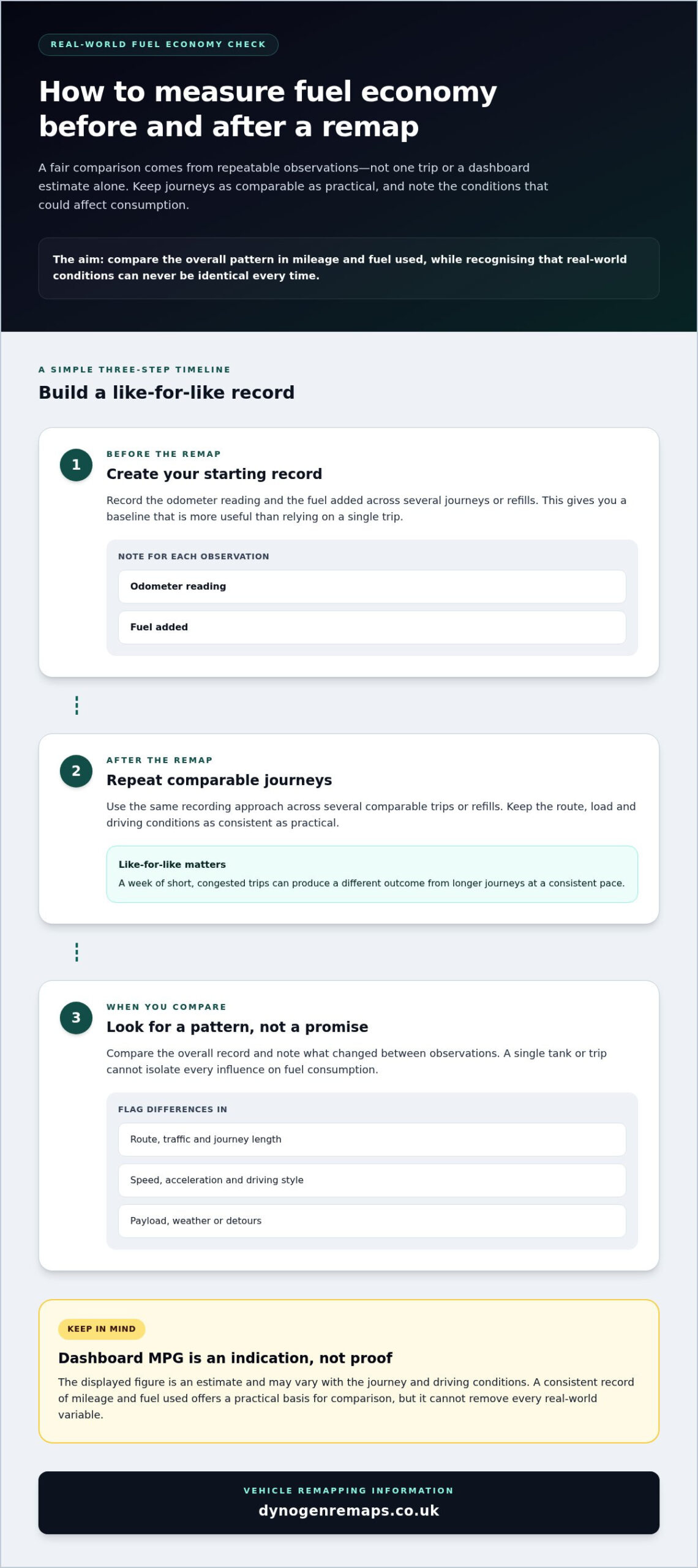
Use repeatable observations rather than relying on a single dashboard estimate. Before the remap, record the mileage and fuel used over several journeys. Afterward, repeat the process across comparable trips, keeping the route, load and driving conditions as consistent as practical. Note unusual traffic, weather or detours, as these can make a comparison less like-for-like.
- Record the odometer reading and the fuel added for each observation.
- Repeat across several comparable journeys or refills, rather than relying on one trip.
- Compare the overall pattern and note differences in route, traffic, speed, payload or weather.
The dashboard MPG figure can be useful for monitoring, but treat it as an indication rather than proof of a lasting change. It’s an estimate, and the displayed result may vary with the journey and driving conditions. A consistent record of mileage and fuel used offers a practical basis for comparison, although it can’t remove every real-world variable.
This approach helps put claims in perspective when deciding what the best remap for fuel economy means for your use. Dynogen’s economy remapping service focuses on a considered calibration, not a guaranteed MPG figure.
How should you compare remaps for fuel economy?
Compare the objective behind each option, not just a headline MPG percentage. A useful claim explains which type of vehicle it relates to, the conditions under which the result was measured and how fuel use was assessed. Without that context, a large advertised figure is a marketing claim, not a personal forecast.
The most relevant remap is the one calibrated around the vehicle and its intended use. Use this comparison to clarify what each choice is designed to do:
| Option | Intended outcome | Dependence on driving style | Evidence to look for |
|---|---|---|---|
| Economy-led calibration | Support efficiency-focused driving through a calibration designed for that aim. | High. The driver’s routes, acceleration and use of the vehicle affect real-world consumption. | A clear explanation of the vehicle, test conditions and method used to assess fuel use. |
| Performance-led calibration | Prioritise stronger power and torque rather than fuel economy. | High. Using the additional performance may increase fuel consumption. | Evidence should relate to the performance objective; don’t treat it as proof of an MPG benefit. |
| Vehicle left standard | Keep the existing factory calibration. | Fuel use still varies with driving habits, vehicle condition and journey conditions. | Establish a baseline using comparable journeys and consistent fuel-use records. |
Which remap objective suits your driving?
If your priority is efficiency-focused driving, an economy-led calibration is the more relevant objective to explore. If stronger performance matters more, a Stage 1 performance remap has a different purpose and shouldn’t be treated as an economy map. For mixed driving, set realistic expectations: a varied week of short trips, congestion and longer runs can’t be reduced to one dependable MPG promise.
Drivers researching fuel efficiency for working vehicles have different considerations from private motorists. This section focuses on comparing objectives for individual use; the fleet fuel economy remapping guide covers that separate context.
What evidence makes a fuel-economy claim more useful?
Look for specifics: the vehicle type, journey pattern, load and driving conditions, plus how fuel consumption was measured. A best-case result under favourable conditions isn’t the same as a typical result, and neither guarantees what your own car will achieve. A claim is more useful when its limits and measurement method are clearly explained.
Be cautious of a universal percentage presented without supporting context. Differences in vehicle condition and use make such figures a poor substitute for vehicle-specific evidence. Compare claims against your own routine and a reliable baseline, rather than selecting the biggest number. That’s a more considered way to identify the best remap for fuel economy for your circumstances.
Is your vehicle ready for a fuel-economy remap?
A sound starting point matters more than a headline MPG claim. Before changing the ECU calibration, work through a straightforward sequence: identify the vehicle accurately, assess its condition, define what you want the remap to achieve, then decide what would count as a realistic result. This helps distinguish a suitable efficiency objective from an attempt to solve a mechanical problem through software.
- Identify the vehicle. Note its make, model, engine and any relevant existing modifications. Accurate details help keep the discussion focused on the right vehicle and calibration.
- Assess its condition. Pay attention to warning lights, unusual running behaviour and maintenance needs before considering a change.
- Define your objective. Be clear that efficiency-focused driving is the priority, rather than stronger performance.
- Review expectations. Consider your typical journeys and establish a measured fuel-use baseline, so you can assess any later change fairly.
What should be checked before changing the ECU calibration?
Start with a sound maintenance baseline. Address warning lights, rough running or other concerns through diagnosis rather than assuming a remap will resolve them. An existing engine or emissions fault can affect how the vehicle operates; changing its calibration is not a substitute for finding and repairing the cause.
Keep the whole vehicle in view. Maintenance, tyre condition and driving habits can influence fuel consumption independently of ECU changes. A vehicle that needs routine attention may not provide a fair basis for judging an economy-focused calibration. Nor should deleting or bypassing emissions equipment be treated as an economy recommendation. The aim is a considered calibration for a roadworthy vehicle, not concealing a fault or avoiding a repair.
What should owners consider beyond the vehicle itself?
Modifications can affect insurance. Tell your insurer about a remap and check its requirements before proceeding, since policy terms and acceptance can differ. Also review current UK emissions and roadworthiness requirements that apply to your vehicle and intended use before making modifications. Keeping these responsibilities in view is part of deciding whether a remap is appropriate.
A measured baseline gives you a more useful point of comparison than memory or a single dashboard reading. Record fuel used and mileage across several comparable journeys, and note meaningful differences in route, load or conditions. After a change, repeat the process as consistently as practical. This won’t remove every variable, but it can help you judge the pattern more fairly.
The best remap for fuel economy starts with a suitable, well-maintained vehicle and a clear objective. Dynogen Remapping Solutions brings over 15 years of vehicle-tuning experience, with specialist software and equipment for its economy remapping work. Explore Dynogen remapping services to see how a considered calibration can be matched to your vehicle and priorities.
How Dynogen approaches an economy remap
Dynogen Remapping Solutions provides economy remaps for cars and vans, with a focus on matching the calibration objective to the vehicle and how it’s used. The team brings over 15 years of vehicle-tuning experience and uses specialist software and equipment for ECU remapping. This supports a considered approach without treating a particular fuel-economy figure as guaranteed.
The process starts with the vehicle and the owner’s priorities. Details such as the vehicle model, engine, current condition and typical journeys help establish the context for an efficiency-focused calibration. Someone making regular longer trips, for example, may describe a different pattern of use from someone who mainly drives short, congested routes. That context helps frame the objective rather than assume one map will suit every car or driver.
What does a tailored economy remap mean in practice?
A tailored economy remap considers the calibration objective in relation to the specific vehicle and intended use. It isn’t a universal file or a promise of a fixed MPG gain. The aim is an efficiency-focused calibration that takes the vehicle’s characteristics into account, while recognising that real-world consumption also depends on condition, route, load and driving behaviour.
That distinction matters after the remap, too. A driver who changes their acceleration habits or journey pattern may use fuel differently from someone following the same routine as before. A calibration can’t control those factors or compensate for an underlying mechanical issue. Setting a realistic objective from the outset makes it easier to judge the result fairly and understand what the remap is intended to do.
How can owners take the next step?
Before considering a change, note your vehicle details and describe how you usually drive. Include the kinds of journeys you make, whether traffic is often stop-start and what you want to prioritise. This gives the discussion a practical starting point. An efficiency objective can then be considered on its own terms, without relying on a universal promise that may not reflect your circumstances.
If stronger performance is also part of your decision, keep that goal distinct from fuel economy. A Stage 1 remap has a performance-led objective, so it shouldn’t be assumed to deliver the same outcome as an economy calibration. The Stage 1 remap versus standard performance comparison can help clarify that choice.
Choosing the best remap for fuel economy starts with a clear understanding of the vehicle, its condition and the journeys it needs to handle. Dynogen’s specialist experience and equipment bring a methodical foundation to that decision, while keeping expectations grounded in the factors that affect fuel use. Explore Dynogen economy remapping to take the next step towards a calibration aligned with your vehicle and efficiency objective.
Make your next step an informed one
Before choosing a calibration, decide what you want your vehicle to do differently and how you’ll judge whether the change suits you. A clear priority, whether efficiency-focused driving or stronger performance, helps keep the conversation practical and expectations grounded. If fuel economy is the goal, look beyond a headline figure and consider whether the calibration objective fits how you actually use your car.
The best remap for fuel economy isn’t defined by the boldest promise. It’s a considered choice based on your vehicle, your priorities and the understanding that real-world results can vary. Taking time to make that distinction can help you approach remapping with confidence.
Ready to explore an economy-focused calibration for your car or van? Explore Dynogen economy remapping and take the next step towards a choice that reflects your needs. A well-informed decision is a strong place to start.
Frequently Asked Questions
Will a remap definitely improve my fuel economy?
No, a remap can’t guarantee better MPG in every vehicle or driving situation. Results depend on the calibration, vehicle condition, route, load, speed and how you use the available power. Some drivers may notice a change; others may see little difference. For a fair assessment, compare fuel use over similar journeys and don’t treat advertised figures as a promise for your car.
How much MPG can I gain from an economy remap?
There isn’t one reliable MPG figure that applies to every vehicle. Engine type, vehicle condition, journey pattern and driving style all influence the result. Before applying a claim to your car, look for details of the vehicle and test conditions behind it. The best remap for fuel economy isn’t established by a headline percentage; compare fuel use across several similar journeys instead.
Is an economy remap suitable for petrol cars as well as diesel cars?
It depends on the specific car, its engine management system and the calibration objective. A result reported for a diesel vehicle shouldn’t be assumed to apply to a petrol model, or vice versa. Consider how the car is used and whether an efficiency-focused calibration suits that use. Dynogen provides economy remaps for cars and vans, with the vehicle’s individual characteristics central to the decision.
Can an economy remap damage my engine?
No modification should be described as risk-free, and a remap is not a fix for mechanical faults. If the car has a warning light, unusual noise, uneven running or difficulty starting, have the cause diagnosed before considering a calibration. Keep up with servicing and address faults rather than masking them with software changes. The vehicle’s condition and the calibration objective both matter when assessing suitability.
Do I need to tell my insurer about an ECU remap?
Yes, disclose the remap to your insurer and check how it affects your cover before driving. Insurers set their own policy terms, so don’t assume an efficiency-focused calibration is exempt from disclosure. Keep a record of the modification and any relevant paperwork. If your policy terms change, make sure the cover remains appropriate for your vehicle and its declared modifications.
Is a remapped car still legal and able to pass its MOT?
A remap doesn’t remove your responsibility to keep the car roadworthy and compliant with applicable emissions requirements. Whether a vehicle meets those requirements depends on its condition and the work carried out. Avoid modifications that make required emissions equipment non-compliant, and consult current UK guidance before changing the vehicle. Keep up with maintenance, and don’t assume a calibration alone determines an MOT outcome.
Does a fuel-economy remap work on vans and fleets?
Economy remapping can be considered for vans, but results depend on the vehicle and its working use. A van carrying different payloads on varied routes presents a different measurement challenge from a car used for regular private journeys. Fleet operators may also need to review vehicle use and fuel reporting across several drivers. For those broader operational considerations, see the fleet fuel economy remapping guide.