
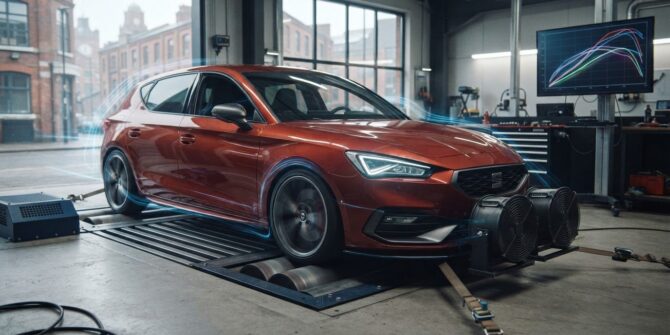
A Seat Leon Cupra remap can make a clear difference on paper: a quoted Stage 1 calibration for the 2.0 TFSI Cupra raises output from 240 bhp to 300 bhp, with torque increasing from 300 Nm to 420 Nm. Those figures show the potential gain against standard output, not a single result for every Cupra variant.
More power is appealing, but the quality of the calibration, the way it’s tested and the effect on warranty matter just as much. This guide explains how Stage 1 software is developed and dyno tested, compares quoted gains with standard figures, and sets out the key warranty considerations. You’ll also see why the engine, transmission and fuel used all matter when assessing what a remap can deliver.
Key Takeaways
- Identify your Cupra’s engine and ECU first, as model and hardware differences affect which software calibration applies.
- Learn how Stage 1 calibration balances power delivery and torque with the car’s existing setup and intended fuel.
- See why dyno testing helps compare standard and tuned output, while understanding what a power run can and can’t show.
- Understand how a remap may affect a manufacturer warranty, particularly if a fault involves a part affected by the software.
- Compare quoted Stage 1 gains with standard figures, then consider whether a performance remap suits your car and driving priorities.
Seat Leon Cupra engine and ECU specifications
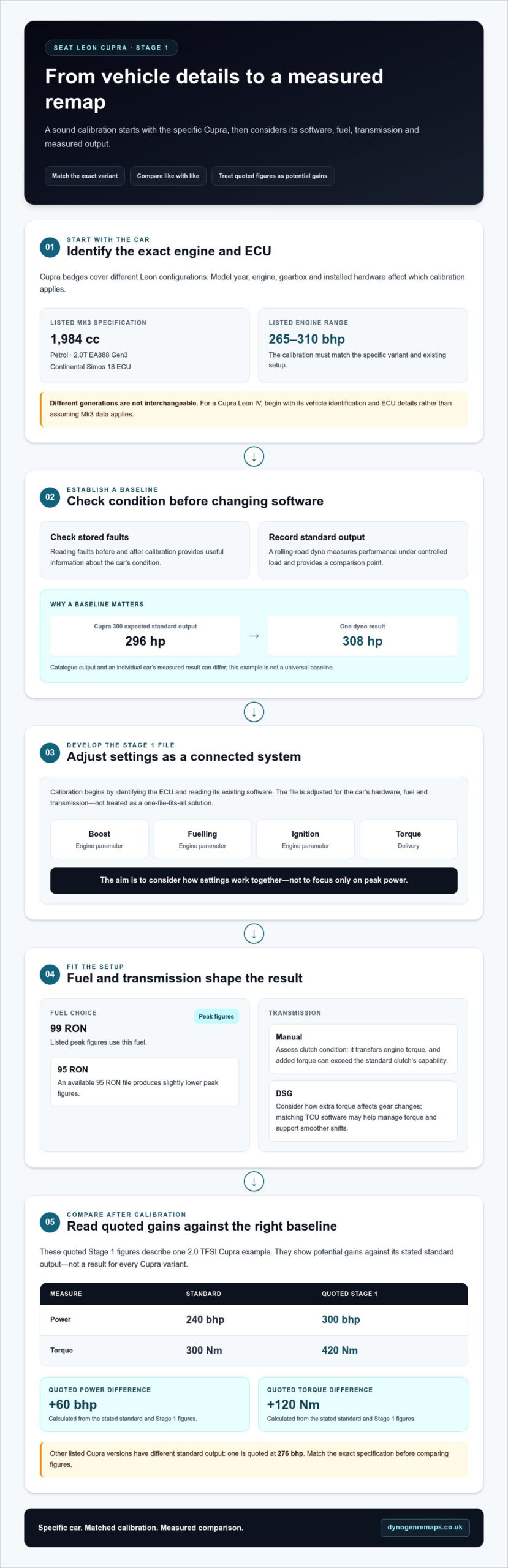
Start with the exact generation and engine code: Cupra badges cover several Leon configurations, and their tuning requirements aren’t interchangeable. The listed Mk3 Cupra has a 1,984 cc petrol engine and a Continental Simos 18 ECU. Its 2.0T EA888 Gen3 engine is listed across variants rated at 265-310 bhp, so identify the car’s model year, transmission and existing hardware before comparing software figures.
Standard output varies by version. The 2.0 TFSI Cupra is quoted at 240 bhp and 300 Nm, while another listed Cupra variant has standard output of 276 bhp. A SEAT Leon Cupra 300 is expected to produce 296 hp, although a dyno result can differ from a catalogue figure. These figures describe different specifications, not a single baseline for every Cupra. Match like with like when assessing gains.
For the Cupra Leon IV, begin with its vehicle identification and ECU details rather than assuming Mk3 data applies. Newer generations can use different engine management and hardware, which affects the calibration pathway. Stage 1 generally refers to software tuned around standard hardware; Stage 2 calls for supporting modifications. The listed Stage 2 requirements are a performance air intake and turbo inlet elbow, performance intercooler, and performance downpipe.
What are the typical Stage 1 and Stage 2 remap options for a SEAT Leon Cupra? Stage 1 recalibrates the engine software around the existing hardware, whilst Stage 2 is associated with the listed intake, turbo inlet, intercooler and downpipe upgrades. The correct route depends on the specific engine and installed parts.
Is a remapped SEAT Leon Cupra legal and MOT compliant in the UK? A remap alone does not prove that a car will pass its MOT or meet road-use requirements. Compliance depends on the vehicle’s condition and emissions, and on whether its modifications meet the applicable requirements.
How do you prepare a SEAT Leon Cupra for a remap, and what checks are needed? Identify the engine, ECU and gearbox, then check for stored faults before and after calibration. For a manual car, assess the clutch, as added torque can exceed the standard clutch’s capability. DSG owners should consider how extra torque may affect gear changes.
Transmission hardware matters. A DSG gearbox may benefit from matching TCU software to manage extra torque and support smoother shifts. For manual owners, clutch condition should be part of the tuning decision from the outset. Both the software’s torque delivery and the clutch’s ability to transfer it affect how the car behaves under load.
Other Leon engines need separate figures and calibration. For example, a customer-reported Leon 2.0 TDI increased from 150 bhp to 199 bhp after remapping; that diesel example isn’t a Cupra benchmark. Confirm the engine variant first, then compare its standard output and ECU with the intended software. That simple step prevents misleading comparisons between petrol, diesel, Mk3 and Cupra Leon IV models.
How Stage 1 software is calibrated
Stage 1 calibration adapts engine software to the car’s hardware, fuel and transmission. The quality of the result depends on matching those variables, rather than applying one file to every Leon Cupra.
Stage 1 ECU Remapping
Calibration starts by identifying the ECU and reading its existing software. The file is then adjusted to manage engine parameters such as boost, fuelling, ignition and torque delivery. A sound approach considers how these settings work together, rather than focusing only on peak power. Checking stored faults before and after the remap also provides useful information about the car’s condition.
Mk3 Stage 1 Remap
A Mk3 Cupra’s 2.0T EA888 Gen3 engine uses a Continental Simos 18 ECU in the listed specification. Its range spans 265-310 bhp, so the calibration needs to match the specific variant and its existing setup. Fuel also matters: listed peak figures use 99 RON, whilst an available 95 RON file produces slightly lower peak figures.
Torque delivery deserves equal attention. In a manual car, the clutch transfers engine torque, so its condition can affect whether a calibration is suitable. With DSG, ECU software works alongside the transmission’s shift behaviour. TCU software may be considered to manage additional torque and support smooth gear changes. The aim is a consistent response across the engine and gearbox, not a headline figure in isolation.
Stage 2 is a hardware-dependent step, not simply a more aggressive Stage 1 file. The listed requirements include a performance air intake and turbo inlet elbow, performance intercooler, and performance downpipe. These parts alter the conditions the engine software must accommodate. Confirm which components are fitted before comparing Stage 2 claims or deciding whether the additional hardware suits your intended use.
Stage 3 describes a further tuning step, but the label alone doesn’t define the parts, calibration or work involved. A meaningful comparison needs the proposed hardware, engine specification and scope of software development. Stage 2 or Stage 3 pricing depends on the case and is given after a quote request; cost factors include the required hardware, calibration work and vehicle setup.
For a considered route from standard software, the Stage 1 engine calibration option should be judged against your Leon’s specification, fuel and gearbox. Keep those details together when assessing a proposed map. That makes it easier to compare the calibration approach, supporting modifications and expected driving behaviour without confusing different Cupra versions.
Dyno testing and software development
A rolling-road dyno measures how a Cupra performs under controlled load, giving a comparison point before and after software changes. A standard SEAT Leon Cupra 300 produced 308 hp on a dyno, against an expected standard output of 296 hp. That example shows why catalogue figures and an individual car’s measured result can differ. It also underlines why a baseline run helps make later comparisons more useful.
Useful testing starts with the car’s condition, not a power run. Check stored faults before calibration and again afterwards. Retain the original ECU software file so it can be restored on request. These steps establish the vehicle’s starting point and create a record of the work, helping distinguish pre-existing issues from changes associated with the new calibration.
A dyno session provides more than a headline peak-power number. Comparing runs helps show how power and torque build through the rev range, and whether delivery remains consistent. The test setup, vehicle condition and fuel all affect the reading. Listed peak figures for the Cupra use 99 RON fuel, so testing with different fuel makes a direct comparison less meaningful. Consistent conditions matter.
The vehicle’s response guides software development and calibration adjustments. Engine parameters are refined for the specific Cupra, while a dyno provides measured feedback under load. The aim is controlled power delivery that works with the car’s existing hardware. A manual car’s clutch also matters: increased torque puts greater demand on its ability to transfer engine output without slipping. A power graph alone cannot show clutch condition.
A Seat Leon 2.0 TFSI Cupra remap with a dyno session takes 4 to 5 hours. That time allows for calibration and testing, rather than just writing software to the ECU. Owners should understand what the session includes: a measured baseline, software work and post-calibration runs provide a clearer comparison than a claimed peak figure alone. Ask what the final report records.
Read dyno results in context. A 308 hp standard Cupra 300 result doesn’t mean every standard example will record the same output, nor does one run establish the gain from a particular remap. Compare the same vehicle before and after, using consistent test conditions and fuel. Check whether the report states measured power, torque and test setup, then interpret the figures together.
For DSG models, engine output is only part of the assessment. TCU software may be considered alongside ECU calibration to manage additional torque and support smooth gear changes. A dyno reading records engine performance, while transmission behaviour is assessed by how the gearbox responds during driving. Considering both gives a more complete picture of the finished calibration.
Money-back guarantee and warranty
A money-back guarantee and a vehicle manufacturer’s warranty are separate protections. A guarantee is governed by the terms attached to a remapping product or service; a manufacturer’s warranty concerns covered vehicle faults. Read the written terms before agreeing to a Seat Leon Cupra remap, and check what each promise actually covers.
What are the risks and reliability concerns of remapping a SEAT Leon Cupra? Extra torque increases demands on components such as the clutch and gearbox. A manufacturer can decline a claim for a part it can show was affected by the remap. The car’s condition, calibration and transmission all matter when assessing reliability.
A warranty does not automatically cover every fault that occurs after tuning. A manufacturer may decline a claim for a component it can show was affected by the remap. A fault involving an unrelated part is different from a failure connected to altered engine operation. Keep the original software file and records of diagnostic checks, calibration and supporting work to maintain a clear history of the car.
Check the warranty wording for its scope, exclusions and claims process. Look for the components named, the circumstances that qualify and any evidence required. For example, a clutch issue following increased torque raises different questions from an unrelated electrical fault. A remap warranty and the car’s original manufacturer warranty are not interchangeable.
Some tuning products have a manufacturer warranty with specific fitting conditions. The stated product warranty is valid only when a VAT-registered professional automotive workshop fits it and provides a VAT invoice for a claim. Keep the invoice with the product documentation. A missing invoice or fitting outside those terms can affect eligibility under that product warranty.
Before relying on a money-back promise, read how the result is assessed. The terms should explain whether a claim depends on a measured power figure, a fault or another stated condition. A dyno result is meaningful only alongside the test conditions and the vehicle’s baseline. Keep written figures and test records with the remapping paperwork.
Reliability also depends on how the engine and gearbox handle the new torque. A manual Cupra’s clutch must transfer that torque without slipping, while a DSG car’s shift behaviour should suit the engine calibration. Diagnostic checks before and after the software change help document stored faults. They do not replace warranty terms, but they provide a clearer record if a problem arises.
For a sound decision, compare three documents: the vehicle’s manufacturer warranty, the remapping service terms and any product warranty. Note who provides each protection, what it covers and what evidence a claim requires. This practical review distinguishes written commitments from assumptions about what tuning warranties usually include.
Remapping gains compared with standard output
Published gains depend on the Leon Cupra variant and its baseline, so compare like with like. Output figures are useful only when the engine, units and fuel context match.
Results by Generation and Engine
Results differ by generation, engine specification and calibration. A listed Cupra variant starts at 265 bhp and is shown reaching 365 bhp, with torque rising from 258 lbft to 347 lbft. Those figures describe that listed setup, not every Mk3 or Cupra Leon IV. Identify the exact version before using them as a comparison.
Other figures refer to different specifications. The SEAT Leon Cupra 300 has an expected standard output of 296 hp, while forum members report Stage 1 results of 360-375 hp. These reports aren’t directly interchangeable with figures given in bhp, or with another generation’s test. Engine, fuel and hardware all shape the comparison.
How do remap results differ by SEAT Leon Cupra generation and engine? The baseline and achievable output vary with the specific engine and its factory calibration. Compare the same generation and engine, using consistent units and fuel, rather than treating all Cupra figures as a single standard.
Effects of a Remap
An ECU remap changes the engine’s software calibration, adjusting how it manages parameters such as boost, fuelling and torque delivery. The practical effect can include stronger acceleration and a broader-feeling power delivery. The scale and character of the change depend on the software, fuel and vehicle specification.
What does a remap do to a SEAT Leon Cupra? It recalibrates engine management to alter power and torque delivery. Assess the resulting figures against the car’s own standard output, not a claimed result from an unrelated Cupra.
Peak power is only one part of the comparison. Torque affects how strongly the car pulls through the rev range, and its delivery shapes how the car feels under acceleration. A headline figure does not show whether power arrives smoothly or how the gearbox handles it. For DSG models, transmission behaviour is part of the driving experience alongside engine output.
Check whether quoted gains use hp or bhp, then compare the same unit and test conditions. A standard car’s measured output can differ from its quoted factory figure, so a proper before-and-after comparison is more informative than comparing separate cars. Fuel matters too: the listed peak figures use 99 RON, and a 95 RON file has slightly lower peak figures.
For a tailored comparison of your Leon’s specification and potential gains, discuss your Cupra remap.
Dynogen Remapping Solutions: Stage 1 Performance Remap
Dynogen Remapping Solutions offers a Stage 1 Performance Remap for drivers seeking sharper engine performance from their SEAT Leon Cupra. It’s a natural next step once you’ve identified your generation, engine, gearbox and preferred fuel, then compared realistic gains with standard output.
A considered remap starts with the car’s specification and your priorities. If stronger performance is your goal, Stage 1 is the relevant option; if fuel economy is the priority, an Economy Remap may suit better. The figures discussed in this guide show why matching the calibration to the specific Cupra matters more than relying on a headline claim.
Share your vehicle details and performance aims with Dynogen Remapping Solutions to discuss the appropriate next step.
Choose the next step for your Cupra
The right calibration starts with a clear priority: stronger performance, improved efficiency or support for another vehicle system. Before proceeding, consider how you use your Cupra, which fuel you intend to run, and whether the gearbox and clutch suit the torque delivery you want. A Seat Leon Cupra remap should fit the car’s specification and your everyday driving, not just chase a peak figure.
Dynogen Remapping Solutions offers a Stage 1 Performance Remap for performance-focused drivers and an Economy Remap for those prioritising efficiency. Its AdBlue Solution addresses a different system-related need. Choosing the service that matches your goal keeps the next step focused and relevant to your vehicle.
If you’re ready to discuss your Cupra and what you want from it, contact Dynogen Remapping Solutions. A clear conversation about your car’s details and driving priorities is a practical way to move forward with confidence.
Frequently Asked Questions
How much power and torque can a SEAT Leon Cupra remap add?
Quoted gains vary by version: one 2.0 TFSI Cupra example rises from 240 bhp and 300 Nm to 300 bhp and 420 Nm, a gain of 60 bhp and 120 Nm. Treat those as figures for that specific example, not a promise for every Cupra. Check your car’s exact engine and standard output before comparing remapped figures, and keep the power units consistent.
How much does a SEAT Leon Cupra remap cost in the UK?
There isn’t one price for every UK Cupra remap. The cost depends on factors such as ECU complexity, your performance or economy goals, and any supporting hardware required. A Stage 1 software calibration and a higher-stage setup involve different work and components, so compare the scope as well as the quoted amount. For a tailored cost, request a quote based on your vehicle and intended setup.
Does a remap affect SEAT Leon Cupra fuel economy and performance?
Yes, a remap can change engine response and fuel consumption. A performance-focused calibration alters how the car delivers power, and using that extra performance frequently can increase fuel use. Economy-focused software aims to improve mileage. For a useful comparison, record fuel consumption before and after across similar journeys, using the same fuel type and driving conditions.
Can a SEAT Leon Cupra remap void the warranty or affect insurance in the UK?
A remap does not automatically cancel every warranty claim, but a manufacturer can decline a claim for a part it can show was affected by the software. Insurance cover depends on your policy, so tell your insurer about the modification and have it recorded. Keep your remapping paperwork and diagnostic records together, particularly if you later need to discuss a fault or make a claim.