

The stage number alone doesn’t tell you exactly what’s been changed. A Stage 1 tune is usually a software remap that adjusts the engine’s ECU calibration while retaining standard major hardware; Stage 2 typically adds supporting hardware, and Stage 3 involves more extensive modifications. There’s no industry-wide definition of the stages, so understanding the actual work matters more than the label.
It’s natural to expect a remap to improve performance, but the result depends on the engine, its original calibration and the condition of the vehicle. This guide explains what the software changes, how the stages differ and what those changes can mean for everyday ownership.
You’ll also learn why emissions compliance, warranty terms and insurance disclosure deserve attention before making a decision. We’ll explain the trade-offs so you can weigh potential performance benefits against the practical responsibilities of tuning a car in the UK.
Key Takeaways
- Stage labels aren’t standardised across tuners, so focus on the actual software changes and hardware involved.
- Boost, fuelling and ignition settings work together; engine type and condition influence how a remap behaves.
- A Stage 1 remap generally changes ECU software while retaining the car’s standard major hardware.
- Consider emissions compliance and the terms of your warranty before modifying a vehicle, and disclose modifications to your insurer.
- Dynogen Remapping Solutions’ Stage 1 Performance Remap is a next step to explore if you want sharper performance from your vehicle.
What is Stage 1, 2 and 3 tuning?
Stage 1, Stage 2 and Stage 3 describe different approaches to engine tuning, but their labels aren’t universal. The useful distinction is the software and hardware changes made to a specific vehicle.
Tuning-stage labels and definitions
A tuning stage is a broad label for a combination of engine calibration and, in some cases, supporting mechanical upgrades. Stage 1 usually describes a software remap on standard hardware; Stage 2 commonly adds intake or exhaust changes, while Stage 3 often involves a larger turbocharger and fuel-system upgrades.
Those descriptions are guides, not fixed specifications. One tuner’s Stage 2 setup might differ from another’s, even for the same engine. Before comparing power gains, identify the actual changes involved, such as an upgraded intercooler or downpipe. That gives you a clearer basis for understanding how the vehicle may behave.
Industry standards for tuning stages
There’s no industry-wide standard that fixes what Stage 1, Stage 2 or Stage 3 must include. The labels don’t guarantee a particular power increase or parts list, so the stage number alone can’t tell you whether two tuning packages are equivalent.
For example, Stage 2 generally combines a remap with supporting hardware, but the chosen parts depend on the engine and tuning approach. Stage 3 often brings more extensive changes, such as a larger turbocharger and upgraded fuel delivery. Comparing the named modifications, rather than relying on the label, helps clarify what a particular tune entails.
Stage 1 tuning and fuel efficiency
Stage 1 tuning can affect fuel efficiency by changing how the engine delivers power. A remap may improve economy when the driver maintains a similar driving style, but increased performance can also encourage heavier acceleration and raise fuel use.
For diesel vehicles, economy tuning can improve fuel economy by 5 to 15 percent if the driver maintains the same driving style. That figure describes diesel economy tuning, not a guaranteed result for every Stage 1 performance remap. Engine type, calibration and driving behaviour all influence the outcome, so consider how you use the vehicle as well as its power gains.
Stage 1 tuning compared with chip tuning
Stage 1 tuning describes the level of calibration and hardware, while chip tuning refers to changing engine-control software through an ECU chip or its programming. The terms describe different aspects of the work, so a Stage 1 tune can also be called a remap.
Modern vehicles mostly use ECU remapping rather than modifying or replacing the ECU chip. A remap changes the calibration that controls engine operation; the programming method depends on the vehicle’s ECU. That distinction matters because “chip tuning” doesn’t tell you whether a setup is Stage 1 or includes supporting hardware. Ask what software and parts the stage label represents before comparing options.
Boost pressure, fuel delivery and ignition timing
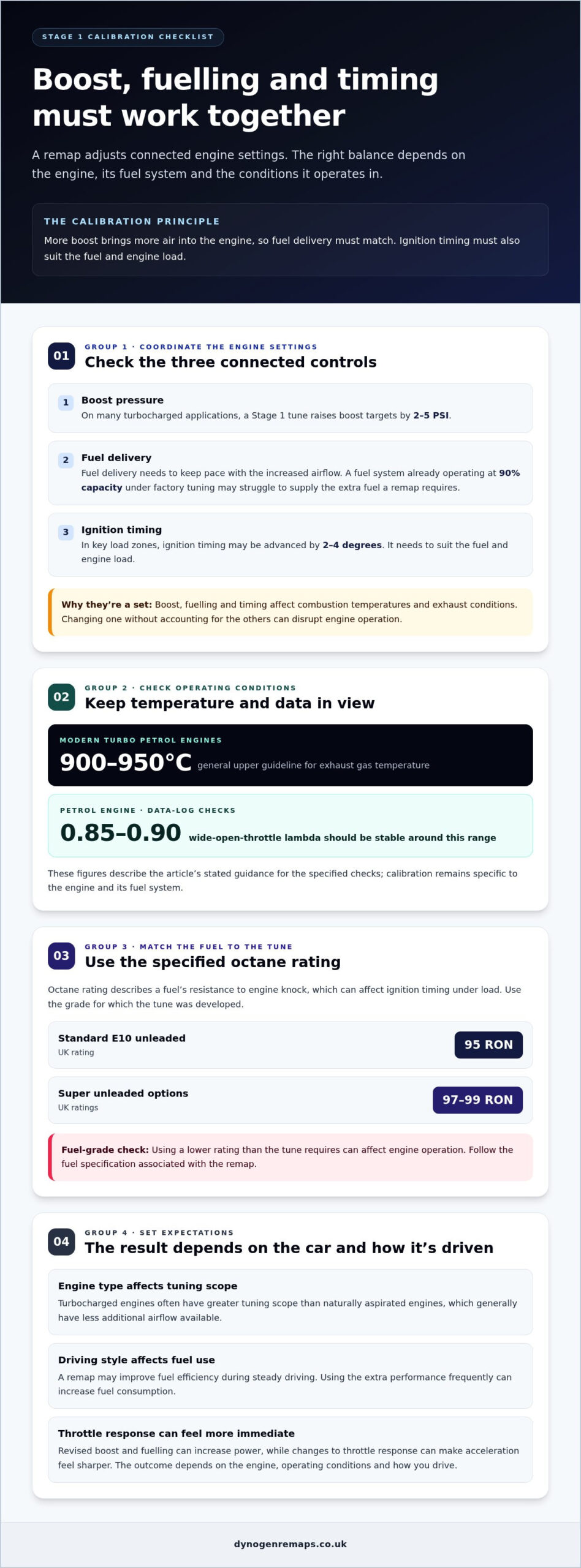
A Stage 1 ECU remap changes engine settings, including boost pressure, fuel delivery and ignition timing. These adjustments work together to increase performance while keeping the calibration within the engine’s operating limits.
Calibrating fuel, boost and timing
Calibration adjusts how the control unit manages air and fuel during different engine loads. On many turbocharged applications, a Stage 1 tune raises boost targets by 2 to 5 PSI and advances ignition timing by 2 to 4 degrees in key load zones.
More boost forces more air into the engine, so fuel delivery must match the increased airflow. Ignition timing also needs to suit the fuel and engine load. These settings affect combustion temperatures and exhaust conditions, so changing one without accounting for the others can disrupt engine operation.
Calibration is specific to the engine and its fuel system. For example, a system already operating at 90% capacity under factory tuning may struggle to supply the extra fuel a remap requires. Fuel, boost and timing must work as a coordinated map, rather than as separate targets.
Performance and fuel-efficiency effects
Revised boost and fuelling can increase power, while changes to throttle response can make acceleration feel more immediate. Turbocharged engines often have greater tuning scope than naturally aspirated engines, which generally have less additional airflow available.
A remap may also improve fuel efficiency, but driving style matters. Using the extra performance frequently can increase fuel consumption, even if the calibration is more efficient during steady driving. The result depends on the engine, operating conditions and how you drive.
Calibration also has to account for combustion and exhaust temperatures. For modern turbo petrol engines, 900-950°C is a general upper guideline for exhaust gas temperature. During data-log checks, wide-open-throttle lambda on a petrol engine should be stable around 0.85-0.90.
Fuel grade requirements for a remap
Use the fuel octane rating for which the tune was developed. Octane rating describes a fuel’s resistance to engine knock, which can affect ignition timing under load.
In the UK, standard E10 unleaded is 95 RON, while super unleaded options are rated at 97-99 RON. The required grade depends on the calibration, so using a lower rating than the tune requires can affect the engine’s operation. Follow the fuel specification associated with the remap, especially when filling the tank.
Stage 1 software remapping on a standard car
A Stage 1 remap changes the calibration stored in a vehicle’s engine control unit, usually while retaining standard major hardware. The distinction matters because added parts, engine condition and software settings can all affect the finished setup.
Supporting modifications and safety tolerances
A typical Stage 1 tune uses software changes on a near-standard car, rather than requiring mechanical modifications. Some setups include a light upgrade, such as an air filter or cat-back exhaust, but these parts don’t define the stage on their own.
A remap changes how the engine operates, including its power and torque delivery. Increased output can expose an existing fuel, ignition, cooling or mechanical problem under greater engine load. Have any known fault addressed before changing the calibration.
Safety depends on matching the calibration to the vehicle and staying within manufacturer tolerances. A Stage 1 tune isn’t automatically safe simply because the original hardware remains fitted. A suitable calibration accounts for the car’s condition and the limits of its standard components.
Many modern vehicles can be programmed through the diagnostic port, but the method depends on the ECU. The original file can be retained and restored to return the software to its previous calibration. Reversing a remap doesn’t undo wear or repair mechanical problems caused by a fault.
Insurance disclosure, legality and MOT effects
Tell your insurer about a remap because it modifies the vehicle. Insurers need accurate information about changes, including software modifications that involve no visible parts. Disclosing the remap helps keep your policy details accurate.
A Stage 1 remap doesn’t alone establish whether a car is legal for road use or will pass its MOT. The vehicle must remain compliant with emissions requirements; removing a catalytic converter or fitting a high-flow downpipe may make it non-compliant. Emissions-affecting hardware changes therefore need separate consideration from an ECU software calibration.
An MOT result relates to the vehicle presented for inspection, not simply its tuning-stage label. For example, a Stage 1 calibration on standard hardware is different from a setup that removes or changes emissions equipment. The stage name cannot establish emissions compliance or predict an MOT result.
A remap may also affect a manufacturer or dealership warranty if detected. Read the warranty terms before changing the ECU calibration and consider how the modification could affect a future claim. Being able to restore the original file doesn’t guarantee that a previous remap will go undetected.
Factory calibration and emissions compromises
Factory ECU calibration balances power delivery, fuel use, emissions and reliable operation across changing conditions. A manufacturer must account for different temperatures, fuel quality and driving loads. Factory settings therefore serve a broad range of vehicles and operating conditions, rather than one driver’s priorities. One estimate places unused potential power within factory settings at 15-25%, although the available scope varies by engine and original calibration. A Stage 1 remap adjusts that balance through software, without automatically replacing the engine’s hardware.
Factory compromises help explain why tuning isn’t simply a matter of raising output. The ECU coordinates fuel delivery, boost and ignition timing, and each adjustment affects engine operation. For example, advancing timing or increasing boost changes combustion conditions, so the calibration must account for the engine’s operating limits. The same adjustment won’t necessarily suit every vehicle, even when two cars share a manufacturer or engine family.
Emissions are also part of the calibration balance. A Stage 1 remap can improve fuel economy and reduce emissions, but those outcomes depend on the software and how the engine is operated. Changes to the air intake, intercooler or exhaust hardware can alter the conditions the calibration must manage. That’s why a software change and a hardware change shouldn’t be treated as interchangeable: each can affect airflow and engine operation differently.
For UK drivers, the key is to consider the whole vehicle, not just its advertised power output. A standard air intake and intercooler create different conditions from upgraded parts, while changes to ignition timing affect combustion. The original calibration also shapes the available tuning scope. A car tune should account for the specific engine, fitted hardware and intended use, rather than applying a generic adjustment across a model range. Factory calibration is a compromise by design; remapping changes that balance, not the vehicle’s underlying mechanical specification.
Warranty and insurance considerations
Yes, a Stage 1 remap can affect a car’s warranty and insurance in the UK. A manufacturer or dealership warranty may be voided if the remap is detected, and insurers should be told about vehicle modifications.
Warranty implications
A remap changes the engine’s ECU calibration and can affect how a warranty claim is assessed. If a fault relates to the engine or its control system, the modification may be relevant. A warranty may be voided if a remap is detected, so review the terms before changing the software.
Warranty cover and the cause of a fault are separate considerations. For example, an ECU change concerns engine management, while an unrelated component fault may be covered by different terms. The warranty wording and diagnosed fault matter, so don’t assume every claim will be rejected or unaffected.
Keep a clear record of the work, including which software was changed and whether standard hardware remained fitted. This gives you accurate information if a garage or warranty provider asks about the car’s calibration. A diagnostic assessment can help distinguish a software-related concern from an existing mechanical problem, such as an issue with cooling or fuel delivery.
Insurance implications
Tell your insurer about a remap because it modifies the vehicle. This applies even when the change is software-only, with no visible upgrade to the intake, exhaust or other hardware. Accurate details help the insurer assess the modified car against your policy information.
Describe the change clearly rather than relying on the phrase “Stage 1”. Tuning-stage labels aren’t standardised, so explain whether the car has an ECU remap and whether supporting parts were fitted. For instance, a standard-hardware calibration differs from a setup that also includes an upgraded air intake or exhaust.
Keep the insurer’s response with your vehicle records, alongside the remapping details. If the car’s software or hardware changes again, update the information you provide. A later upgrade can change the vehicle beyond the original remap, making an old description inaccurate.
Before proceeding, weigh the potential warranty impact against your performance goals, then disclose the change to your insurer. For guidance on a Stage 1 performance remap and its implications, discuss your requirements with a remapping specialist.
Dynogen Remapping Solutions: Stage 1 Performance Remap
Dynogen Remapping Solutions offers a Stage 1 Performance Remap for drivers seeking a software change aimed at improving engine performance. It’s a relevant next step if you’ve weighed the effects on fuel use, warranty and insurance, and want to explore a remap for your vehicle.
If fuel economy is your priority, Dynogen Remapping Solutions also offers an Economy Remap. The right option depends on what you want from your vehicle and how you use it. Consider the trade-offs above before deciding which approach suits your driving needs.
To discuss a Stage 1 Performance Remap, contact Dynogen Remapping Solutions.
Choose a remap that fits your plans
Before deciding, consider what you want the car to do in everyday use. A sharper response may appeal on familiar roads, while you may prioritise efficiency, predictable running costs or keeping the vehicle close to its original specification. Knowing what matters most gives you a clearer basis for discussing your options.
If you’re still asking what a Stage 1 tune means for your own car, focus on the vehicle’s condition, intended use and your responsibilities as its owner. A considered decision accounts for more than the potential change in performance. It also considers how a modification fits your plans for the vehicle over time.
Dynogen Remapping Solutions can help you explore the next step for your vehicle. Contact Dynogen Remapping Solutions to discuss your requirements and move forward with confidence.
Frequently Asked Questions
Is Stage 1 safe for my engine?
A Stage 1 tune isn’t automatically safe simply because it uses standard hardware. Engine condition, calibration quality and manufacturer tolerances all matter. An existing fault in the fuel, ignition or cooling system may become more apparent under increased load. Before remapping, consider whether the car runs properly and whether diagnostic checks reveal issues that should be addressed first.
What Is a ‘Stage 1’ Tune?
A Stage 1 tune is an ECU software calibration intended to improve engine performance on a car with standard major hardware. If you’re asking what a Stage 1 tune is in practical terms, it changes engine-control settings rather than automatically adding a turbocharger or other major parts. The exact calibration and result depend on the vehicle’s engine and original settings.
So, What Does Stage 1 Actually Mean?
Stage 1 indicates a tuning category, not a guaranteed parts list or power figure. It usually describes software changes for a near-standard vehicle, although some setups include light supporting upgrades. Since tuners use stage labels differently, ask what the particular setup includes. For example, clarify whether an air filter or exhaust part is part of the calibration package or remains unchanged.
What Is a Stage 1 Remap?
A Stage 1 remap is a change to the calibration stored in the vehicle’s engine control unit. On many modern cars, the software is programmed through the vehicle’s electronics rather than by replacing an ECU chip. The method depends on the ECU. This distinction helps explain why “remap” describes the software work, while “Stage 1” describes its tuning category.
Why do other tuners define the stages differently?
There’s no industry-wide standard defining the modifications or calibration each tuning stage must include. Tuners use their own definitions, often shaped by the vehicle platform, available supporting hardware and intended performance level. One business might classify a particular intake upgrade differently from another. Compare the actual parts and software changes rather than assuming matching stage labels mean the work is the same.
Can I go straight to Stage 2 without doing Stage 1 first?
Stage 1 isn’t a universal prerequisite for Stage 2. The stage names describe types of setup, not mandatory steps that every vehicle must follow. Stage 2 commonly combines an ECU remap with supporting hardware, such as intake or exhaust changes. The relevant question is whether the vehicle has the hardware required for its intended calibration, not whether it previously carried a Stage 1 label.
Can a remap be reversed?
A remap can be reversed if the original ECU file has been retained and can be restored. This returns the software to its previous calibration, but doesn’t undo physical modifications fitted separately. Keep a record of the remap and any hardware changes, particularly if the car later returns to standard software or is assessed for a fault or warranty claim.
Does Stage 1 or 2 affect my warranty or insurance?
Either remap may affect warranty cover if detected, and you should tell your insurer about vehicle modifications. Before tuning, read the warranty terms and establish what information the insurer needs. Describe the ECU change and any supporting hardware accurately. For example, a software-only remap and a Stage 2 setup with exhaust modifications are not identical changes to the vehicle.