

Your vehicle’s engine is currently operating under a digital straightjacket, restricted by generic factory settings designed for the lowest common denominator of global fuel quality and environmental extremes. It’s a common frustration to feel a sluggish throttle response or hit a flat spot just when you need a burst of acceleration for a safe overtake on a busy A-road. You might find yourself wondering, what does a stage 1 remap do to bridge the gap between standard factory output and the car’s true mechanical capability without touching a single physical component?
At Dynogen Remapping Solutions, we specialise in removing these artificial limitations to reveal the performance your car was always meant to deliver. This guide explores how professional software calibration unlocks hidden reserves of power and torque whilst actually improving your fuel economy on long motorway runs. We’ll detail the precise process of recalibrating your engine control unit to create a smoother, more responsive drive that feels entirely transformed. You’ll discover how our fifteen years of technical expertise ensures these significant gains are delivered safely, providing the perfect balance of driving exhilaration and long-term mechanical reliability.
Key Takeaways
- Understand how Stage 1 remapping removes artificial factory restrictions to align your engine’s software with its true mechanical capability.
- Discover exactly what does a stage 1 remap do by recalibrating turbo boost and fuel timing to unlock significant power gains safely.
- Identify the real-world benefits of increased torque, including sharper throttle response and reduced gear hunting during motorway overtakes.
- Gain peace of mind by exploring the mechanical safety margins that allow for performance enhancements without compromising engine longevity.
- Learn why bespoke software calibration is superior to generic files, ensuring your vehicle receives a personalised map tailored to its specific condition.
What is a Stage 1 Remap and Why Do Manufacturers Restrict Power?
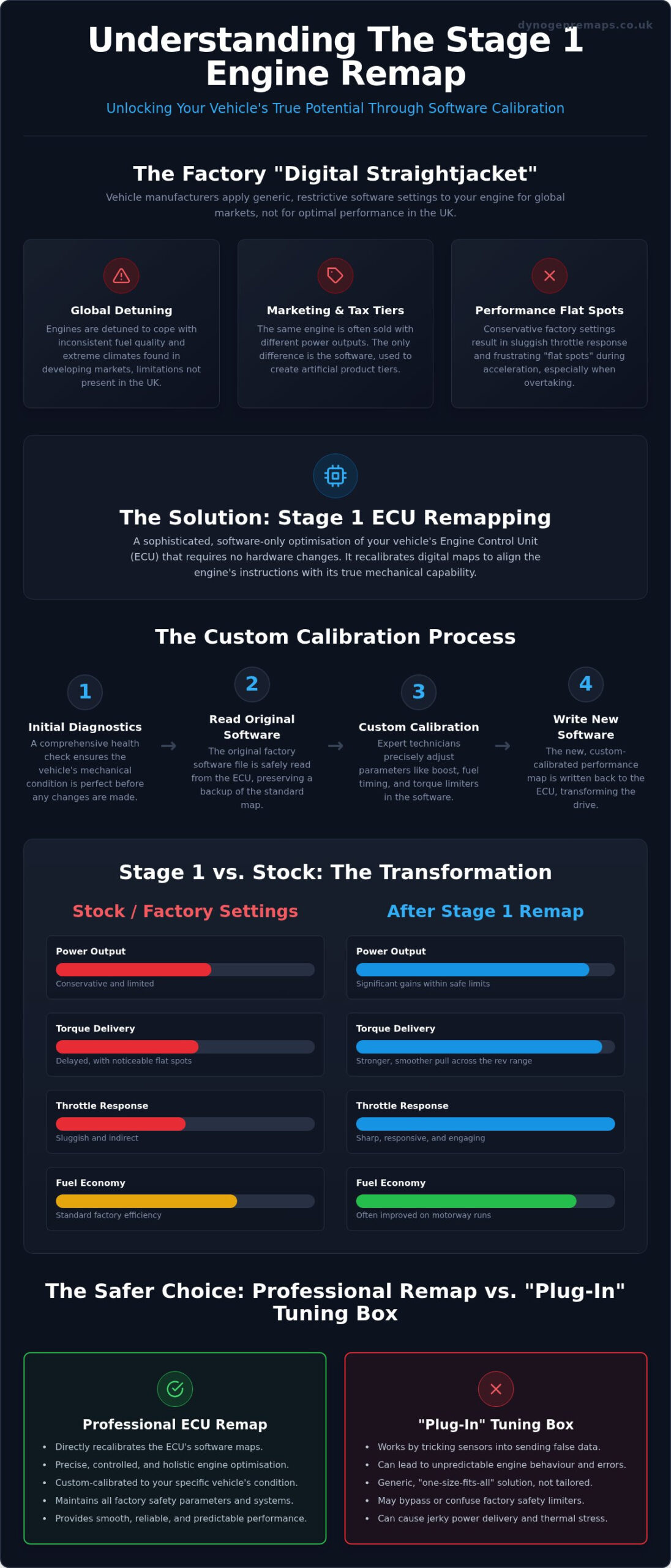
A Stage 1 remap is a sophisticated software-only optimisation of your vehicle’s Engine Control Unit (ECU). Unlike more intensive modifications, it requires no physical hardware changes; the process focuses entirely on recalibrating the internal digital maps that govern engine behaviour. Many drivers ask, what does a stage 1 remap do to fundamentally change a car’s character? By rewriting the factory code, we unlock the latent performance that manufacturers intentionally leave on the table during the production phase. This process, often referred to as Chip tuning, is the most cost-effective way to enhance a modern vehicle whilst maintaining its original mechanical integrity.
Manufacturers typically employ a “Global Calibration” strategy when developing engine software. They must ensure a vehicle performs reliably in every corner of the world, from the extreme heat of the Sahara to the high altitudes of the Andes. To achieve this, they detune engines to accommodate poor fuel quality and neglected maintenance schedules in developing markets. In the United Kingdom, where we have access to high-grade fuels and temperate weather, these restrictive factory settings are unnecessary. As we move through 2026, The Ultimate Guide to Stage 1 Performance Remapping serves as the definitive resource for UK drivers looking to reclaim this lost potential.
The ECU: The Brain of Your Vehicle
The ECU acts as the central nervous system of your car, constantly managing ignition timing, fuel delivery, and turbocharger boost pressure. Factory software is often engineered to be conservative, not for safety, but to meet specific tax brackets or to differentiate between various marketing tiers in a manufacturer’s line-up. For example, a single engine might be sold with three different power outputs, with the only difference being the software installed at the factory. In the era of software-defined performance, a Stage 1 remap simply aligns the engine’s digital instructions with its true mechanical capability. Specialists like N2 Speed take this further for American brands, providing the critical PCM and TCM unlocking required to access and recalibrate these restricted factory modules.
Stage 1 vs. Tuning Boxes
It is vital to distinguish professional ECU remapping from “plug-and-play” tuning boxes. While tuning boxes are often marketed as a convenient alternative, they typically work by tricking sensors into sending false data to the ECU, which can lead to unpredictable engine behaviour. Direct ECU recalibration is a far more precise and safer method. At Dynogen, we always begin with a comprehensive diagnostic labour session. This ensures the vehicle is in peak mechanical health before any software is installed, providing a level of precision and longevity that generic boxes simply cannot match.
The Technical Architecture of a Stage 1 Performance Upgrade
To understand what does a stage 1 remap do on a technical level, one must look at the digital architecture of the Engine Control Unit (ECU). The process begins with a precision read of the original factory software file. This file contains thousands of individual maps that dictate how the engine reacts to every driver input. Our specialists then create a custom-calibrated version of this software, adjusting specific parameters to align with the mechanical potential of your specific vehicle. Unlike generic “chip” files, this bespoke approach ensures that every adjustment is made with surgical precision, respecting the unique wear and tear of your engine.
Advanced tuning software allows us to maintain the integrity of all factory safety maps whilst enhancing performance. We pay particular attention to the Lambda correction, which monitors the air-fuel ratio (AFR) in real time. By ensuring the AFR remains optimal across the entire rev range, we guarantee that the engine runs efficiently without the risk of running “lean” or “rich”. This technical rigour is why many enthusiasts choose professional ECU calibration over unverified alternatives.
Optimising Boost and Fuel Duration
In turbocharged vehicles, increasing boost pressure safely within manufacturer-defined tolerances provides that characteristic “shove” in the back during acceleration. This increase in air volume must be perfectly matched with fuel duration to ensure clean combustion and prevent excessive exhaust gas temperatures (EGTs). If fuel is injected for too long or at the wrong moment, it can lead to thermal stress on the turbocharger and internal components. Torque limiters are the digital ceilings placed on engine output by the factory. By precisely lifting these ceilings, we allow the engine to produce its maximum available torque without overstressing the gearbox or clutch.
Ignition Timing and Throttle Response
For petrol engines, advancing ignition timing is a key lever for improving both efficiency and power. By initiating the spark slightly earlier in the combustion cycle, we ensure that the maximum pressure from the fuel burn occurs at the optimal point of the piston’s stroke. This results in more work being extracted from every drop of fuel. We also focus heavily on the drive-by-wire throttle map. Most modern cars suffer from a programmed lag between your foot moving and the engine reacting. Recalibrating this map is essential for improving car drivability with remapping, as it eliminates that frustrating initial hesitation and makes the vehicle feel significantly more alert.
Stage 1 vs. Stock: Transforming the Road Experience
The transition from a factory-standard vehicle to one with a professional software calibration is immediately noticeable from the first pull away. Whilst the technical data provides the evidence, the real-world transformation is found in how the car interacts with the road. When considering what does a stage 1 remap do for your daily commute, the most significant change is the surge in mid-range torque. This allows for effortless cruising on motorways with far fewer downshifts required to maintain pace or execute an overtake. Instead of the engine feeling strained, it operates with a newfound sense of urgency and poise.
Modern turbocharged engines are frequently plagued by “flat spots” or hesitations in the power delivery, often programmed by manufacturers to meet specific emissions cycles. Our Stage 1 process effectively iron outs these inconsistencies, providing a linear and predictable sweep of power from the bottom of the rev range to the top. This refined delivery is particularly beneficial for those using their vehicles for more demanding tasks. If you frequently pull heavy loads, remapping for towing power ensures that your vehicle has the necessary grunt to handle inclines and motorway merges without the engine gasping for breath. The result is a more confident, responsive driving experience that removes the stress of sluggish throttle response.
BHP vs. Torque: What Actually Moves You?
In the world of tuning, Brake Horsepower (BHP) often gets the headlines, but torque is the figure that defines your daily driving experience. BHP determines your top-end speed, whilst torque is the force that provides acceleration and pulling power. For a typical 2.0 TDI engine common on UK roads, a stock output of 150 BHP and 320 Nm of torque can often be increased to roughly 190 BHP and 420 Nm. This 100 Nm increase in torque is what transforms a car from feeling “adequate” to feeling genuinely powerful. It’s the difference between waiting for the turbo to spool and having instantaneous access to the power you need to merge safely into fast-moving traffic.
Drivability and Smoothness
A professional remap is not about creating a “spiky” or aggressive car that is difficult to drive in town. It’s about enhancing the power delivery curve to ensure every gear change and throttle input feels deliberate and smooth. This is especially true for vehicles equipped with automatic or dual-clutch (DSG) gearboxes. By recalibrating the engine software to work in harmony with the transmission’s shift points, we eliminate the clunky or indecisive behaviour often found in factory setups. Our commitment to Safe Engine Remapping: Increase Torque and Power ensures that whilst the performance is vastly improved, the vehicle remains as refined and easy to live with as the day it left the showroom.
Safe Engine Tuning: Reliability and Maintenance in the UK
A frequent concern for owners considering performance upgrades is the potential impact on long-term mechanical health. It’s vital to understand that vehicle manufacturers engineer engines with substantial safety margins to account for neglected servicing and substandard fuel in global markets. When asking what does a stage 1 remap do for reliability, the answer lies in utilising these existing margins without exceeding them. By optimising the software, we often find that engine health actually improves. Increased low-end torque prevents the engine from labouring in high gears, which reduces the mechanical stress on internal components during motorway cruising.
In the United Kingdom, transparency regarding vehicle modifications is a legal necessity. You must declare a Stage 1 remap to your insurance provider to ensure your policy remains valid. Whilst some drivers fear a significant hike in premiums, many insurers now recognise professional remapping as a standard modification. Research indicates that declaring a remap can lead to an average premium increase of up to 15.9 per cent, though this varies significantly between providers. Ensuring your vehicle is legally compliant is as essential as the technical quality of the software itself.
The Myth of Reduced Engine Life
The idea that a software upgrade inevitably shortens an engine’s lifespan is a persistent misconception. In reality, engine failures are almost always the result of poor maintenance or the use of generic files that ignore safety protocols. Our approach ensures that component protection maps, such as exhaust gas temperature limits, remain fully operational to safeguard the turbocharger and pistons. For a deeper dive into these technical safeguards, read our Safe Engine Tuning UK: Expert Myth-Busting guide. When a vehicle is maintained with high-quality oils and regular filter changes, a professional remap is a safe and sustainable enhancement.
Preparing Your Vehicle for Tuning
Peak performance requires a solid mechanical foundation. Before any software is installed, a comprehensive health check is non-negotiable. This diagnostic phase identifies underlying issues like minor boost leaks or DPF soot accumulation that could be exacerbated by increased power. We also recommend using premium fuels, such as 99 RON petrol or high-cetane diesel, to allow the ECU to advance timing safely for maximum efficiency. To understand why this preparation is critical for the best results, explore the ECU remapping benefits available to well-maintained cars. Ready to transform your drive? Contact our specialist team today to check your vehicle’s compatibility.
The Dynogen Approach: Custom-Calibrated Performance Software
With over fifteen years of industry experience, Dynogen Remapping Solutions operates as a seasoned specialist at the leading edge of vehicle software technology. We reject the “one-size-fits-all” approach prevalent in many corporate tuning franchises, instead adhering to a strict per-vehicle philosophy. No two engines are identical; manufacturing tolerances, mileage, and previous maintenance history create a unique mechanical profile for every car that enters our care. This is why we develop bespoke software calibrations rather than relying on generic, pre-written files that often fail to account for these critical variables.
When considering what does a stage 1 remap do in a professional setting, the focus must be on the quality of the digital interface. We utilise advanced diagnostic and programming equipment to communicate safely with your vehicle’s ECU, ensuring a stable and secure data transfer. This elite-level service is not restricted by geography; our national UK service coverage ensures that drivers across the country can access our specialised expertise. We pride ourselves on delivering a personalised alternative to dealership software, providing results that are both aspirational in performance and grounded in technical excellence. This level of brand-specific dedication is mirrored by specialists like PowerUP Szczecin, who provide expert care for the Audi, BMW, and Mercedes groups.
Our calibration process extends beyond simple power increases to provide a holistic performance solution. We meticulously balance raw output with operational efficiency, ensuring that your vehicle remains a practical daily driver. For those prioritising fuel savings, our expertise in Diesel economy tuning UK demonstrates how precision software can reduce fuel consumption whilst maintaining a responsive drive. We also provide technical support for emissions-related software, including DPF and AdBlue solutions, to ensure your vehicle’s systems operate in perfect harmony.
Booking Your Professional Remap
The journey begins with a consultative diagnostic process where we identify your specific driving goals. Whether you require safer overtaking power for the motorway or enhanced torque for towing, we tailor the software to meet those exact requirements. This methodical approach provides the reassurance that only a specialist with a deep understanding of ECU architecture can offer. We remain committed to the pursuit of perfection in every file we write, ensuring your complete satisfaction with the end result. Unlock your vehicle’s true potential with a Dynogen Stage 1 Remap today and experience the difference that expert calibration makes.
Reclaim Your Vehicle’s True Performance
Modern vehicles are capable of far more than their factory settings suggest. By removing the artificial restrictions imposed by global calibrations, you gain access to a driving experience defined by smoothness, precision, and untapped power. Understanding exactly what does a stage 1 remap do is the first step toward a superior journey; it’s the alignment of sophisticated software with the genuine mechanical potential of your engine. This transformation provides sharper throttle response and safer overtaking power whilst often improving fuel efficiency on long motorway runs.
At Dynogen Remapping Solutions, we bring over 15 years of technical expertise to every vehicle we tune. We refuse to use generic files; instead, we provide bespoke, custom-calibrated software tailored to your car’s specific condition and your personal driving goals. Our professional national service ensures that elite-level tuning is accessible across the UK, giving you the peace of mind that comes from a specialist installation. Don’t settle for the compromises of factory software when peak performance is within reach. Book Your Custom Stage 1 Remap with Dynogen Today and experience the road as it was meant to be felt.
Frequently Asked Questions
Is a Stage 1 remap safe for my car’s engine long-term?
A Stage 1 remap is entirely safe for a well-maintained engine because it operates within the manufacturer’s original mechanical safety margins. At Dynogen, we utilise bespoke software calibrations that respect component limits rather than using generic files. This ensures that whilst you enjoy enhanced performance, the long-term reliability of the engine remains uncompromised. Regular servicing with high-quality oils is the only additional requirement to maintain this peak operational health.
Will a Stage 1 remap void my manufacturer warranty?
Modifying your vehicle’s software can potentially void the powertrain section of your manufacturer warranty. Most dealerships use advanced diagnostic tools that can detect changes to the ECU’s flash counter or checksums. Whilst a Stage 1 remap is a software-only upgrade, it is vital to check your specific warranty terms. We recommend discussing this with your provider if you have concerns about maintaining a valid manufacturer-backed guarantee on a new vehicle.
How much extra BHP and torque can I expect from a Stage 1 remap?
Most turbocharged petrol and diesel engines see an increase of 20 to 35 per cent in both BHP and torque. For example, a standard 2.0-litre diesel engine might see gains of 40 BHP and 80 Nm of torque. When people ask what does a stage 1 remap do for their specific car, the answer depends on the factory’s original level of detuning. Naturally aspirated engines typically see smaller gains of around 5 to 10 per cent.
Do I need to upgrade my brakes or suspension for a Stage 1 tune?
Hardware upgrades like uprated brakes or stiffer suspension are not required for a Stage 1 performance remap. This level of tuning is specifically engineered to work in perfect harmony with your vehicle’s factory-standard components. Manufacturers build cars with significant tolerances to handle varied driving conditions; our software simply utilises these existing capabilities. If you decide to progress to Stage 2 or Stage 3 later, physical hardware modifications would then become necessary.
Can a Stage 1 remap improve my fuel economy (MPG)?
A Stage 1 remap can certainly improve fuel economy, particularly in diesel vehicles used for motorway cruising. By increasing the available torque lower down the rev range, the engine doesn’t have to work as hard to maintain speed. This often results in fewer downshifts and improved MPG during steady-state driving. Whilst the primary goal is performance, many drivers report a noticeable reduction in fuel consumption when maintaining their usual driving style.
Do I need to tell my insurance company about a Stage 1 remap?
You must declare a Stage 1 remap to your insurance company as it is classified as a performance modification in the United Kingdom. Failing to disclose this change can invalidate your policy, leaving you unprotected in the event of a claim. Whilst some providers may increase premiums by an average of 15.9 per cent, many specialist insurers offer competitive rates for modified vehicles. Transparency is essential for staying legally compliant on UK roads.
Can the remap be uninstalled if I sell the car?
We can easily revert your vehicle to its original factory settings if you decide to sell the car or return it to a dealership. During the initial process, we take a complete backup of your original ECU software. Reinstalling this factory file is a straightforward procedure that restores the vehicle to its stock performance levels. This flexibility is one of the key advantages of a software-only Stage 1 performance upgrade.
How long does the remapping process take to complete?
The entire remapping process typically takes between 1.5 and 3 hours to complete. This duration includes a comprehensive pre-tuning diagnostic health check to ensure your engine is fit for the upgrade. We then read the original software, create a custom-calibrated file, and write it back to the ECU. When considering what does a stage 1 remap do for your schedule, it is a relatively quick procedure with immediate results.