

Why should your vehicle’s true potential remain locked behind a generic factory setting designed for the lowest common denominator? Most owners select a diesel for its legendary torque and longevity, yet many find themselves battling a sluggish throttle response or a frustrating lack of overtaking power when it matters most. You likely understand that your engine is capable of more, especially when those fuel costs start to climb whilst you are towing heavy loads.
This guide explores the precision world of turbo diesel performance tuning in 2026, where professional software recalibration serves as the key to unlocking significant gains. We promise to show you how bespoke Stage 1 remapping delivers smoother power and improved MPG without sacrificing the mechanical integrity of your vehicle. By moving beyond crude hardware fixes, we will examine the sophisticated diagnostic process and technical solutions that transform your driving experience into something truly exceptional.
Key Takeaways
- Modern engine optimisation has evolved from physical “chipping” to sophisticated ECU recalibration, allowing for precise control over vehicle dynamics.
- Professional turbo diesel performance tuning unlocks hidden power by safely adjusting boost pressure and fuel injection timing for a more responsive drive.
- You can achieve a superior balance of performance and economy because increased torque allows for fewer gear changes and better MPG whilst cruising.
- Custom-calibrated software ensures reliability by maintaining engine parameters within 80-90% of their mechanical limits, protecting components such as the DPF.
- Selecting a bespoke Stage 1 Performance Remap over generic alternatives is essential for achieving a refined result that respects your engine’s specific health and history.
What is Turbo Diesel Performance Tuning?
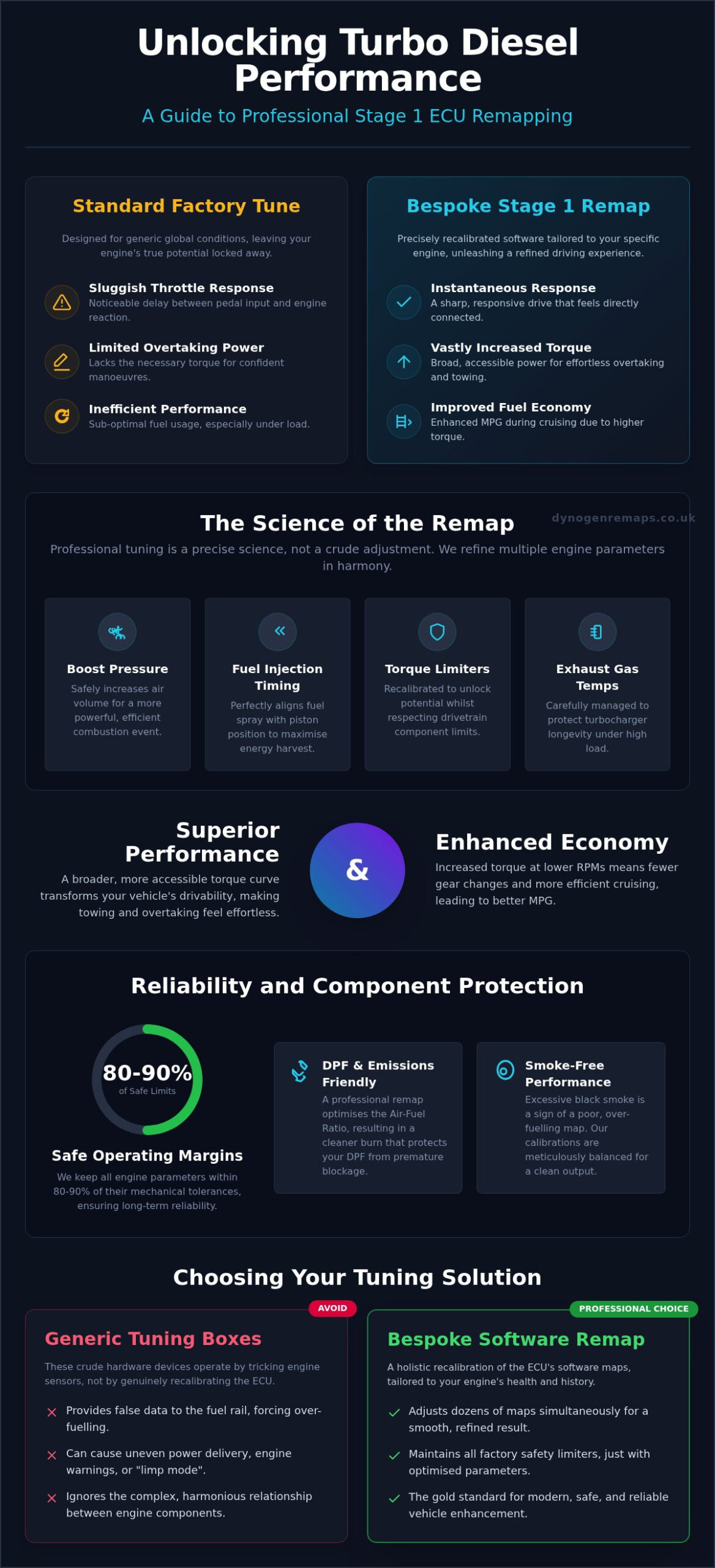
Turbo diesel performance tuning is the precise recalibration of the factory software housed within your vehicle’s Engine Control Unit (ECU). Rather than adding physical components, we refine the digital instructions that govern fuel delivery, turbocharger boost, and ignition timing. Manufacturers typically build engines with significant “headroom,” detuning them to survive poor maintenance or sub-standard fuel in global markets. We reclaim this lost potential through professional software remapping, offering a more refined driving experience than generic plug-in tuning boxes that merely “trick” the engine sensors into requesting more fuel.
Generic hardware boxes often fall short because they operate by intercepting signals to the fuel rail, providing the ECU with false data to force a change in behaviour. This crude method can lead to “limp mode” or uneven power delivery. In contrast, bespoke software remapping adjusts dozens of different maps simultaneously, maintaining a harmonious relationship between all engine components. This holistic approach is why professional turbo diesel performance tuning is considered the gold standard for modern vehicle enhancement, ensuring that safety limiters remain active whilst performance is maximised.
The Evolution of Diesel Tuning Technology
The industry has shifted dramatically from the days of physical “chipping,” where technicians were required to solder new memory chips onto the circuit board. Modern engine management relies on high-pressure common rail injection, which allows for microscopic precision in how fuel enters the cylinder. By 2026, ECUs have become sophisticated hubs of data, often requiring advanced bench remapping techniques to access protected memory sectors safely. This evolution means we can now achieve smoother power delivery and better reliability than was possible even five years ago, provided the specialist understands the latest encryption protocols.
Why Diesel Engines Respond So Well to Tuning
Diesel engines are the ideal candidates for software optimisation because of their robust internal construction. Built to handle high compression ratios, their reinforced internals can easily manage the increased torque generated by a Stage 1 Performance Remap. The presence of a turbocharger is the deciding factor; by adjusting the volume of air forced into the combustion chamber, we can significantly increase power without overstressing the engine block. This process optimises the combustion cycle, ensuring that every drop of fuel is converted into useful kinetic energy rather than wasted heat or excessive soot.
The Science of the Remap: How Software Changes Performance
Adjusting boost pressure allows us to safely increase the volume of air entering the cylinder, creating the necessary environment for a more powerful combustion event. By refining the digital instructions sent to the turbocharger, we ensure that this extra air is delivered precisely when the engine requires it most. This isn’t a crude increase in pressure; it’s a calculated enhancement that respects the mechanical limits of the turbine and its associated cooling systems.
Optimising fuel injection timing ensures that the spray duration and start point are perfectly aligned with the piston’s position, maximising the energy harvested from every stroke. In a factory setting, these timings are often conservative to account for varied fuel qualities across different continents. We recalibrate these maps to take advantage of high-quality UK fuels, resulting in a more efficient burn that delivers immediate power whilst reducing internal stress on the engine components.
Torque limiters act as a digital safety net within the ECU. Whilst we unlock the engine’s hidden potential, we ensure these parameters remain within the structural tolerances of your drivetrain, including the gearbox and clutch. Monitoring Exhaust Gas Temperatures (EGTs) is a non-negotiable part of a professional calibration. Excessive heat is the primary enemy of turbocharger longevity, so we maintain temperatures at levels that protect your hardware during sustained high-load scenarios, such as towing or motorway climbing.
Air-Fuel Ratio (AFR) Optimisation
A smoke-free tune is the definitive hallmark of a professional remap, achieved by meticulously balancing increased boost with precise fuel quantities. If you see a diesel vehicle emitting clouds of black soot under acceleration, it’s a clear sign of a poor-quality map that is over-fuelling. In the context of diesel performance, the Air-Fuel Ratio (AFR) is the exact mass of air required to completely combust a specific mass of fuel without leaving unburnt soot behind. This balance ensures your engine stays clean, protecting your DPF from premature blockage.
Managing Torque Curves for Drivability
Peak BHP figures often grab headlines, yet a broad, accessible torque curve is what truly defines a vehicle’s character on the road. By refining the delivery of power, we can significantly improve car drivability remapping stock settings to provide immediate response for safer overtaking. This tailored approach ensures your vehicle feels lighter and more eager, regardless of the load you’re carrying. If you are curious about how these technical adjustments apply to your specific vehicle, you can explore our range of custom-calibrated software solutions to see the potential gains for your specific model.
Performance vs. Economy: Can You Have Both?
A common misconception amongst vehicle owners is that increasing power must lead to higher fuel consumption. In reality, professional turbo diesel performance tuning often delivers a significant boost to efficiency by embracing the concept of “Blue Optimisation.” By increasing the available torque at lower RPMs, we enable the engine to pull through the gears more effectively, which reduces the frequency of downshifts. When your vehicle isn’t constantly hunting for a lower gear during a climb, it remains in its most efficient operating window, naturally lowering your fuel spend.
A Stage 1 Performance Remap is especially beneficial during steady-state motorway cruising. By refining the injection timing and boost pressure, the engine maintains speed with less effort. It’s a simple mechanical truth that an engine under less stress consumes less fuel. However, we must be clear about the trade-off: whilst the software provides the potential for better MPG, heavy-footed driving will always override these gains. The power is there when you need it, but the economy is there when you drive with precision.
The Mechanics of Fuel Saving
We achieve fuel savings by reducing “pumping losses” through superior turbocharger efficiency. When the turbo provides the correct volume of air without creating excessive backpressure, the engine breathes more easily and consumes less energy during the intake and exhaust strokes. This increased torque allows you to select a higher gear at lower speeds, keeping the RPMs down and the fuel injectors closed for longer. For a comprehensive look at how we achieve these results, you can read our guide to Diesel economy tuning UK.
Performance Tuning for Towing and Commercial Use
For UK caravanners and motorhome owners, the benefit of a custom remap is immediate and transformative. Carrying a heavy load often leaves stock engines breathless, forcing the driver to work the engine hard just to keep up with traffic. Professional tuning provides the grunt needed to pull away smoothly and maintain speed on steep inclines without straining the drivetrain. This isn’t just about comfort; it’s about the Return on Investment (ROI) for commercial operators. Improving the efficiency of a fleet through software can lead to fuel economy gains of 2-5 MPG. You can explore our specialised advice on Van remapping for better MPG to see how these savings accumulate over thousands of miles.
Reliability and Component Protection: Is Tuning Safe?
Professional turbo diesel performance tuning is fundamentally an exercise in managed risk and technical precision. We operate under a strict philosophy of staying within 80-90% of any given component’s mechanical limit, ensuring that a significant safety buffer remains for extreme driving conditions. Manufacturers design engines with these tolerances to account for varied global climates and neglected maintenance; our role is to utilise that headroom without overstepping into the “danger zone” where hardware failure becomes a genuine risk.
The health of your Diesel Particulate Filter (DPF) is a primary concern during the calibration process. A sophisticated remap ensures that the engine produces minimal soot, which prevents the DPF from becoming overwhelmed and requiring frequent, fuel-heavy regeneration cycles. Conversely, a poor-quality map often results in excessive carbon buildup, leading to premature EGR (Exhaust Gas Recirculation) valve failure and costly repair bills. We perform a comprehensive diagnostic health check before any software is applied, ensuring your vehicle is mechanically sound enough to handle the increased output safely.
Protecting the Turbocharger and Drivetrain
Advanced software recalibration prevents the turbocharger from “over-speeding,” a condition where the turbine spins beyond its structural integrity. By carefully managing boost request maps, we ensure the turbo remains within its efficient operating window, protecting the bearings and seals from premature wear. On manual vehicles, we specifically tailor the torque delivery to prevent clutch slip, ensuring the power is accessible without compromising the lifespan of your drivetrain components. You can learn more about our commitment to Safe engine tuning UK standards to understand how we balance power with longevity.
The Importance of Maintenance Post-Remap
High-quality, fully synthetic oil is a non-negotiable requirement for any tuned diesel engine. Because the engine is working more efficiently and producing more torque, the thermal load on the lubricant increases slightly. We recommend shortening your service intervals by approximately 20% to ensure the oil retains its protective properties and keeps internal components clean. The idea of “set and forget” tuning is a myth; a performance-orientated vehicle deserves a performance-orientated maintenance schedule. If you are ready to experience the benefits of a professionally calibrated engine, you can book your custom Stage 1 Performance Remap with our specialist team today to ensure your vehicle remains at its peak.
Choosing a Professional Software Solution
Selecting the right specialist is the most important decision you will make for your vehicle’s longevity and performance. The market is currently flooded with cut-price “eBay maps” and generic file-service tuning options that promise high gains for minimal investment. These unverified files often bypass critical safety limiters, leading to catastrophic engine failure or permanent ECU damage. A professional tuning centre provides a reassuringly authoritative alternative, prioritising technical excellence over quick, unrefined results.
A custom Stage 1 Performance Remap stands as the safest and most effective option for any modern vehicle. Unlike generic alternatives, this bespoke approach treats your car as a unique mechanical entity. At Dynogen, we bring over 15 years of technical expertise to every session, ensuring that our calibrations are as precise as they are powerful. We position ourselves as the elite alternative to standard dealership options, offering a personalised service that respects the intricate engineering of your turbo diesel engine.
Custom Calibration vs. Generic Files
Every engine has lived a different life, meaning a “one-size-fits-all” software file is fundamentally flawed. Professional turbo diesel performance tuning relies on real-time data-logging to monitor how your specific engine reacts to pressure and timing adjustments. This methodical process allows us to identify and correct any underlying issues before they become expensive problems. Furthermore, modern ECUs from 2026 often feature sophisticated anti-tune protection and sentinel security protocols. Only high-end, professional-grade equipment can safely navigate these layers to deliver a seamless upgrade without compromising the vehicle’s diagnostic transparency.
Next Steps for Your Vehicle
Preparing your vehicle for a performance upgrade is a straightforward but essential process. We recommend a thorough mechanical inspection to ensure that your turbocharger, injectors, and cooling system are in peak condition. During a professional remapping session, you should expect a comprehensive diagnostic health check followed by the careful application of your custom software. Once the write is complete, a series of road tests confirms that the power delivery is smooth and the torque curve is perfectly linear. If you are ready to unlock the hidden potential of your engine with total confidence, you can Book your Stage 1 Performance Remap with Dynogen today and experience the pinnacle of diesel optimisation.
Unlocking the True Potential of Your Diesel Engine
Turbo diesel performance tuning represents the pinnacle of modern engine management, moving far beyond the limitations of factory settings. By choosing a professional software recalibration, you ensure that your vehicle delivers a smoother, more responsive drive whilst maintaining the reliability of critical components like the DPF and turbocharger. We have explored how increased torque not only improves towing capability but also offers the potential for significant fuel savings during motorway cruising.
With over 15 years of ECU remapping expertise, our team provides bespoke software specifically calibrated for the unique demands of UK roads. We are specialists in DPF and EGR technical solutions, ensuring that every modification is as safe as it is effective. You don’t have to settle for a sluggish throttle or high fuel costs when a refined, professional solution is within reach. Take the next step toward a more capable and efficient vehicle by choosing a specialist who understands the intricate science of your engine.
Optimise your diesel engine with a professional Stage 1 Remap from Dynogen and transform your driving experience today.
Frequently Asked Questions
Will turbo diesel performance tuning damage my engine?
Turbo diesel performance tuning will not damage a healthy engine when performed by a seasoned specialist. Professional recalibration stays within the mechanical tolerances of the engine block and turbocharger, ensuring that safety limiters remain active. We maintain strict control over parameters such as Exhaust Gas Temperatures to protect against overheating. Problems only arise when using unverified files that ignore these structural limits or bypass essential protection layers.
How much extra BHP can I expect from a Stage 1 remap?
Typical gains for a Stage 1 Performance Remap vary by vehicle, but common UK diesel engines like the BMW 2.0d or Ford 2.0 TDCi often see increases of 30 to 50 BHP. Torque improvements are even more significant, providing the immediate response needed for safer overtaking. These results are achieved through precise software optimisation, ensuring the power delivery remains linear and predictable across the entire rev range.
Does remapping a diesel car improve fuel economy?
Turbo diesel performance tuning can improve fuel economy by up to 10% under normal driving conditions. By increasing low-end torque, the engine works less hard to maintain cruising speeds, allowing for earlier upshifts and fewer gear changes. This efficiency gain is most noticeable in vans and motorhomes carrying heavy loads, where the engine is no longer forced to labour aggressively against the weight of the vehicle.
Will a remap affect my MOT or emissions test?
A professional remap will not cause your vehicle to fail a UK MOT or emissions test. We ensure that the Air-Fuel Ratio remains perfectly balanced to prevent excessive soot production that would clog the DPF. As long as your emissions control systems are functioning correctly, the vehicle will continue to meet the required legal standards for smoke opacity and particulate levels without any technical issues.
Can the remap be reversed if I sell the car?
The remapping process is entirely reversible at any time. We always maintain a secure backup of your vehicle’s original factory software on our local servers. If you decide to sell the car or return it to a leasing company, we can simply overwrite the modified map with the stock settings, returning the engine management system to its exact factory state without leaving any physical traces of the modification.
Is a tuning box as good as a proper ECU remap?
A tuning box is a crude alternative that merely tricks sensors into requesting more fuel, whereas a proper ECU remap recalibrates dozens of internal maps simultaneously. Remapping provides a smoother, more refined power delivery and allows for the precise adjustment of boost pressure and injection timing. This holistic approach is far safer for your engine’s long-term health and component longevity compared to generic hardware boxes.
How long does a professional remapping session take?
A standard remapping session typically takes between one and two hours to complete. This timeframe includes a full diagnostic health check, the data-logging of original parameters, and the careful writing of the new custom-calibrated software. More complex ECUs found in 2026 models may require slightly longer if bench remapping is necessary to bypass advanced security protocols and sentinel protection layers housed within the unit.
Do I need to inform my insurance company about a remap?
You are legally required to inform your insurance provider of any performance modification, including software remapping. Failing to disclose the upgrade could invalidate your policy in the event of a claim. Many specialist insurers now recognise the safety and efficiency benefits of professional tuning and often apply only a modest premium increase for the added horsepower and torque your vehicle gains through the recalibration process.