

What if your vehicle’s underwhelming performance isn’t a mechanical limitation, but a deliberate software restriction imposed by the manufacturer? Most drivers simply accept sluggish throttle response and frustrating flat spots as inherent traits of their car or van. This common frustration often leads to a single, pivotal question: what is ECU remapping? At its core, remapping is the sophisticated recalibration of your engine’s Electronic Control Unit to reclaim the performance and efficiency that manufacturers intentionally leave on the table to account for global fuel variations and neglected maintenance schedules.
We understand the desire for a vehicle that feels more responsive and costs less to run, especially when factory-set speed limiters or poor fuel economy hinder your daily operations. This guide promises to demystify the process of professional software tuning, showing you exactly how custom-calibrated maps transform your driving experience. We will examine the tangible benefits of Stage 1 performance and economy remaps, including increased torque and gains of up to 40 bhp on typical diesel engines, whilst explaining why bespoke software is always superior to generic, off-the-shelf alternatives.
Key Takeaways
- Understand what is ECU remapping and how professional software recalibration unlocks the performance manufacturers restrict through global safety margins.
- Discover why engines are factory-tuned for the lowest common denominator in global fuel quality and how custom tuning reclaims that lost efficiency.
- Explore the differences between Stage 1 Performance and Economy Remaps to determine which solution best suits your driving style or fleet requirements.
- Learn about the rigorous diagnostic health checks and OBDII data extraction processes used by specialists to ensure a safe and successful tuning experience.
- Gain insights into how technical emissions solutions for DPF and AdBlue systems can restore vehicle reliability and eliminate frustrating limp-mode errors.
Understanding the ECU: The Brain of Your Vehicle
Every modern vehicle relies on a central processor to manage its complex mechanical functions. This component, the Engine Control Unit (ECU), acts as the brain of your engine, constantly interpreting data to dictate performance and behaviour. It receives a relentless stream of information from various sensors, including the Mass Air Flow (MAF), Manifold Absolute Pressure (MAP), and Oxygen (O2) sensors. By processing these signals in real-time, the ECU makes millisecond adjustments to fuel delivery and ignition timing to keep the engine running within its programmed parameters.
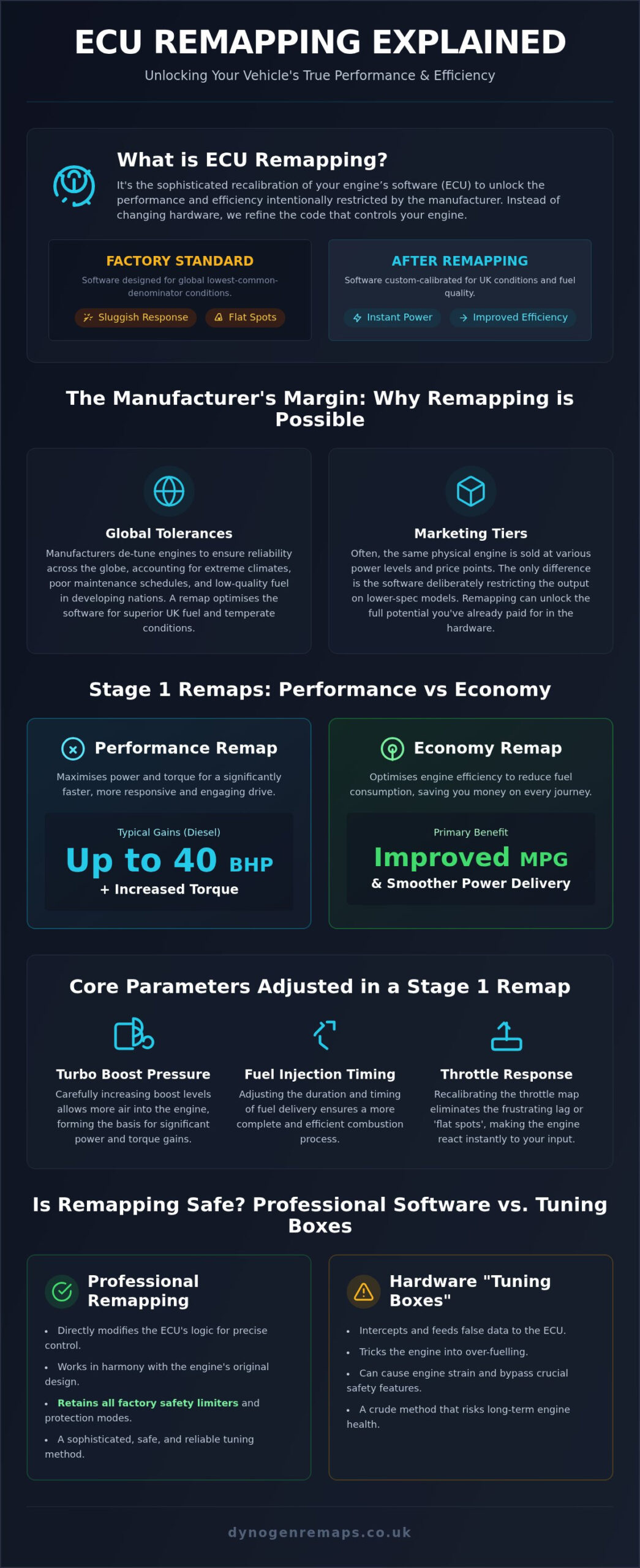
When you seek to understand what is ECU remapping, you’re looking at the digital evolution of engine tuning. Rather than replacing physical parts, remapping involves overwriting the restrictive factory software with a custom-calibrated version. It’s a precise, non-invasive procedure. During a standard Stage 1 remap, we don’t change any physical hardware. We simply refine the internal code to allow the engine to operate with greater efficiency and power, unlocking the potential that the manufacturer purposely left dormant.
What Parameters Does a Remap Actually Change?
A professional recalibration touches several vital areas of engine management. We typically focus on three core pillars to transform the driving experience:
- Turbo Boost Pressure: By carefully increasing boost levels, we allow more air into the combustion chamber, providing the foundation for increased BHP and torque.
- Fuel Injection Timing: We adjust the duration and timing of fuel delivery to ensure a more efficient burn, which is critical for both power delivery and fuel economy.
- Throttle Response Mapping: We modify the throttle maps to eliminate factory-set lag or “flat spots,” ensuring the engine reacts instantly to your foot’s command.
Software vs. Hardware: Why Software is King
It’s vital to distinguish between professional remapping and the physical “tuning boxes” or “chips” of the past. Hardware boxes often work by intercepting sensor signals and providing false data to force an increase in fuel. This is a crude method that can lead to engine strain. Having spent over 15 years at the leading edge of this industry, we’ve seen how sophisticated performance software for cars has rendered these boxes obsolete. Because we work directly with the ECU’s logic, all integrated safety limiters remain active. If the software detects a potential issue, it will still trigger factory protection modes, ensuring your engine’s longevity remains the top priority.
The Manufacturer’s Margin: Why Remapping is Possible
A common misconception is that if an engine could produce more power safely, the manufacturer would have delivered it that way from the factory. In reality, car makers don’t build vehicles specifically for the temperate British climate or our high-quality forecourt fuels. They produce engines designed to survive the harshest conditions on the planet, from the dust of the Sahara to the sub-zero temperatures of the Arctic. To ensure these units don’t fail when running on low-grade fuel in developing nations, they implement massive “Global Tolerances” that significantly restrict performance. This is the fundamental reason behind what is ECU remapping: it’s the professional removal of these generic, worldwide constraints.
Marketing strategies also play a major role in engine detuning. It’s a well-known industry secret that manufacturers often sell the exact same mechanical engine at multiple power levels. By using software to “strangle” the output, they can offer various “Marketing Tiers” at different price points. For example, a van might be sold with 100bhp, 120bhp, or 150bhp variants, despite the turbo, injectors, and pistons being identical across the range. Software is the only differentiator, and remapping simply unlocks the higher potential you’ve already paid for in the hardware.
Reclaiming Your Engine’s True Potential
By localising your vehicle’s software to the UK’s 95 or 99 RON fuel quality, we can optimise the technical process of remapping to deliver a sharper, more responsive drive. When we provide safe engine tuning UK specialists like us ensure that a healthy safety buffer remains intact. We aren’t “overclocking” the engine beyond its physical capabilities; we’re merely operating within the generous margins that manufacturers use to hit specific insurance groups or CO2 tax brackets. This approach ensures your car remains reliable whilst finally delivering the torque it was designed to produce.
The Role of Service Intervals
Manufacturers also detune engines to account for the “lowest common denominator” of vehicle ownership. They assume some drivers will miss oil changes or use sub-standard filters. A detuned engine can tolerate this neglect more easily than one tuned for maximum efficiency. Consequently, a remapped vehicle demands a more disciplined approach to maintenance. We always advise our clients that whilst our software is robust, it works best when supported by high-quality lubricants and regular servicing. If you’re a proactive owner who wants to stop leaving performance on the table, our Stage 1 Performance Remap is the most effective way to transform your vehicle. For enthusiasts looking to start with a robust platform, vehicles from Tom Whiteside Chrysler Dodge Jeep Ram provide an excellent example of models that respond well to these performance enhancements, particularly within their RAM and Jeep lineups.
Types of ECU Remapping: Performance, Economy, and Solutions
Understanding what is ECU remapping requires moving beyond the idea of a “one size fits all” solution. Professional tuning is a bespoke service, tailored to the specific operational requirements of the vehicle and the driver’s objectives. Whether the goal is exhilarating acceleration or reduced overheads for a commercial fleet, the software recalibration must be precise. We offer a range of specialised maps that target different aspects of engine behaviour, ensuring that every driver finds their ideal balance of efficiency and power.
Stage 1 Performance: The Daily Driver’s Favourite
A stage 1 remap is the most popular choice for standard vehicles, offering a refined balance between enhanced power and long-term reliability. For a typical turbo-diesel car in 2026, this calibration can safely add between 20 to 40 bhp and 50 to 100 Nm of torque. However, the true value lies in the “drivability” factor. We focus on smoothing out the power delivery, ensuring that the transition into the turbo’s boost threshold is seamless rather than aggressive. This transforms the vehicle’s character. It makes overtaking effortless and eliminates the frustrating lag found in factory settings.
Diesel Economy Tuning for Fleets and Motorhomes
For high-mileage drivers, diesel economy tuning UK specialists provide a solution that pays for itself at the pump. This process is specifically designed to increase engine torque and power at lower RPMs. By widening the torque band, the engine requires fewer gear changes and less throttle input to maintain cruising speeds. This is particularly effective for van remapping for better MPG, where commercial fleets often see significant reductions in annual fuel expenditure. In these scenarios, we can also integrate speed limiter removal to ensure the vehicle is perfectly suited to its specific logistical role.
Beyond performance, we provide technical software solutions for complex emissions components such as AdBlue, DPF, and EGR systems. These solutions often resolve persistent limp-mode issues that hardware repairs alone cannot fix. It is critical to understand the safety and warranty implications of these changes, which is why we insist on custom per-vehicle software tuning. Generic “flash” maps or “off-the-shelf” files cannot account for the unique wear and tear of your specific engine. Our 15 years of industry experience confirms that only a bespoke calibration, based on a live diagnostic of your vehicle, guarantees the elite standard of results we demand.
The Remapping Process: What Happens at the Tuning Centre?
A professional tuning session begins long before any software is modified. We start every appointment with a full diagnostic health check to ensure the vehicle is mechanically sound. Applying a performance map to an engine with an existing fault, such as a failing turbo or a blocked DPF, is a recipe for disaster. For those who need to address mechanical issues beforehand, Thurton Auto Centre offers expert vehicle repairs and servicing to ensure your car is ready for tuning. We use advanced diagnostic equipment to interrogate the ECU for stored fault codes and monitor live data streams. Only once we are certain the hardware is healthy do we proceed to the extraction phase. This meticulous preparation is a fundamental part of what is ECU remapping when performed by a seasoned specialist.
Most modern cars allow for seamless software updates via the diagnostic port, known as OBDII. This is the most non-invasive method for data extraction. However, many vehicles produced from 2021 onwards feature “locked” ECUs with sophisticated anti-tamper security. In these instances, we perform bench tuning. This requires the unit to be carefully removed and connected directly to our advanced hardware using specialised pins. It’s a delicate technical process that demands a high level of precision to bypass security layers safely without triggering permanent tamper flags.
The Importance of Data Logging
We believe that a remap is only as good as the data that supports it. During the final phase of the process, we perform extensive data logging whilst the engine is under load. We monitor critical variables such as exhaust gas temperatures, air-to-fuel ratios, and injector duty cycles. This ensures that every component, from the turbocharger to the clutch, operates within its safe mechanical limits. Many “mobile remappers” skip this vital step, but for us, it’s a non-negotiable safety check that guarantees long-term reliability. If you’re ready to experience a professionally calibrated drive, you can book your custom remap today with our expert team.
Is Remapping Safe? Reliability, Warranty, and Insurance
Safety is the primary concern for any vehicle owner considering a software upgrade. When people ask what is ECU remapping, they often worry about the long-term impact on engine longevity. The reality is that professional tuning, executed within safe mechanical tolerances, does not damage a healthy engine. In fact, many ECU remapping benefits actually improve the vehicle’s lifespan by optimising combustion and reducing the strain on components during heavy tasks like towing. Problems only arise when amateur tuners bypass safety limiters or push hardware beyond its physical capabilities.
Insurance and legal compliance are equally important factors to consider. In 2026, remapping remains entirely legal in the UK, provided you declare the modification to your insurance provider. Whilst some owners fear a significant premium increase, many insurers now view software optimisation as a standard modification. Failing to disclose it can invalidate your policy, so transparency is essential. To ensure a safe and compliant tuning experience, we always recommend:
- Verifying the tuner’s industry experience and diagnostic capabilities.
- Confirming that the software is a custom calibration, not a generic file.
- Declaring the modification to your insurance provider immediately.
- Ensuring the vehicle continues to meet MOT emissions standards.
Warranty and Dealership Servicing
Modern dealership diagnostic tools can identify that an ECU has been modified, even if the software is returned to stock. It’s a common misconception that a remap will automatically void your entire warranty. In practice, a manufacturer must prove that the software caused a specific failure to reject a claim. Routine servicing is unaffected, and many mod-friendly dealerships continue to support tuned vehicles. Choosing a specialist with over 15 years of experience ensures your software is stable and compatible with the latest dealer-level diagnostic protocols, minimising the risk of unwanted attention during your next service.
Solving Limp Mode with Software
We often use software recalibration as a definitive fix for persistent reliability issues. Many modern diesel engines suffer from sensitive emissions hardware that frequently triggers limp mode or dashboard warning lights. Our DPF and AdBlue solutions provide a way to manage these errors through software coding, often proving far more cost-effective than repeatedly replacing expensive hardware components. By adjusting how the ECU interprets signals from these systems, we can restore vehicle reliability and prevent the engine from entering restricted power modes. This technical approach positions remapping as a sophisticated diagnostic tool, solving complex mechanical headaches through precision software adjustment.
Transform Your Driving Experience with Precision Tuning
Understanding what is ECU remapping represents the first step toward unlocking your vehicle’s genuine potential. By removing the restrictive global margins imposed by manufacturers, you gain a car or van that is smoother, more responsive, and perfectly calibrated for the quality of UK fuels. We’ve explored how professional software tuning preserves vital safety limiters whilst reclaiming the power and efficiency that factory settings intentionally hide. Whether you require a Stage 1 Performance Remap for a more engaging drive or an Economy Remap to lower fleet overheads, the emphasis must always remain on bespoke, custom-calibrated software rather than generic files.
With over 15 years of expert tuning experience, we pride ourselves on delivering technical excellence through advanced diagnostic equipment. We provide specialist technical solutions for DPF, EGR, and AdBlue issues, ensuring your vehicle remains reliable whilst performing at its peak. Don’t settle for factory-set limitations when professional recalibration is within reach. Get a custom quote for your Stage 1 Performance Remap today and discover how our passion for workmanship transforms every journey. It’s time to experience your vehicle as it was truly meant to be driven.
Frequently Asked Questions
Will ECU remapping damage my engine or turbocharger?
A professional remap won’t damage a healthy engine or turbocharger because it operates strictly within the manufacturer’s physical safety limits. We ensure that all integrated engine protection modes remain active whilst refining the software for better performance. Problems only occur when amateur tuners bypass these vital safeguards. If your vehicle is well-maintained and free from underlying mechanical faults, the recalibration actually improves efficiency and reduces the strain on components during daily driving.
How much does a professional ECU remap cost in the UK?
The investment for a professional remap in the UK depends on the specific architecture of your vehicle’s Engine Control Unit and your desired outcomes. Newer vehicles with locked ECUs often require more technical labour and advanced equipment to access safely. Whilst generic files are cheaper, they lack the precision of a custom calibration. We calculate our fees based on the complexity of the software installation and the diagnostic time required to ensure an elite result.
Can I reverse a remap if I want to sell my car?
Yes, the process is entirely reversible if you decide to sell your vehicle or return it to factory settings. We always store a secure backup of your original manufacturer software before applying any changes to the system. Writing the factory file back to the ECU is a straightforward procedure that restores the car to its original power and torque levels. This provides total peace of mind for owners who might want to revert the modification later.
Do I need to tell my insurance company about a remap?
You must inform your insurance provider about any software modifications to ensure your policy remains valid and enforceable. Whilst ECU remapping is legal in the UK, failing to declare it is considered a non-disclosure of a material fact. Most insurers are now familiar with performance software and will simply note the change on your file. Being transparent protects you in the event of a claim and ensures you are fully covered for road use.
Will a remap help my car pass an MOT test?
A remap is designed to optimise performance and efficiency rather than serve as a dedicated fix for an MOT failure. Whilst our technical solutions can resolve persistent dashboard errors related to emissions, the vehicle must still meet the legal smoke and CO2 limits during testing. Professional tuning ensures the engine runs cleanly and efficiently, but it cannot compensate for mechanical hardware failures that would naturally cause an emissions test to fail.
What is the difference between a Stage 1 and a Stage 2 remap?
The main difference lies in the requirement for hardware modifications to support the software. A Stage 1 Performance Remap is a software-only upgrade designed for a standard, unmodified vehicle. In contrast, a Stage 2 remap requires physical changes such as an uprated intercooler or a high-flow exhaust system to handle the increased heat and airflow. Stage 1 remains the favourite for most drivers as it offers the best balance of power and reliability.
How much extra BHP can I expect from a Stage 1 performance remap?
When drivers ask what is ECU remapping in terms of tangible power, they can typically expect a significant increase in output. For a standard turbo-diesel car in 2026, a Stage 1 recalibration usually adds between 20 to 40 bhp and 50 to 100 Nm of torque. These figures represent a safe, reliable increase that transforms the vehicle’s responsiveness without pushing the engine’s internal components beyond their designed mechanical tolerances or safety margins.
Is remapping a diesel car different to a petrol car?
Remapping a diesel car typically yields more dramatic torque improvements compared to a naturally aspirated petrol engine. Turbocharged engines, whether petrol or diesel, offer the greatest potential for gains because the software can precisely control the boost pressure. Whilst diesels focus on low-end pull and fuel economy, petrol remapping often targets a sharper throttle response and higher peak power. Both fuel types benefit from a significantly smoother and more refined power delivery across the entire rev range.