

That frustrating hesitation when you plant your foot isn’t a mechanical flaw; it’s a digital restriction deliberately programmed into your vehicle’s brain. Most drivers in the UK accept this “drive-by-wire” lag as an unavoidable characteristic, yet it often leads to dangerous delays when merging into fast-moving traffic or a sluggish engine behaviour that belies your car’s actual power figures. You’ve likely felt that disconnected sensation where the machine fails to mirror your intent, leaving you feeling unsatisfied with an engine you know is capable of much more.
Our bespoke Stage 1 Performance Remap is engineered to bridge this gap, restoring the immediate and linear responsiveness your vehicle deserves. When you choose to improve throttle response remap calibrations, you’re not just chasing peak figures; you’re removing the electronic filters that stifle acceleration and create artificial dead zones. This article explains how professional software adjustments eliminate these digital dampeners to ensure smoother power delivery across the entire rev range. We will examine the technical nuances of ECU architecture and demonstrate how expert calibration can finally align your driving experience with your car’s true mechanical potential.
Key Takeaways
- Modern “drive-by-wire” systems introduce an artificial delay between your foot and the engine that can be successfully eliminated through expert software calibration.
- Professional software adjustments allow you to improve throttle response remap parameters by recalibrating “Driver Wish” maps to provide immediate, linear torque delivery.
- Discover how manufacturers use software restrictions to differentiate between trim levels and why these generic factory settings often stifle your engine’s true capability.
- Learn why a bespoke Stage 1 remap offers a superior, more holistic solution compared to simple throttle controller boxes that merely intercept electrical signals.
- Understand the technical process behind adjusting ignition timing and torque limits to restore the mechanical connection between the driver and the machine.
Understanding Throttle Response and the “Drive-by-Wire” Delay
Throttle response is the precise measurement of latency between your foot pressing the accelerator pedal and the engine delivering the requested torque. In the era of mechanical performance, this was a direct relationship governed by a physical steel cable. Today, that physical connection has been replaced by Understanding Throttle Response and the ‘Drive-by-Wire’ Delay technology. While this shift allows for more sophisticated engine management, it has introduced a digital layer that often feels sluggish or disconnected. Many UK drivers find that their vehicle feels strangely unresponsive during the first 20% of pedal travel, a sensation that isn’t caused by a mechanical fault but by deliberate software programming. High-quality software serves as the essential bridge to increase engine torque and power by removing these artificial barriers.
The Mechanics of Modern Acceleration
Your accelerator pedal houses a potentiometer, a sensor that converts physical movement into a digital signal. This signal travels to the Engine Control Unit (ECU), which must then interpret your request based on factory-defined “Driver Wish” maps. Manufacturers often program these maps with significant electronic dampening to prioritise fuel economy or passenger comfort over raw responsiveness. Instead of the engine reacting to your foot’s exact position, the ECU filters the signal, smoothing out the delivery and creating a perceived delay. When you choose to improve throttle response remap services, we access these internal maps to sharpen the interpretation process. This ensures that the ECU prioritises immediate action over generic factory dampening.
Why Sluggish Response Can Be Dangerous
In the context of UK driving, a delayed throttle is more than just an annoyance; it’s a genuine safety concern. Attempting to join a fast-moving roundabout or pull out of a busy junction requires predictable, instant acceleration. If your car hesitates for half a second before the power arrives, you’re left in a vulnerable position in the middle of traffic. This unpredictable behaviour also erodes driver confidence during overtaking manoeuvres on narrow A-roads, where every millisecond counts. Throttle Lag is the intentional digital delay inserted by manufacturers for non-mechanical reasons. By opting to improve throttle response remap calibrations, you regain the ability to command your vehicle with precision. This transformation provides the immediate acceleration required to navigate complex road layouts safely and with total certainty in your machine’s capabilities.
How ECU Software Calibration Unlocks Engine Responsiveness
Professional software calibration offers a far more sophisticated solution than the generic signal-interception boxes commonly found on the market. Whilst those “plug-and-play” devices merely trick the ECU by amplifying the pedal signal, a bespoke remap modifies the core logic of the engine management system. When you choose to improve throttle response remap files, you’re fundamentally altering how the Engine Control Unit (ECU) processes your intentions. This holistic approach ensures that every component, from fuel injectors to turbochargers, works in perfect synchronisation with your right foot.
Modifying Driver Wish and Torque Request Maps
At the heart of modern engine management lie the “Driver Wish” maps. These are complex tables containing thousands of individual data points that translate pedal position into a specific torque request. Factory software often includes significant “dead zones” or non-linear curves designed to make the car feel sedate for the average commuter. We access these maps to remove those artificial dampeners, ensuring that the first 15% of pedal travel results in immediate, crisp acceleration. By prioritising the driver’s input over generic comfort filters, we restore a sense of urgency that makes the vehicle feel significantly lighter and more alert.
Removing Electronic Dampening and Torque Limiters
Manufacturers frequently implement software-based torque limiters, particularly in lower gears, to protect drivetrain components or to meet strict emissions targets. These limiters act as a digital “throttle” that prevents the engine from delivering its full potential during initial take-off. Our calibration process identifies these restrictive parameters and adjusts them to allow for a more natural power delivery. We maintain essential safety buffers to protect the engine’s longevity, but we eliminate the excessive dampening that causes the car to feel bogged down. This restoration of the mechanical connection ensures the drivetrain reacts with surgical precision to every input.
Beyond simple pedal sensitivity, we also focus on ignition timing and boost pressure optimisation. Adjusting ignition timing ensures the combustion process begins at the optimal moment for instant torque delivery, whilst recalibrating turbocharger wastegate control significantly reduces the time it takes for boost pressure to build. One of the primary ECU remapping benefits is the achievement of a smoother, more predictable power delivery that feels completely intuitive. If you’re ready to experience this level of precision, our professional calibration service can transform your daily drive into a far more engaging experience.
Why Manufacturers Deliberately Restrict Throttle Sensitivity
Manufacturers adopt a “Lowest Common Denominator” approach when developing global vehicle software. A car sold in the UK must use the same fundamental ECU logic as one sold in regions with sub-standard fuel quality or extreme high-altitude climates. This necessity leads to extremely conservative factory calibrations that prioritise engine survival over driving pleasure. By dampening the throttle response, manufacturers create a massive safety buffer that accounts for poor maintenance and low-grade lubricants. For the enthusiast driver, this results in a muted experience where the engine feels unnecessarily restricted.
Commercial Tiering and Marketing Logic
Software is the most cost-effective tool a manufacturer has to differentiate between various model trim levels. It is common for the same 2.0-litre turbocharged engine to be sold with three or four different power ratings across a brand’s lineup. By artificially limiting torque and introducing digital lag in the software, manufacturers can sell “sporty” responsiveness as a premium optional extra. When we perform Stage 1 performance upgrades, we are effectively restoring the performance that was locked at the factory for purely commercial reasons. This allows you to access the full mechanical potential of your engine without paying for an expensive trim upgrade.
Emissions Standards and Component Longevity
Strict fleet emissions targets are another primary driver for sluggish throttle behaviour. A dampened response prevents sudden fuel enrichment during rapid pedal movements, helping the vehicle stay within narrow CO2 and NOx limits during standardised testing. Beyond emissions, these digital filters protect the drivetrain from drivers who may not respect mechanical limits. Manufacturers must calibrate software for the most abusive driving habits amongst the general public. While this protective layer ensures longevity for a neglected vehicle, it creates a disconnected sensation for those who maintain their cars correctly.
By opting to improve throttle response remap calibrations, you are choosing to bypass these generic, global restrictions. Professional remapping allows us to recalibrate the engine’s behaviour to suit UK fuel standards and your specific driving style. This process removes the artificial “dead” feel of the pedal, replacing it with a crisp, linear delivery that makes the vehicle feel significantly more alert. It is the most effective way to ensure your engine performs exactly as its engineers intended before the marketing and emissions departments intervened. Drivers who want to address all factory-imposed digital restrictions comprehensively may also benefit from exploring a speed limiter removal service to unlock their vehicle’s full performance potential through expert ECU recalibration.
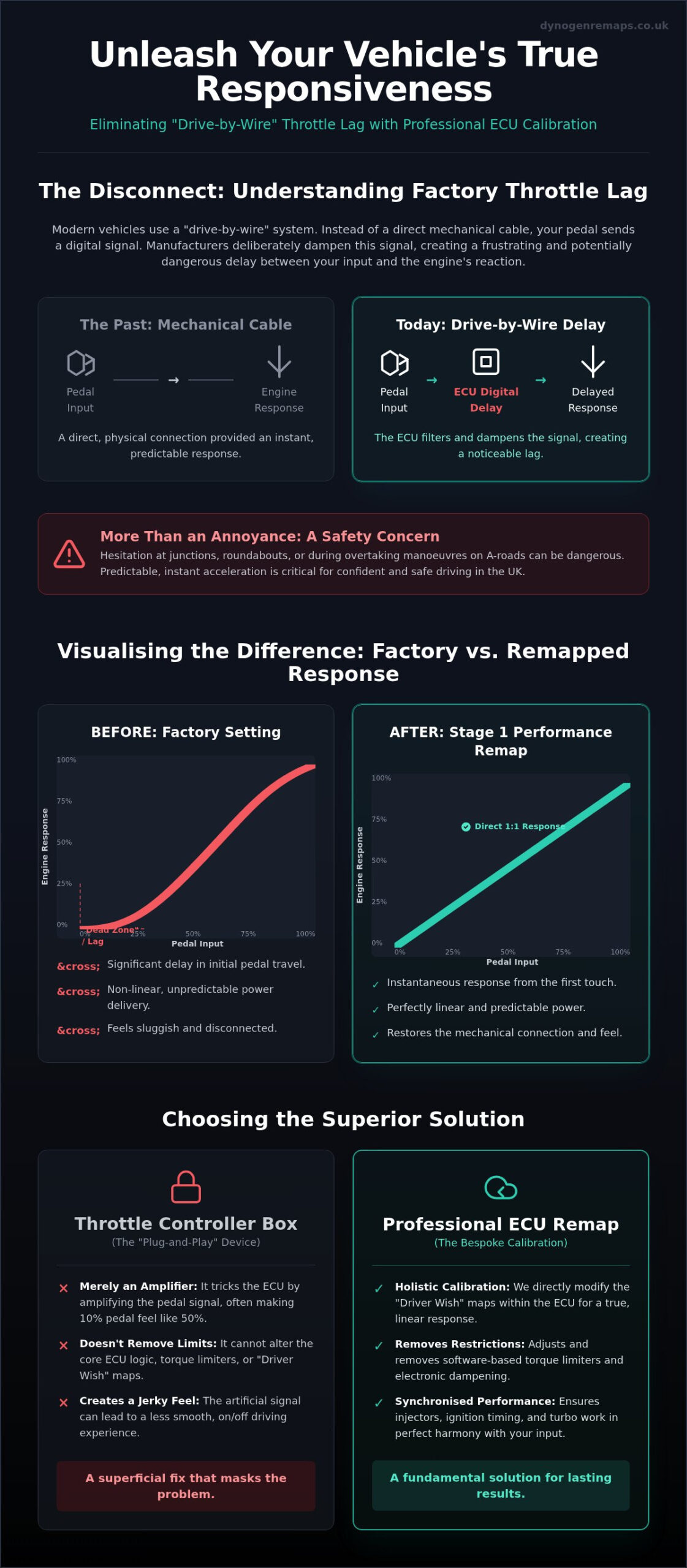
Remapping vs. Throttle Controllers: Choosing the Superior Solution
When assessing the options for enhancing your vehicle, it’s vital to distinguish between signal manipulation and genuine software recalibration. Many owners are tempted by “throttle boxes” or “pedal commanders” due to their low entry price and easy installation. However, these devices don’t actually change the engine’s performance; they simply intercept and amplify the electrical signal from the pedal. To truly improve throttle response remap services are required, as they address the root cause of lag within the Engine Control Unit itself rather than merely masking it.
The Limitations of Signal Interception
Throttle boxes operate as simple multipliers. If you press the pedal 20%, the box tells the ECU you’ve pressed it 50%. While this creates an initial illusion of speed, it often results in a “twitchy” and unpredictable driving experience that lacks finesse. Crucially, these boxes have no control over turbo boost, ignition timing, or fuel maps. They cannot increase your vehicle’s actual horsepower or torque. Because they exist outside the car’s standard diagnostic ecosystem, they frequently trigger “limp mode” or sensor errors when the ECU detects an illogical jump in input data that doesn’t align with other engine parameters.
The Holistic Benefits of Custom ECU Software
A bespoke remap is a comprehensive engineering solution that integrates seamlessly with your vehicle’s existing safety systems. Unlike a generic box, our performance software for cars is calibrated to account for the specific health, mileage, and mechanical condition of your engine. We don’t just “turn up” the pedal sensitivity; we recalibrate the entire torque delivery curve to ensure a smooth, linear response that feels factory-original but significantly more capable. This ensures that the power is available exactly when you need it, without the jerky delivery associated with signal interceptors.
This methodical approach guarantees that safe engine tuning in the UK remains the absolute priority for every client. By modifying the internal data maps, we provide a permanent and sophisticated improvement that no external hardware can replicate. It’s about achieving a balance between immediate urgency and long-term mechanical reliability. If you want to unlock the true potential of your machine without compromising reliability, you can book your professional Stage 1 remap here to experience the difference for yourself.
Professional Performance Tuning: What to Expect on the Road
When you invest in an improve throttle response remap, the process begins long before we connect our specialised interface to your ECU. Professional tuning is not a generic “one-size-fits-all” software upload; it’s a methodical recalibration that must be preceded by a rigorous assessment of your vehicle’s current mechanical state. This ensures that the newly unlocked power is delivered reliably and safely, providing a permanent but entirely reversible enhancement to your machine’s character. The result is a vehicle that feels fundamentally different from the moment you leave the workshop.
The Importance of Pre-Remap Health Checks
A seasoned specialist understands that software can only perform as well as the hardware it controls. Before any calibration takes place, we perform a comprehensive diagnostic interrogation to identify existing faults in critical systems like the turbocharger, DPF, or ignition coils. We ensure the drivetrain is in peak condition to safely manage the increased torque and heightened responsiveness. Prioritising engine health over raw peak figures is what separates a professional calibration from a generic “tuning box” installation. This protective approach ensures that your vehicle remains as reliable as it was when it left the factory, just significantly more alert.
The Driving Experience Reimagined
The transformation is immediate. A bespoke Stage 1 remap fundamentally transforms car drivability and throttle response by aligning the software perfectly with the engine’s mechanical limits. Instead of the engine feeling like it’s fighting through a digital fog, it reacts with a crispness that suggests a much lighter vehicle. You’ll notice this change most clearly in these scenarios:
- Pulling away from junctions: The hesitation that once made joining traffic stressful is replaced by instant, predictable movement.
- Merging onto motorways: The engine reaches its power band with far less pedal effort, making overtaking manoeuvres effortless and safe. For fleet van operators and performance car owners alike, pairing this improvement with a professional speed limiter removal service can fully eliminate all artificial digital restrictions that prevent the vehicle from reaching its true engineering potential.
- Efficiency and gear changes: Because the engine reacts more efficiently to load changes, drivers often find they can hold higher gears for longer, which can lead to improved fuel economy during daily commutes.
By opting to improve throttle response remap parameters, you gain the peace of mind that comes from a high-quality, custom-calibrated solution. The “drive-by-wire” lag is eliminated, restoring the linear connection between your intent and the engine’s output. This isn’t just about speed; it’s about the satisfaction of driving a machine that is finally performing at its true mechanical potential. You regain total confidence in your car’s ability to react exactly when you need it to, transforming every journey into a more engaging and precise experience.
Restore Your Connection to the Machine
The artificial delay between your foot and the engine isn’t something you have to live with. By choosing to improve throttle response remap calibrations, you’re removing the digital filters that manufacturers use to restrict performance for global marketing and emissions reasons. Unlike generic hardware boxes that simply intercept signals, a professional software recalibration provides a holistic and safe improvement. It ensures that every input is met with immediate, linear acceleration whilst maintaining the long-term reliability of your drivetrain.
At Dynogen Remapping Solutions, we leverage over 15 years of specialist tuning expertise and advanced diagnostic equipment to deliver results that exceed factory standards. Our bespoke maps are meticulously tailored to your specific driving needs, ensuring a transformative experience on every road. Whether you’re merging onto a busy motorway or navigating a tight roundabout, you deserve a vehicle that reacts with surgical precision. Unlock the true responsiveness of your vehicle with a Dynogen Remapping Solutions Stage 1 Remap and rediscover the joy of a perfectly calibrated engine.
Frequently Asked Questions
Is it legal to improve throttle response with remapping in the UK?
Yes, it is entirely legal to improve throttle response remap parameters in the UK as long as the vehicle remains compliant with road traffic acts and emissions standards. Professional tuning focuses on optimising the internal software logic rather than removing essential hardware. You should ensure that any performance enhancement does not compromise the vehicle’s MOT compliance, particularly regarding smoke opacity. Always choose a specialist who operates within safe mechanical boundaries to ensure total legality.
Will a throttle response remap affect my car insurance?
You must declare a performance remap to your insurance provider as it constitutes a modification to the vehicle’s factory specification. Most UK insurers are accustomed to Stage 1 upgrades and will adjust your premium accordingly. Failing to disclose these changes could void your policy in the event of a claim. Transparency ensures that your specialist software calibration is fully covered and that your legal protections remain intact while you enjoy the enhanced drivability.
Can software tuning damage my engine or turbocharger?
Professional software tuning will not damage a healthy engine or turbocharger when the calibration remains within the manufacturer’s mechanical safety margins. We perform a rigorous diagnostic check before any work begins to ensure your hardware is fit for the increased load. By carefully managing boost pressure and ignition timing, we achieve a significant gain in responsiveness without overstressing components. Reliability is our primary objective, ensuring your machine performs optimally for years to come.
How much extra BHP can I expect from a Stage 1 remap?
A Stage 1 remap typically yields power increases of 20% to 35% on modern turbocharged petrol and diesel engines. These gains are achieved by optimising factory-set restrictions and improving the efficiency of the combustion process. Whilst the peak BHP figures are impressive, the most significant change is the broader torque curve and the elimination of the “drive-by-wire” lag. This combination ensures the vehicle feels more capable and alert during real-world driving conditions.
Is a custom remap better than a plug-in throttle controller?
A custom remap is significantly superior to a plug-in controller because it modifies the actual engine management data rather than just intercepting a pedal signal. While a controller merely tricks the ECU into thinking you’ve pressed the pedal harder, a remap adjusts fuelling, timing, and boost pressure. This creates a holistic improvement in performance and safety. To truly improve throttle response remap technology is the only solution that addresses the root cause of digital lag.
Will my car fail its MOT after a throttle response remap?
Your vehicle will not fail its MOT due to a performance remap, provided the engine’s emissions remain within the legal limits for its age and type. Our Stage 1 calibrations are designed to maintain full compliance with UK environmental regulations. We do not remove essential emissions hardware like DPFs or catalytic converters during a standard performance tune. Your car will continue to pass its MOT whilst benefiting from a much more direct and engaging driving experience.
Can I revert my car back to the factory software settings?
Yes, your vehicle’s software can be reverted to its original factory settings at any time. We maintain a secure backup of your car’s original ECU file before any modifications are applied. This provides total flexibility if you decide to sell the vehicle or return it to its stock configuration for any reason. The process is straightforward and ensures that the transition back to factory behaviour is seamless and safe once the original data is restored.
How long does the professional remapping process take?
The professional remapping process typically takes between one and three hours to complete, depending on the complexity of your vehicle’s ECU architecture. This duration includes the essential pre-tuning diagnostic health check, the custom software calibration, and a final road test to verify the results. We refuse to rush this process, as meticulous attention to detail is required to ensure the perfect balance between immediate responsiveness and long-term mechanical reliability for every client.