

Your vehicle’s top speed isn’t determined by its mechanical limits, but by a few lines of restrictive code. It’s incredibly frustrating to find an ex-fleet van struggling to maintain safe overtaking speeds on the motorway or a performance car hitting an artificial wall during a track day. You’ve invested in a machine capable of so much more; however, you’re currently held back by factory-set governors. This is why many drivers seek a professional speed limiter removal service to finally align their vehicle’s performance with its true engineering potential.
We agree that a vehicle should perform exactly as its mechanical specifications suggest, without arbitrary digital anchors holding it back. You’ll discover how professional speed limiter removal can reclaim your vehicle’s true capabilities through expert ECU recalibration. This guide explores the technical nuances of the unlocking process, how we maintain the highest safety standards, and why trusting a seasoned specialist is the only way to avoid the risks associated with amateur tuners. It’s time to experience the smoothness and responsiveness your vehicle was always meant to deliver whilst ensuring total peace of mind.
Key Takeaways
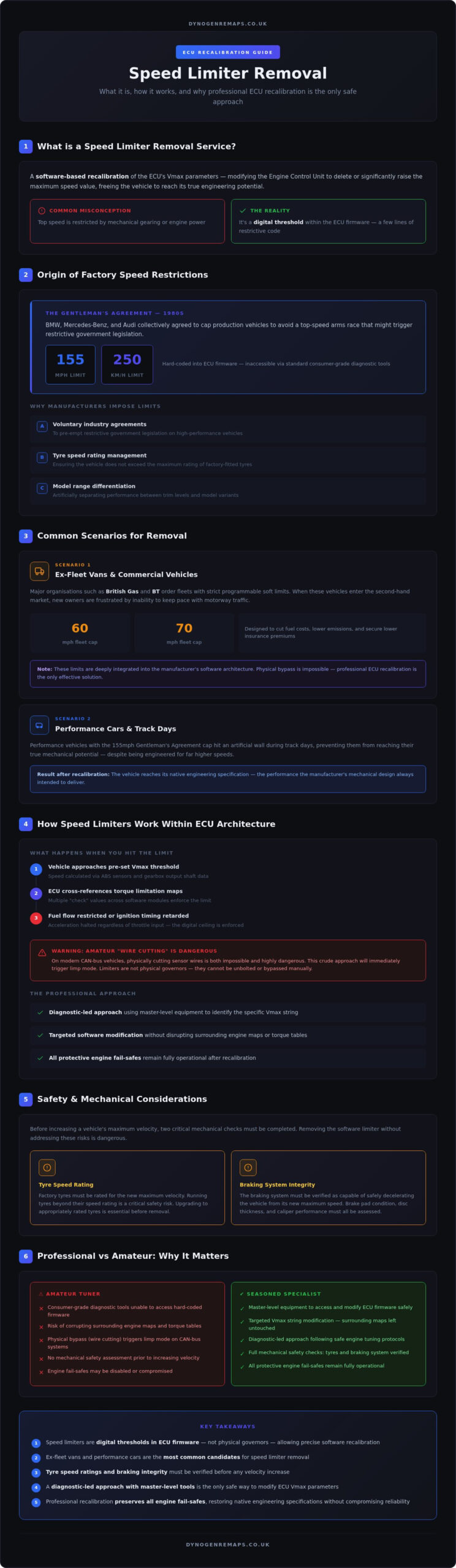
- Understand that speed limiters are digital thresholds within the ECU firmware rather than physical governors, which allows for precise software recalibration.
- Identify how a professional speed limiter removal service can transform the drivability of ex-fleet vans and unlock the full potential of performance cars for track use.
- Recognise the vital importance of mechanical safety checks, specifically regarding tyre speed ratings and braking system integrity, before increasing a vehicle’s maximum velocity.
- Learn why a diagnostic-led approach and master-level equipment are essential to ensure the ECU software is modified safely and accurately without compromising reliability.
- Discover how to reclaim the native engineering specifications of your vehicle, moving beyond artificial factory restrictions to achieve the performance the manufacturer originally intended.
What is a Speed Limiter Removal Service?
A speed limiter removal service is a software-based recalibration of the ECU’s Vmax parameters. This technical process involves modifying the Engine Control Unit (ECU) software to either delete or significantly increase the maximum speed value, which is known in the industry as the Vmax limit. Whilst many drivers assume their vehicle’s top speed is restricted by mechanical gearing or engine power, it’s actually governed by a digital threshold within the vehicle’s electronic brain. By recalibrating these specific data maps, we can unlock the vehicle’s true performance potential without compromising the underlying engine safety parameters or reliability.
Most modern vehicles leave the factory with these restrictions already in place. Manufacturers often impose these limits to comply with voluntary agreements, manage tyre speed rating requirements, or differentiate between various models within their range. A professional speed limiter removal service ensures that the engine continues to operate within its safe mechanical tolerances, simply removing the artificial ceiling that prevents the vehicle from reaching its native engineering specifications.
The Origin of Factory Speed Restrictions
The prevalence of speed limiters in high-performance cars largely traces back to a “Gentleman’s Agreement” amongst major German manufacturers like BMW, Mercedes-Benz, and Audi. During the 1980s, these brands collectively decided to limit their production vehicles to 155mph (250km/h) to avoid a top-speed arms race that might have prompted restrictive government legislation. These restrictions are often hard-coded into the ECU’s firmware, making them inaccessible through standard consumer-grade diagnostic tools. Beyond these agreements, manufacturers also use limiters to ensure the vehicle does not exceed the maximum speed rating of the factory-fitted tyres, which is a critical safety consideration for any owner looking to increase their vehicle’s velocity.
Commercial and Fleet Limiters
In the commercial sector, speed limiters serve a different, more pragmatic purpose. Large organisations such as British Gas or BT frequently order fleets of vans with strict programmable soft limits, often capped at 60mph or 70mph. These restrictions are designed to reduce fuel consumption, lower carbon emissions, and secure more favourable insurance premiums. However, when these vehicles enter the second-hand market, the new owners often find themselves frustrated by an inability to keep pace with motorway traffic. Unlike basic aftermarket governors that might be physically attached to the throttle, these fleet limits are deeply integrated into the manufacturer’s software architecture. Professional recalibration is the only effective way to remove these commercial restrictions, restoring the van’s motorway drivability and making it a far more versatile tool for a small business or independent tradesperson.
How Speed Limiters Function Within ECU Architecture
The speed limiter is an integrated digital threshold embedded within the ECU’s firmware rather than a physical governor that can be unbolted or bypassed manually. When your vehicle approaches the pre-set maximum velocity, the engine management system intervenes by restricting fuel flow or retarding ignition timing. This precise digital intervention prevents further acceleration regardless of how much pressure is applied to the throttle. Modern, advanced ECUs often utilise multiple “check” values across various software modules to enforce this limit, which creates a complex web of dependencies that requires expert knowledge to navigate.
Professional recalibration involves identifying and modifying the specific Vmax string without disrupting the delicate balance of other engine maps. It’s essential that these modifications adhere to the established Safe engine tuning UK protocols to ensure the vehicle remains reliable and responsive. By targeting the software at its core, we can unlock the vehicle’s native capabilities whilst keeping all protective engine fail-safes fully operational.
Vmax and Torque Monitoring
Modern engine management systems calculate vehicle speed with extreme precision by monitoring data from ABS sensors and gearbox output shafts. This information is constantly cross-referenced against torque limitation maps within the ECU architecture. In the past, some might have attempted to “cut a wire” to bypass sensors, but on contemporary CAN-bus vehicles, this is both impossible and highly dangerous. Such crude actions will immediately trigger limp mode or disable critical safety systems like electronic stability control. A professional speed limiter removal service avoids these risks by using sophisticated software to communicate with the ECU in its native language.
The Role of ECU Remapping in Removal
ECU remapping provides the only sophisticated method for adjusting the Vmax byte without affecting other critical engine functions. By accessing the software at a master level, a specialist can precisely locate the speed restriction maps and raise the threshold to the vehicle’s native mechanical limit. For many owners, combining this with a stage 1 remap offers a complete performance overhaul, improving both power delivery and top-end capability. This bespoke approach is vastly superior to generic “delete” files because it accounts for the specific software version and hardware configuration of your individual vehicle. If you’re looking to transform your driving experience, you can explore our bespoke tuning solutions to see what your vehicle is truly capable of achieving.
Common Scenarios for Speed Limiter Removal
While technical curiosity often drives interest, most clients seek a speed limiter removal service because of a specific, practical bottleneck in their vehicle’s performance. Whether it’s a commercial asset transitioning to private ownership or a high-end saloon restricted by legacy agreements, these digital caps often conflict with the driver’s requirements. Motorhome owners, for instance, frequently find that removing factory restrictions helps improve car drivability remapping for long-distance European tours, where maintaining consistent speeds on steep gradients is essential for a relaxed journey.
In other instances, we encounter vehicles where a previous owner has installed a third-party aftermarket limiter. These are often crude devices that interfere with the throttle signal or fuel rail pressure. Replacing these outdated physical components with a clean, software-based solution ensures the vehicle operates as the manufacturer intended, without the jerky interventions common with low-quality hardware.
Unlocking Ex-Fleet Vans for Private Use
Ex-utility vehicles represent one of the most common cases for recalibration. Vans formerly operated by major UK fleets, such as British Gas or BT, are typically restricted to a hard 70mph limit to manage corporate liability and fuel costs. Whilst this makes sense for a national fleet, it becomes a significant safety hazard for a private owner attempting to overtake a lorry on a busy motorway. Models like the Ford Transit or Mercedes Sprinter are frequently hampered by these settings. Removing these fleet limiters doesn’t just restore speed; it often improves real-world fuel efficiency by allowing the driver to stay in a more optimal gear during motorway cruising rather than constantly fighting against the ECU’s throttle cut-off intervention.
Performance Vehicles and the 155mph Ceiling
For performance enthusiasts, the motivation is often about reclaiming the vehicle’s native engineering potential. Owners of BMW “M” models, Audi “RS” variants, and Mercedes AMG saloons often find the standard 155mph ceiling restrictive during track days or continental travel on the German Autobahn. A professional speed limiter removal service allows these high-performance machines to breathe at the top end of their rev range. It’s not merely about the absolute top speed, but about the smoothness of the power delivery as the car approaches its natural limits. High-speed stability is paramount here, which is why we ensure the software recalibration is handled with the precision these elite engines demand to maintain their factory-set safety fail-safes. BMW owners in particular should be aware that models equipped with the B58 straight-six benefit enormously from this process, and a dedicated B58 engine remap can unlock substantial gains beyond simply removing the top-speed restriction.
Safety, Legality, and Mechanical Considerations
Unlocking a vehicle’s top speed is a significant technical modification that requires a holistic view of the machine’s mechanical integrity. Whilst the software recalibration itself is precise, the physical components of the vehicle must be capable of handling the increased velocities. We prioritise a safety-first approach, ensuring that every speed limiter removal service is preceded by a rigorous assessment of the vehicle’s health. This includes verifying that the braking system and suspension components are in peak condition, as higher speeds naturally place greater thermal and mechanical stress on these critical systems.
Tyre Speed Ratings: A Critical Safety Check
The most vital mechanical consideration is the speed rating of your tyres. Every tyre manufactured for the UK market features a speed symbol on the sidewall, such as V, W, or Y, which indicates the maximum speed the tyre can safely sustain under its recommended load. For example, a ‘V’ rated tyre is capped at 149mph, whilst a ‘Y’ rated tyre can handle up to 186mph. You should never exceed the speed rating of your tyres, regardless of what the ECU software allows. A professional tuner will always cross-reference your vehicle’s new potential top speed with its current tyre specifications to ensure your safety isn’t compromised on the road or track.
MOT Requirements and Road Legality
It’s a common misconception that removing a speed limiter will lead to an MOT failure. In the UK, speed limiter removal is entirely legal for private cars and light goods vehicles (LGVs). The MOT test for these vehicle classes does not currently include a check for Vmax settings. However, it’s essential to differentiate between voluntary limiters and those legally mandated for heavy goods vehicles (HGVs) or large passenger-carrying vehicles, where strict regulations apply. Our commitment is to provide the numerous ECU remapping benefits whilst strictly adhering to UK safety standards and road regulations.
Finally, you must inform your insurance provider about any software modification to the ECU. Transparency ensures your policy remains valid and that you’re fully covered for the vehicle’s enhanced capabilities. If you’re ready to discuss the mechanical suitability of your vehicle for this upgrade, you can contact our specialist team for technical advice tailored to your specific make and model.
The Dynogen Approach to Speed Limiter Removal
At Dynogen Remapping Solutions, our methodology is defined by technical precision and a steadfast commitment to vehicle safety. Every speed limiter removal service we perform begins with a comprehensive diagnostic health check. This initial phase is crucial; it allows us to identify any underlying faults or sensor irregularities that might compromise the recalibration process. We only proceed when we’re certain the vehicle is in a fit state to be tuned. By utilising advanced master-level equipment, our engineers safely read the ECU’s original software, creating a secure backup before any modifications occur. This ensures we always have a point of restoration, maintaining the professional standard our clients expect.
Once the software is accessed, our expert engineers meticulously identify the specific Vmax parameters within the hexadecimal code. This isn’t a generic adjustment; it’s a bespoke modification tailored to your vehicle’s unique software version. We isolate the exact bytes responsible for speed governance and recalibrate them to align with your requirements. Crucially, we perform a final verification after the write process to ensure all other engine protection maps, such as oil temperature thresholds and exhaust gas temperature limits, remain active and unaffected. This methodical approach ensures your vehicle retains its factory-built reliability whilst operating at its true potential.
Bespoke Software Calibration
We strictly avoid generic “off-the-shelf” files that often lead to dashboard errors or trigger limp mode. These low-quality solutions frequently ignore the subtle differences between various ECU software versions and hardware revisions. With over 15 years of industry experience, we possess the specialised knowledge required to handle complex ECU architectures, including the latest protected modules that require sophisticated unlocking techniques. For those seeking a complete transformation, we offer the option to combine limiter removal with performance software for cars, delivering a significant return on investment through improved responsiveness and power delivery.
National Service and Professional Support
While many tuners operate on a purely local basis, our reach is national. We provide expert solutions to a UK-wide audience, ensuring that elite-level technical skill is accessible regardless of your location. Choosing a seasoned specialist provides peace of mind that a generic garage simply cannot offer. Our relationship with our clients doesn’t end when the vehicle leaves the workshop; we provide ongoing post-service support and technical advice to ensure you remain satisfied with your vehicle’s performance. It’s this blend of elite skill and humble dedication to customer satisfaction that defines our position as a leader in the remapping industry.
Reclaim Your Vehicle’s True Performance
Understanding that your vehicle’s limitations are often digital rather than mechanical is the first step toward a superior driving experience. By recalibrating the ECU’s Vmax parameters, we remove artificial restrictions whilst maintaining the essential safety fail-safes that protect your engine. Whether you’re reclaiming the motorway capability of an ex-fleet van or preparing a performance car for the track, our professional speed limiter removal service delivers the precision your vehicle deserves.
With over 15 years of technical tuning expertise and bespoke software solutions, we provide national UK coverage for all vehicle types. Don’t let factory-set code dictate your journey any longer. You can unlock your vehicle’s potential with Dynogen today and experience the smoothness and responsiveness that only expert ECU recalibration can provide. It’s time to drive the machine you were always meant to have.
Frequently Asked Questions
Is speed limiter removal legal in the UK?
Speed limiter removal is entirely legal in the UK for private cars and light goods vehicles. Whilst certain heavy goods vehicles (HGVs) and large passenger vehicles are legally required to have limiters fitted, private owners can choose to remove factory-imposed restrictions. You must remember that removing a digital governor doesn’t grant permission to exceed national road speed limits. It simply restores the vehicle’s native mechanical capability for use in environments like private tracks or the German Autobahn.
Will removing the speed limiter affect my MOT?
Removing a speed limiter will not cause your vehicle to fail its MOT test. The current DVSA testing criteria for private cars and light commercial vehicles do not include a check for the maximum speed setting within the ECU. Because this is a software recalibration rather than a physical modification to emissions equipment or safety hardware, it remains outside the scope of the standard annual inspection. Your vehicle’s roadworthiness depends on its mechanical condition rather than its digital Vmax threshold.
Can you remove the 70mph limit on an ex-fleet van?
We can definitely remove the restrictive 70mph limits found on ex-fleet vans such as those formerly owned by British Gas or BT. These vehicles are often limited at the factory to meet corporate safety and fuel economy targets, which can be dangerous for private owners when overtaking on motorways. Our speed limiter removal service involves accessing the ECU to delete these specific fleet-based parameters, allowing your Transit or Sprinter to keep pace with modern traffic flow.
Do I need to tell my insurance company about speed limiter removal?
You must inform your insurance provider about any software modification, including speed limiter removal. Most insurers view any change to the factory-set ECU parameters as a declarable modification. Failing to disclose this information could potentially void your policy in the event of a claim. Whilst many specialist insurers are comfortable with remapping and limiter removal, it’s essential to maintain transparency to ensure you remain fully covered whilst enjoying your vehicle’s enhanced performance.
Will speed limiter removal damage my engine?
Professional speed limiter removal will not damage your engine because it doesn’t bypass the manufacturer’s core safety fail-safes. We meticulously ensure that oil temperature thresholds, coolant limits, and exhaust gas temperature protections remain fully operational within the software. The engine simply continues to run within its native mechanical tolerances, only without the artificial digital ceiling. Damage typically only occurs when “cowboy” tuners use poor-quality files that interfere with these critical protective engine maps.
Can the speed limiter be reinstated later if I sell the car?
The speed limiter can be fully reinstated at any time if you decide to sell the vehicle or return it to its original factory state. During our recalibration process, we always create a complete backup of your vehicle’s original ECU software. If you require the restriction to be reapplied, we can simply reflash the original Vmax parameters back onto the module. This flexibility is particularly useful for owners of performance cars who wish to maintain a standard profile for resale.
How long does the speed limiter removal process take?
The entire process typically takes between one and two hours to complete at our specialised facility. This duration includes a comprehensive pre-tuning diagnostic health check, the reading of the original ECU software, and the precise modification of the Vmax strings. We also perform a final verification to ensure the software is functioning correctly before handing the keys back. This methodical approach ensures that the recalibration is performed safely and accurately without rushing the technical nuances.
Is speed limiter removal the same as a Stage 1 remap?
Speed limiter removal and a Stage 1 remap are two distinct software services, though they are frequently performed together. A speed limiter removal service specifically targets the Vmax byte to remove the top-speed cap. In contrast, a Stage 1 remap focuses on optimising fuel, ignition, and boost maps to increase overall power and torque. Combining both services ensures that your vehicle not only has a higher top-end capability but also the improved acceleration and responsiveness to reach it.