

The £50 device you found on a marketplace might seem like a bargain, but in the high-stakes world of modern vehicle calibration, the cheapest hardware often carries the heaviest price tag. When weighing up clone vs genuine tuning tools, it’s easy to be swayed by the massive disparity in initial investment, especially whilst facing the rising costs of professional subscriptions. As modern ECUs like the Bosch MG1 and MD1 families become increasingly sophisticated with multi-layer encryption and irreversible tamper flags, the gap between a licenced tool and a counterfeit copy has never been wider.
We understand that the barrier to entry for professional grade equipment can feel daunting, particularly when subscription models for industry leaders like Alientech or Autotuner add to your overheads. You want to deliver excellence without compromising the integrity of a vehicle or risking a catastrophic ECU failure that could cost thousands to rectify. This guide explores the critical technical and safety differences you must understand to protect your reputation and your vehicles. We will examine why professional grade hardware is the only viable choice in 2026, detail the risks inherent in static clone firmware, and identify the brands that remain the gold standard for precision and reliability.
Key Takeaways
- Understand the fundamental technical and safety risks when evaluating clone vs genuine tuning tools to prevent irreversible damage to your vehicle’s ECU.
- Learn how hardware instability and sudden connection losses in unlicensed devices can lead to ‘bricking’, necessitating a costly professional intervention.
- Discover the critical advantage of weekly protocol updates and security patches provided by industry-standard hardware such as Alientech and Autotuner.
- Assess the significant financial risks of using counterfeit equipment by comparing the price of professional tools with the high cost of replacing modern, encrypted control units.
- Recognise how a steadfast commitment to using only genuine, licensed hardware ensures the long-term reliability and performance of every Stage 1 remap.
Defining the Divide: What Are Clone vs Genuine Tuning Tools?
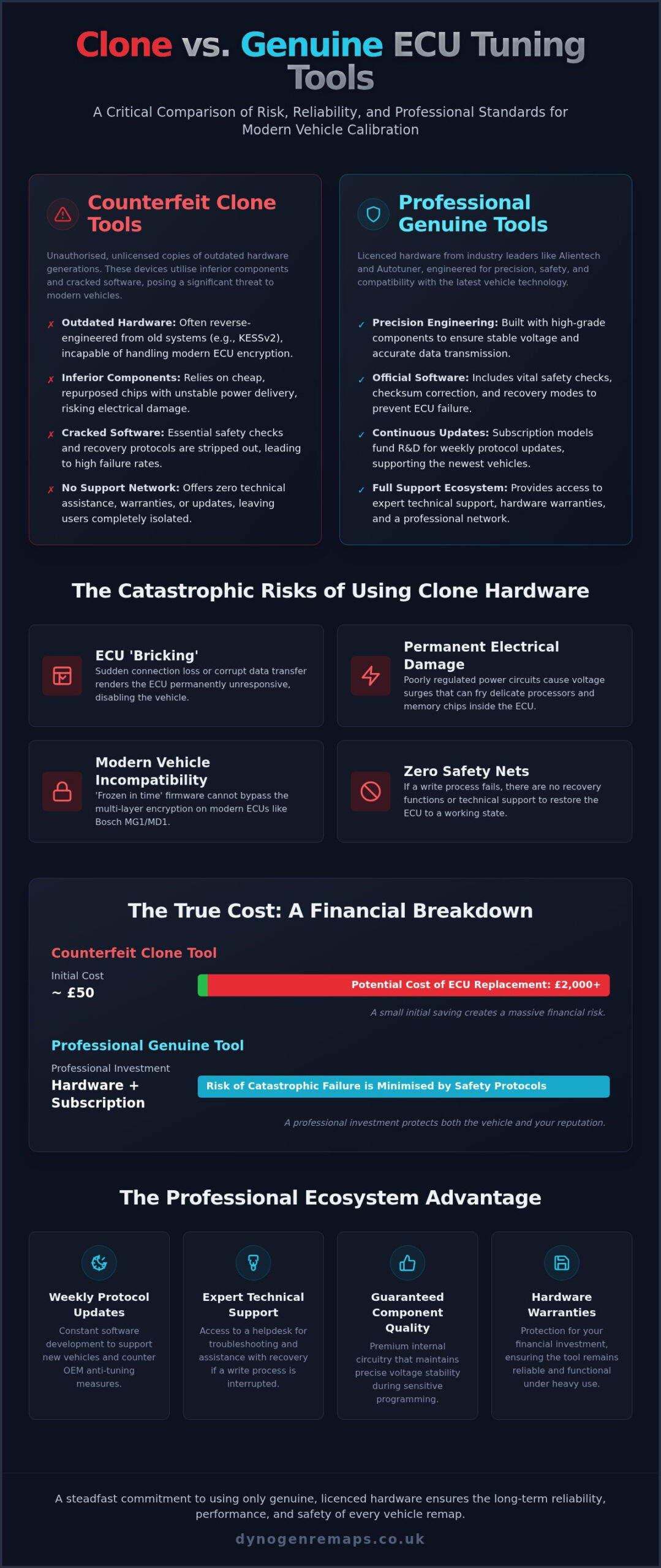
The physical casing of a tuning tool often masks a vast internal disparity. Genuine hardware from industry leaders like Alientech, Autotuner, or Magic Motorsport represents the pinnacle of automotive engineering, whilst clones are merely unauthorised, unlicensed copies of outdated hardware generations. This distinction between clone vs genuine tuning tools is fundamental to vehicle safety. Whilst a clone might look identical to an older Alientech KESSv2 on the outside, the internal components are frequently low-grade substitutes that lack the precision required for modern ECU communication. Professional grade hardware is built to withstand the rigours of a workshop environment, ensuring that data packets are delivered with absolute timing accuracy.
Professionals typically operate using ‘Master’ or ‘Slave’ configurations. A Master tool grants the user full autonomy to read, write, and manually edit calibration files. Conversely, a Slave tool is cryptographically linked to a specific Master, ensuring that the files being flashed are sourced from a verified, expert provider. This structure maintains a high standard of quality control. Clones bypass these security layers entirely, often using ‘cracked’ software that has been stripped of its essential safety checks. At the processor level, a genuine tool utilises high-speed components designed for the specific voltage requirements of an ECU, whereas a clone often relies on repurposed, inferior chips that can fail without warning.
The Origin of Clone Hardware
Unregulated factories often mass-produce these devices by reverse-engineering older protocols. A common example is the legacy KESSv2 system, which was cracked years ago and remains a staple of the counterfeit market. These clones are effectively ‘frozen in time’. They cannot handle the encrypted 2026 vehicle architectures that require real-time server verification. Understanding What is Chip Tuning? helps clarify why these older, cracked protocols are entirely unsuitable for modern engine management. Using pirated tuning software in the UK carries significant legal risks and ethical concerns for any business, as it relies on stolen intellectual property and offers zero protection for the end-user’s vehicle.
The Professional Ecosystem of Genuine Tools
Investing in genuine hardware provides access to a sophisticated support network. Manufacturers like Alientech and Autotuner operate on modular subscription models. These fees aren’t just for access; they fund the intensive research required to stay ahead of OEM anti-tuning measures. This ensures your tool can safely communicate with the latest Bosch MG1 or MD1 ECUs. The professional ecosystem provides several vital safeguards:
- Weekly Protocol Updates: Continuous software refinements to support new vehicle releases and security patches.
- Technical Support: Access to expert helpdesk tickets to assist with recovery if a read or write operation is interrupted.
- Hardware Warranties: Protection for your investment, ensuring the tool remains reliable whilst under heavy load.
- Component Quality: Premium internal circuitry that maintains precise voltage stability during sensitive programming tasks.
The Hidden Dangers of Using Clone Remapping Hardware
Selecting between clone vs genuine tuning tools isn’t merely a matter of budget; it is a critical assessment of risk for the vehicle’s most sensitive electronic systems. Counterfeit electronics threaten global supply chains, and the automotive sector remains a prime target for these inferior components. Inside a clone tool, you’ll often find poorly regulated power circuits. These cheap components can cause sudden voltage surges that fry delicate ECU circuits during a write operation. Unlike professional hardware, which maintains a stable, filtered power supply, a clone can send erratic signals that permanently damage the processor.
The most common disaster encountered by DIY enthusiasts is ‘bricking’. Bricking is the permanent software lock-out of an ECU, rendering it unresponsive and requiring an expensive bench-top recovery or a total replacement. Professional tools include a robust ‘Recovery Mode’. This safety net allows the hardware to re-establish communication even if a write is interrupted by a laptop failure or a disconnected cable. Clones almost always lack this feature, leaving the user with a dead vehicle and no path to restoration.
Why Checksum Calculations Matter
A checksum acts as the ECU’s internal security handshake and ‘spell-check’ for data. It ensures that the software code is mathematically consistent before the engine is allowed to start. Genuine tools calculate this complex value on a secure manufacturer server, ensuring absolute accuracy for every file. In contrast, clones attempt to guess this value locally using outdated algorithms. A bad checksum is the leading cause of non-starting vehicles after a remap. The ECU identifies a software fault and refuses to crank, often locking the immobiliser as a security precaution.
Physical Risks: Beyond the Software
Hardware failure often starts at the physical connection. Poorly soldered pins and brittle OBD-II connectors in counterfeit tools can short-circuit the vehicle’s diagnostic port. Inconsistent data transmission during the write process frequently triggers ‘Limp Mode’, as the ECU detects corrupted data packets. Ensuring your vehicle receives a Stage 1 performance remap using authorised hardware eliminates these physical variables. Professional grade cables and gold-plated connectors ensure that every bit of data reaches its destination without interference, preserving the long-term health of your engine control unit.
Why Genuine Hardware is the Professional Choice for ECU Tuning
Professional tuners rely on hardware that evolves at the same pace as automotive technology. Whilst clones remain static, genuine tools receive weekly protocol updates to address new ECU versions and the latest security patches from manufacturers. This constant development is the primary differentiator when comparing clone vs genuine tuning tools. Professional grade equipment also integrates seamlessly with advanced logging tools. This allows a technician to monitor real-time vehicle health parameters, such as exhaust gas temperatures and boost pressures, whilst the remap is being applied to ensure the engine operates within safe tolerances.
By utilising advanced GPT (Guided Pin Technology) and Tricore protocols, modern genuine hardware allows for ‘Bench’ and ‘Boot’ operations without the need to physically open the ECU casing. This non-invasive approach preserves the factory seal and prevents potential moisture ingress or physical damage to the circuit board. Additionally, professional tools are designed to manage ‘Counter’ resets. This technical feature helps maintain a low profile during routine dealer servicing by ensuring the flash counter reflects a factory-consistent state, a level of sophistication that counterfeit devices simply cannot replicate.
Cloud-Based Protocols and Security
The landscape of vehicle calibration shifted significantly in 2026 toward server-verified tuning. Offline clones are now effectively obsolete for modern vehicles because they lack the necessary connection to manufacturer databases. Genuine tools utilise ‘Virtual Reads’, a process where the hardware identifies the ECU software version and automatically downloads the corresponding original file from a secure cloud server. This ensures the baseline data is 100% accurate. This server-side integration provides a vital layer of protection against the aggressive ‘Anti-Tuning’ software updates frequently deployed by OEMs like VAG and BMW, which can easily detect and block unauthorised write attempts from inferior hardware.
Long-Term Reliability and Support
Investing in legitimate equipment grants access to a global professional community and manufacturer-led training programmes. This support network is invaluable when encountering rare ECU variants or complex software locks. From a business perspective, genuine tools hold their resale value exceptionally well; they are an asset rather than a disposable liability. The numerous ECU remapping benefits, such as enhanced throttle response and superior fuel economy, are only fully realised when the hardware providing the calibration is reliable and precise. Choosing professional grade tools is a commitment to quality that ensures every vehicle leaves the workshop in peak condition.
Choosing the Right Path: Guidance for Aspiring Tuners and Owners
The initial price tag of a counterfeit device is a classic example of a ‘false economy’. When evaluating clone vs genuine tuning tools, owners must weigh the negligible saving of a cheap cable against the multi-thousand-pound replacement cost of a modern ECU. We’ve seen numerous instances where a DIY attempt with a clone tool has resulted in a vehicle being recovered to a workshop on a flatbed. Attempting to save money on hardware often leads to significantly higher expenses at a professional tuning centre. Professional grade tools offer far more than just a file transfer; they provide comprehensive diagnostic suites and high-speed data logging capabilities that allow for a thorough health check before any software changes are made.
The True Cost of ECU Recovery
If a clone tool fails mid-write, the ECU usually enters a ‘bricked’ state. Recovering such a module is a complex, time-consuming process that requires specialist ‘Bench’ equipment to bypass the standard OBD-II port. This involves removing the unit and connecting directly to the circuit board pins to restore the factory firmware. It’s a delicate operation that requires deep technical knowledge and expensive, licenced recovery software. Many established professionals now refuse to work on vehicles that have been compromised by clone hardware due to the high liability risks and the potential for underlying electronic instability that can persist even after a recovery attempt.
Investing in Your Vehicle’s Longevity
True Safe engine tuning UK starts with a hardware-first safety mindset. Using tools backed by active development teams provides the peace of mind that your vehicle’s software is being handled by current, verified protocols. To ensure your car is in safe hands, ask your tuner for proof of their hardware subscriptions or their official dealer status. A genuine professional will be proud to show you their licenced equipment and explain the safety checks it performs. If you want the certainty of a professional calibration, you can book your performance remap here to ensure only industry-standard hardware touches your vehicle’s ECU.
The Dynogen Standard: Excellence Through Professional Grade Tools
At Dynogen Remapping Solutions, our commitment to technical excellence is absolute. Over 15 years of industry experience has taught us that the hardware is the foundation of every successful calibration. The debate regarding clone vs genuine tuning tools is one we settled long ago by choosing to invest exclusively in the best. We utilise only the latest, genuine licensed hardware for every Stage 1 Performance Remap we perform. This ensures that the communication between our workstations and your vehicle’s ECU is flawlessly stable, eliminating the catastrophic risks associated with inferior, counterfeit devices.
The synergy between high-performance software and professional-grade hardware is critical for a successful result. Even the most sophisticated, custom-calibrated file can be compromised by unstable data transmission. By investing in industry-leading equipment from manufacturers like Alientech and Autotuner, we provide a level of precision that standard corporate options simply cannot match. We never cut corners with ‘clone’ technology because protecting your investment and ensuring vehicle reliability are our primary objectives. Our reputation is built on the pursuit of perfection in vehicle performance.
Our Technical Approach to Remapping
Every project begins with a comprehensive diagnostic health check. We use genuine protocols to verify that your engine is in peak condition before any software modification is attempted. This methodical process ensures a smooth, factory-like delivery of power and torque that respects the mechanical limits of your vehicle. For a deeper look at our methodology, you can explore our Ultimate Guide to Stage 1 Performance Remapping. Our goal is always to provide an enhancement that feels as refined as it is powerful, maintaining the architectural integrity of the modern ECU.
The Result: Performance Without Compromise
Choosing the professional path yields tangible rewards for the driver in terms of reliability and drivability. A map applied with genuine tools delivers a superior experience that stays within safe tolerances. This precision is particularly vital for our technical services, such as our DPF Solution and EGR Solution, which require exact data manipulation to maintain system efficiency. Whether you’re seeking an Economy Remap to maximise fuel efficiency or a bespoke Pop & Bang Map for a more aspirational driving experience, our hardware-first mindset guarantees a result that stands the test of time. Contact Dynogen today for a professional consultation and unlock your vehicle’s potential safely.
Securing Your Vehicle’s Future with Professional Grade Hardware
Navigating the technical landscape of vehicle calibration requires a firm commitment to quality over convenience. The fundamental differences between clone vs genuine tuning tools highlight a clear choice for any discerning owner: the safety and precision of professional grade hardware are non-negotiable. Whilst counterfeit devices offer a seductive entry price, they lack the critical server-side updates and recovery protocols necessary to handle the encrypted ECU architectures of 2026. Choosing a specialist who prioritises legitimate equipment isn’t just about avoiding a ‘bricked’ module; it’s about ensuring your engine operates with the refinement it deserves.
At Dynogen, we leverage over 15 years of technical expertise to deliver results that exceed factory standards. By utilising genuine licensed hardware only and providing bespoke, custom software calibrations, we guarantee a level of reliability that clones simply cannot replicate. You shouldn’t leave your car’s brain to chance when expert solutions are within reach. Book your professional Stage 1 Remap with Dynogen today and experience the peak of automotive performance with absolute peace of mind. We look forward to helping you unlock your vehicle’s true potential through our steadfast dedication to technical excellence.
Frequently Asked Questions
Can a clone tuning tool really damage my car’s engine permanently?
Yes, a clone tool can cause irreversible damage to the Engine Control Unit (ECU) and other sensitive electronics. Because these devices often use inferior components and unstable power regulators, they can trigger voltage surges that fry delicate circuitry. If the hardware fails mid-write, the ECU may become unresponsive, a state known as ‘bricking’. Recovering from such a failure often requires specialised bench-top equipment or a complete unit replacement costing thousands of pounds.
How can I tell if a remapping company is using a clone tool?
Identifying a professional tuner involves checking their equipment and software subscriptions. Genuine tools from Alientech or Autotuner require active, paid subscriptions to access the latest protocols. You should ask to see their hardware and check if it’s a current model, such as the KESS3. If a company offers prices that seem impossibly low compared to the market average, they might be cutting costs by using risky clone vs genuine tuning tools.
Are genuine tuning tools always connected to the internet during a remap?
Most modern professional tools require an active internet connection to perform ‘Virtual Reads’ and verify checksum calculations. In 2026, server-side validation is a critical security layer that ensures the software being flashed is correct for your specific vehicle variant. This connection allows the hardware to download the original factory file from a secure database, providing a level of accuracy and safety that offline, static clone devices simply cannot provide.
Why are genuine tuning tools so much more expensive than clones?
The high cost of professional hardware reflects the massive investment in research and development required to stay ahead of manufacturer anti-tuning measures. When you pay for genuine equipment, you’re funding the expert teams who reverse-engineer complex ECU architectures and provide weekly security updates. Clones are cheap because they’re unauthorised copies of old technology, offering zero support, no safety net, and no protection if something goes wrong during the process.
What should I do if my car won’t start after using a clone tool?
If your vehicle fails to crank after a write operation, you must immediately seek a specialist capable of ECU recovery. This usually indicates a checksum error or a ‘bricked’ module caused by the clone’s inability to handle the software handshake. Don’t attempt further writes with the same tool. A professional with genuine bench-tuning equipment will need to remove the ECU and attempt to restore the original firmware directly through the circuit board pins.
Do genuine tools support all car makes and models?
Whilst no single tool covers every vehicle in existence, professional manufacturers like Alientech and Magic Motorsport provide the widest possible coverage. These companies constantly release new protocols for the latest 2026 models, including complex BMW and Mercedes systems. If a specific vehicle isn’t supported, it’s usually because the ECU encryption hasn’t been safely bypassed yet. Professionals prioritise safety over speed, whereas clones often claim support for vehicles they can’t program safely.
Is it illegal to use clone tuning tools in the United Kingdom?
Using clone tools to bypass emissions systems or modify vehicles in a way that violates UK road standards is illegal. Beyond emissions, using cracked software involves intellectual property theft, which carries significant legal and ethical risks for businesses. As of August 2026, the UK has tightened regulations regarding vehicle modifications. Using authorised, genuine hardware ensures that any software solution, such as a Stage 1 Performance Remap, is applied within a legitimate framework.
Can a genuine tool bypass the latest 2026 manufacturer security?
Professional grade hardware is specifically designed to navigate modern security measures like Bosch ‘SENT’ protocols and multi-layer encryption. Manufacturers like Autotuner work tirelessly to find safe entry points that don’t trigger permanent tamper flags or irreversible security locks. This constant battle between OEMs and tuning companies is why active subscriptions are vital. In the debate of clone vs genuine tuning tools, only the latter has the server-side power to handle these sophisticated architectures.