

Installing a Stage 1 Performance Remap without informing your insurer isn’t just a minor oversight; it’s a high-stakes gamble that could leave you personally liable for every penny of a claim. You’ve likely spent hours researching the ideal software upgrade to sharpen your vehicle’s throttle response or optimise its fuel efficiency, only to find the conversation around legality and coverage shrouded in conflicting advice. Understanding the car remapping insurance implications UK drivers must navigate in 2026 is essential for anyone looking to balance technical excellence with total legal peace of mind.
We’ll provide a definitive roadmap for protecting your performance investment whilst staying fully compliant with the Consumer Insurance Act. This guide breaks down why insurers distinguish between an Economy Remap and high-output tuning, how modern diagnostic tools make non-disclosure a futile risk, and how to find specialist brokers who actually value professional modifications. By the end of this guide, you’ll have the technical clarity to choose a professional tuner and the commercial knowledge to ensure your policy remains rock-solid, even with significant power gains.
Key Takeaways
- Understand the car remapping insurance implications UK law mandates to ensure your policy remains valid and your performance investment is fully protected.
- Learn how modern ECU architecture, including flash counters and checksums, enables insurers to identify software calibrations during a post-incident inspection.
- Follow a methodical process for declaring your Stage 1 or Economy Remap to your provider whilst ensuring all technical specifications are accurately reported.
- Discover how insurers distinguish between performance-focused tuning and efficiency-driven upgrades when calculating your unique risk profile.
- See why choosing a seasoned specialist for your ECU calibration helps maintain vehicle reliability and provides a transparent record for your insurance broker.
Understanding Car Remapping and UK Insurance Legality
Modern vehicle performance is no longer dictated solely by mechanical components; it’s governed by the Engine Control Unit (ECU). Remapping is a sophisticated software calibration process where factory-set parameters are refined to unlock latent potential in power, torque, and fuel efficiency. While some still refer to this as “chipping”, the industry has evolved. For a deeper technical background on the origins of this practice, exploring What is Chip Tuning? provides useful context on how digital adjustments replaced physical hardware swaps. Today, professional remapping focuses on optimising the digital architecture of the engine to improve the driving experience without compromising reliability.
The Legal Status of ECU Tuning in the UK
Drivers often worry about the legality of modifying their engine software. Clarity on this point is essential: ECU remapping is entirely legal in the UK for road use. There are no specific statutes prohibiting the optimisation of a vehicle’s software, provided the car remains roadworthy. When you opt for a Stage 1 performance remap, the software remains within the safe mechanical tolerances of the factory hardware. This ensures that the vehicle continues to meet UK emissions standards. A professional tuner ensures that the calibration doesn’t lead to an MOT failure due to excessive pollutant levels, maintaining the car’s legal status on public highways.
What Constitutes a “Material Fact” for Insurers?
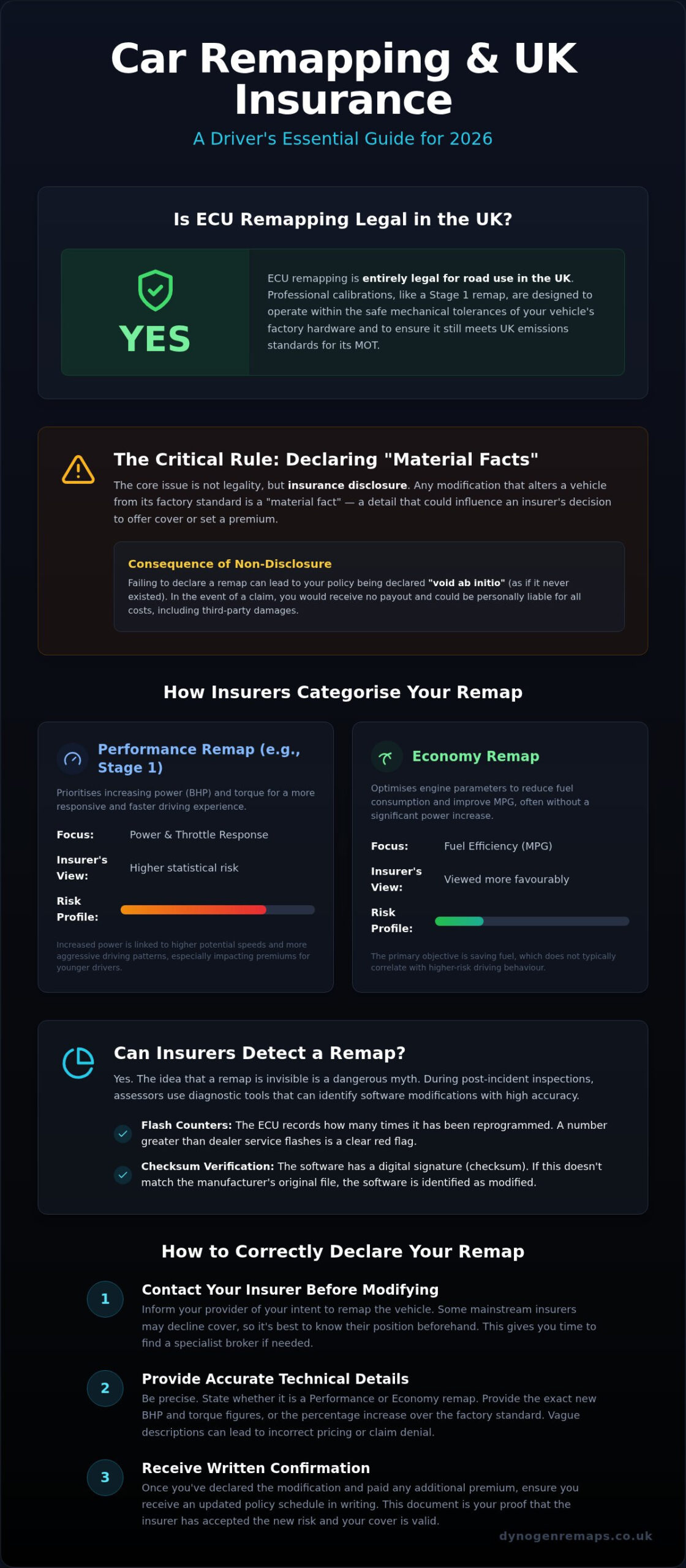
The core of the car remapping insurance implications UK owners face lies in the concept of “material facts”. In the insurance industry, a material fact is any detail that would influence an underwriter’s decision to accept a risk or set a premium. Because a remap changes the vehicle’s factory specifications, it’s classified as a modification. Even an Economy Remap designed for better MPG is a material fact because it alters the vehicle from its original state.
Failing to disclose these changes is legally defined as misrepresentation or non-disclosure. Under the Consumer Insurance Act, insurers have the right to cancel a policy or declare it “void ab initio”. This means the policy is treated as if it never existed from the start. If you’re involved in an incident and haven’t declared your software tuning, you may find yourself without cover and facing significant financial liability. Transparency is the only way to ensure your performance upgrades are actually protected.
How Insurers Categorise Remapping: Performance vs. Efficiency
Insurance underwriters don’t view every software modification through the same lens. When assessing the car remapping insurance implications UK drivers face, companies distinguish between calibrations that prioritise raw power and those designed for operational efficiency. A performance-focused upgrade is statistically linked to a higher risk profile. This is because increased brake horsepower (BHP) and torque naturally lead to higher potential speeds and more aggressive driving patterns. In contrast, an economy-focused map is often viewed more favourably, as the primary objective is reducing fuel consumption rather than chasing lap times.
Stage 1 Performance Remaps and Risk Profiling
A Stage 1 Performance Remap is the most common entry point for enthusiasts. Insurers typically focus on the percentage increase in power over the stock factory figure. While the ECU remapping benefits include a smoother power delivery and sharper throttle response, these enhancements can signal a change in driving behaviour to an underwriter. Younger drivers often experience the most significant premium shifts because they are already in a high-risk demographic; adding 20% more power to their vehicle compounds the statistical probability of a claim. It’s vital to be precise when declaring modifications to your insurer, as vague descriptions can lead to overpricing or, worse, a rejected claim.
Stage 1 software upgrades are generally accepted by mainstream insurers. However, once you move into Stage 2 or 3 territory involving hardware changes like upgraded intercoolers or exhausts, you’re entering the world of specialist modified car insurance. These builds represent a different class of risk that requires a broker who understands the technical nuances of high-performance engineering. Specialist brokers often require a detailed dyno printout to verify the exact power output before they finalise your cover.
Economy Remapping and Technical Solutions
The landscape for commercial vehicles and motorhomes is quite different. Many owners seek diesel economy tuning UK wide to combat rising fuel costs. Because these maps often limit top-end speed or focus on low-end torque for towing, some insurers don’t increase premiums at all. They recognise that an efficiency-led driver is often a lower-risk policyholder. Professional software also provides technical solutions for DPF and EGR systems, which are often classified as “software fault corrections” rather than performance enhancements. When speaking to your provider, clarify if the remap is for fuel saving or power, as this distinction can save you a substantial amount on your annual premium. You must understand the car remapping insurance implications UK brokers associate with your specific software choice. If you’re unsure how your specific map will be categorised, consulting with a specialist tuning professional can provide the technical data needed for a clear declaration.
The Technical Reality: Can Insurers Detect a Remap?
A pervasive myth within the automotive community suggests that software calibrations are entirely invisible once the diagnostic tool is unplugged. This assumption is technically incorrect and dangerously misleading. Modern vehicle architecture is designed with multiple layers of digital security that leave a permanent record of any modifications. When evaluating the car remapping insurance implications UK owners must consider, the ability of an insurer to detect these changes is no longer a matter of “if”, but “when” they choose to look.
Diagnostic Footprints and ECU Flash Counters
Every time an Engine Control Unit is accessed and rewritten, an internal component known as a flash counter increments. This counter acts as a digital seal; even if a vehicle is returned to its factory settings, the counter will reflect that the software has been altered at least twice. Many manufacturers also utilise “TD1” flags. These are automated markers that trigger as soon as a diagnostic tool detects non-standard parameters in the engine’s management system. Once a TD1 flag is raised, it is stored permanently in the vehicle’s history, accessible to both dealerships and, during an investigation, insurance loss adjusters.
Checksums provide another layer of detection. These are mathematical values used to verify the integrity of the software. If the code is modified, the checksum changes. Even the most advanced “stealth” maps can be identified by comparing the current checksum against the factory master file. Attempting to bypass these digital footprints often leaves timestamps that forensic tools can easily recover.
Post-Accident Inspections and Forensic Analysis
In the event of a high-value claim, such as a total loss or an incident involving serious injury, insurers often employ forensic specialists to conduct a deep-dive analysis of the ECU. These experts don’t just look for a modified file name; they examine operational data logs. If the recorded peak boost pressure or fuel rail pressure exceeds the factory-defined maximums for that specific model, it provides irrefutable evidence that a remap was active at the time of the incident.
This level of scrutiny makes the prospect of hiding a map a significant financial risk. Choosing safe engine tuning UK services is the only logical approach for a responsible driver. Professional calibration focuses on transparency and mechanical longevity, ensuring that your upgrades are performed correctly and can be declared with confidence. The risk of having a multi-thousand-pound claim rejected far outweighs the modest increase in an insurance premium. By prioritising a professional, declared installation, you protect both your vehicle and your financial future.
Declaring Your Remap: A Step-by-Step Guide for UK Owners
The process of declaring a vehicle modification is often perceived as a hurdle, yet it’s the only way to safeguard your performance investment. Navigating the car remapping insurance implications UK drivers face requires a methodical approach to communication with your provider. Transparency ensures that your policy accurately reflects the technical state of your vehicle, preventing any ambiguity during a claim. By following a structured declaration process, you maintain the legal integrity of your cover whilst enjoying the enhanced responsiveness of your engine.
When and How to Notify Your Provider
It is worth noting that while remapping is a significant software modification, other enhancements like advanced infotainment or security systems also fall under the umbrella of disclosable changes. Working with a professional installer such as Safe & Sound Mobile ensures that any new hardware is fitted safely and documented correctly, making the declaration process much smoother for the vehicle owner.
The most effective strategy is to contact your insurer for a “quote for modification” before you book your software upgrade. This proactive step allows you to understand any premium changes without committing to the work first. Waiting until your annual renewal is a common mistake; it leaves a window of time where your vehicle is technically modified but not covered for those specific changes.
- Step 1: Request a mid-term adjustment quote. This provides immediate cover from the moment the software is written to the ECU, ensuring you’re protected the second you leave the workshop.
- Step 2: Provide specific technical data. You should inform the agent of the estimated power increase, typically stating an “approx. 20% increase” in BHP and torque for a standard Stage 1 calibration.
- Step 3: Confirm the nature of the work. Clearly state that the modification is a software-only ECU remap and doesn’t involve hardware changes like induction kits or exhaust systems, unless those are also being installed.
If your current provider refuses to cover modifications, you aren’t at a dead end. Some mainstream insurers have rigid risk profiles that don’t accommodate software tuning, but this simply means you’ve outgrown their service and require a more sophisticated insurance product.
Finding Specialist Modified Car Insurance
Specialist brokers and dedicated modified car insurers operate with a deeper understanding of automotive engineering. Unlike standard corporate providers, these specialists often view a car maintained and tuned by a reputable professional as a well-cared-for asset. They frequently offer “agreed value” policies. This ensures that in the event of a total loss, you receive a payout that reflects the true value of the vehicle and its enhancements, rather than a generic market valuation that ignores your performance upgrades.
Professional brokers also understand the distinction between different stages of tuning. They’re far more likely to offer competitive rates for a vehicle that has undergone a professional Stage 1 Performance Remap compared to an amateur calibration. If you’re ready to enhance your vehicle’s capabilities with a professional calibration, you can book your professional remap today to ensure the work is performed to the highest technical standards and is fully supportable by your insurance provider.
Professional Remapping: Ensuring Long-Term Reliability and Peace of Mind
The quality of a software calibration is the single most important factor in determining the long-term reliability of a vehicle. When navigating the car remapping insurance implications UK drivers encounter, the distinction between a professional installation and a generic “chip” becomes a critical point of discussion with underwriters. A high-quality remap is designed to work in harmony with the vehicle’s existing safety protocols, ensuring that components like the turbocharger and fuel system are never pushed beyond their mechanical limits. This professional approach to vehicle optimisation provides a transparent record of work that insurers find far easier to support than clandestine or amateur modifications.
Why Software Quality Matters for Insurance and Warranty
Sophisticated safe engine remapping differs fundamentally from basic tuning boxes that simply trick engine sensors into requesting more fuel or boost. Insurers are increasingly aware of this technical difference. They are far more comfortable providing cover for custom-calibrated software that maintains all factory safety buffers and emissions controls. A professional tuner provides a detailed invoice and technical summary of the changes made, which acts as a material record for your insurance declaration.
Regarding manufacturer warranties, it’s a reality that any engine modification can lead to a warranty claim being questioned if the failure is related to the tuned component. However, a professional remap is designed to be as non-intrusive as possible. Because the software remains within the manufacturer’s own design tolerances, the risk of mechanical failure is significantly lower than with aggressive, generic files. This commitment to technical excellence ensures that your vehicle remains a reliable asset whilst delivering the enhanced driving dynamics you desire.
Dynogen’s Approach to Transparent Vehicle Tuning
Dynogen brings over 15 years of technical experience in ECU architecture to every vehicle we calibrate. Our methodology is built on a foundation of precision and per-vehicle tuning, ensuring that every software adjustment is tailored to the specific health and mileage of your engine. We don’t believe in “one size fits all” solutions; instead, we focus on delivering a smooth, refined power delivery that respects the integrity of the vehicle’s hardware. This level of professional service provides the peace of mind needed to declare your modifications confidently to your insurer.
Remapping has become a standard part of modern car ownership for drivers who want to unlock the true potential of their vehicle. When you choose a specialist who prioritises safety and transparency, the insurance process becomes a straightforward administrative step rather than a source of anxiety. If you’re ready to experience the benefits of a sophisticated software upgrade, you can enquire about a professional Stage 1 remap today to ensure your vehicle is optimised by an industry veteran who values performance and legality in equal measure. Understanding the car remapping insurance implications UK law requires is the final step in a successful tuning journey, allowing you to enjoy your enhanced vehicle with total confidence.
Securing Your Performance Future
Securing your vehicle’s performance future requires a balance of technical ambition and legal diligence. We’ve established that the car remapping insurance implications UK drivers face are manageable when approached with transparency. Modern ECU architecture ensures that software changes leave a permanent digital footprint; non-disclosure is a high-risk strategy that rarely pays off. By choosing a professional, custom-calibrated Stage 1 or Economy map, you ensure your vehicle remains within safe mechanical limits whilst providing the documented evidence necessary for a valid insurance declaration.
Dynogen offers a UK-wide specialist service backed by over 15 years of technical expertise. Our commitment to custom-calibrated software ensures your vehicle delivers peak responsiveness without compromising long-term reliability. Don’t leave your coverage to chance. Instead, choose a partner who understands the sophisticated intersection of engine management and legal compliance.
Get a Professional Remapping Quote from Dynogen and enjoy the ultimate driving experience with total peace of mind. Your journey toward superior performance starts with a safe, professional, and fully declared calibration.
Frequently Asked Questions
Is it worth declaring a remap to insurance in the UK?
Declaring your modification is essential for legal compliance and financial protection. It’s the only way to ensure your policy remains valid and enforceable. Under the Consumer Insurance Act, a remap is a material fact that must be disclosed to your provider. Failing to do so can result in a voided policy, leaving you personally liable for damages in the event of an accident. Transparency protects your performance investment and maintains your legal standing.
Can insurance companies tell if a car has been remapped after an accident?
Modern insurance investigators use sophisticated diagnostic tools to interrogate the Engine Control Unit after a significant claim. They look for incremented flash counters and TD1 flags that indicate software alterations. Even if you attempt to reset the software to factory settings, forensic analysis of boost pressure logs and fuel rail data can reveal the presence of a remap. These digital footprints make non-disclosure a high-risk strategy that modern insurers are equipped to detect.
How much does car insurance go up after a remap?
Premium adjustments depend entirely on your insurer’s risk assessment and the nature of the software upgrade. While an Economy Remap might result in no increase at all, a Stage 1 Performance Remap often attracts a modest uplift to reflect the increased BHP and torque. Some specialist brokers offer competitive rates for professionally tuned vehicles because they recognise that enthusiasts often maintain their cars to a higher technical standard than average drivers. Always request a quote before installation.
Does a Stage 1 remap void my car insurance policy?
A Stage 1 remap only voids your policy if you fail to disclose it to your insurer. When you follow the correct declaration process, the insurer simply updates your policy to reflect the car remapping insurance implications UK law requires. Most mainstream providers accept software-only modifications, provided they are performed by a professional. The policy only becomes void if the insurer can prove non-disclosure of a modification that would have altered their initial risk assessment.
What happens if I do not declare my remap and I have an accident?
If an undeclared remap is discovered after an accident, your insurer will likely cancel your policy void ab initio. This means the cover is treated as if it never existed, leaving you to pay for all third-party damages and your own repairs. Additionally, you could face prosecution for driving without valid insurance. This can lead to a fixed penalty, six points on your licence, and significant difficulty obtaining insurance coverage for any vehicle in the future.
Are there insurance companies that specialise in remapped cars?
Several UK-based specialist brokers focus exclusively on modified and performance vehicles. These companies have a deeper understanding of technical software upgrades and often provide agreed value cover that standard insurers cannot match. They view a professional Stage 1 calibration as a sophisticated enhancement rather than a generic risk. Using a specialist broker is often the most cost-effective way to ensure your tuned vehicle is fully protected without paying excessive premiums for your upgrades.
Will an economy remap lower my insurance premium?
An Economy Remap is designed to optimise fuel efficiency rather than peak power, which insurers generally view as a lower risk. While it is unlikely to reduce your premium below the standard factory rate, many providers will not increase your costs for this specific modification. You must still declare it as a material fact, but you should emphasise the efficiency-led nature of the software to ensure the underwriter categorises the risk correctly during the adjustment process.
Does remapping void my manufacturer warranty as well as insurance?
Remapping can potentially void the powertrain section of your manufacturer warranty if a mechanical failure is directly attributed to the software change. However, it does not void the entire warranty for unrelated components like suspension or electronics. Professional tuners with over 15 years of experience focus on keeping calibrations within safe factory limits to minimise this risk. Always weigh the performance benefits against your specific warranty terms before proceeding with any professional ECU modification or software upgrade.