
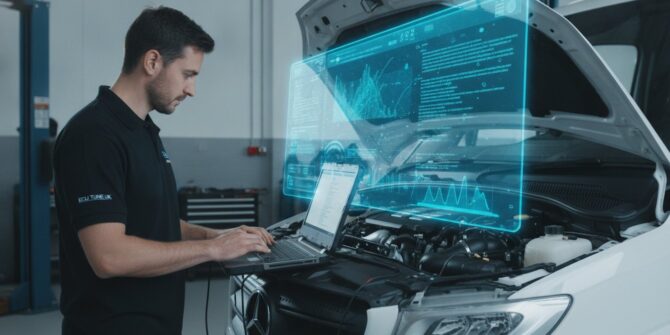
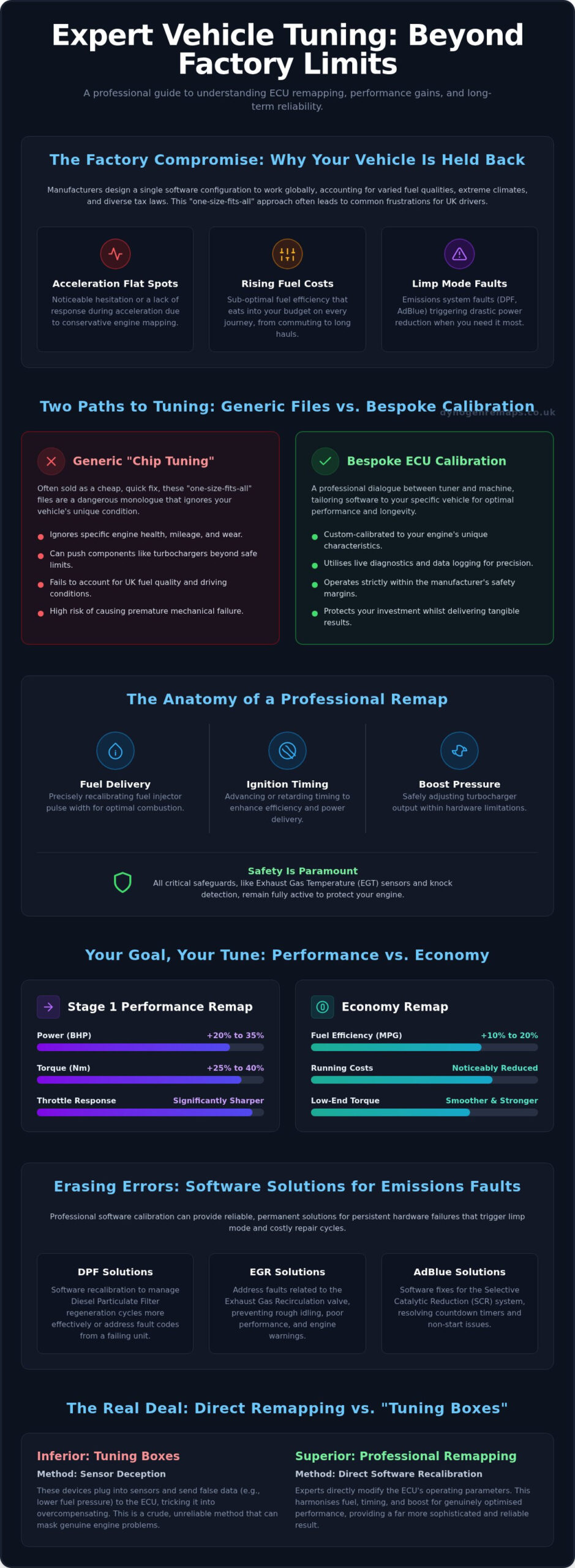
Your vehicle’s factory software is often a compromise designed to meet the lowest common denominator of global fuel quality and varied climates. This generic approach frequently leaves drivers struggling with frustrating flat spots during acceleration or rising fuel costs that eat into the margins of every journey. You shouldn’t have to settle for a driving experience that feels restricted or unreliable. Expert vehicle tuning services offer a sophisticated alternative to these factory limitations, providing a precision-engineered bridge between raw mechanical potential and refined software control.
We understand the frustration of seeing an AdBlue or DPF fault code trigger limp mode just when you need your van or motorhome most. It’s a common pain point that demands more than a temporary fix. In this specialist guide, you’ll discover how professional ECU calibration transforms power, torque, and efficiency whilst maintaining the long-term mechanical reliability you depend on. We’ll examine the technical shift from generic files to custom-calibrated solutions, detailing how bespoke software provides smoother power delivery and permanent resolutions for persistent emissions-related faults.
Key Takeaways
- Understand the critical distinction between generic “chip tuning” and bespoke ECU remapping to ensure your vehicle receives a calibration tailored to its unique mechanical condition.
- Discover how expert vehicle tuning services precisely adjust fuel, ignition timing, and boost pressure to enhance performance whilst maintaining strict mechanical safety margins.
- Evaluate the specific outcomes of Stage 1 Performance and Economy remaps to determine which calibration best aligns with your driving goals and fuel saving targets.
- Identify reliable software-based solutions for persistent emissions hardware failures, including DPF, EGR, and AdBlue faults that frequently cause frustrating limp mode cycles.
- Learn why direct software recalibration offers far superior results and long-term reliability compared to inferior “tuning box” sensor-deception technology.
Defining Expert Vehicle Tuning Services in the Modern Era
Expert vehicle tuning services represent the professional recalibration of a vehicle’s Engine Control Unit (ECU). It’s about precision. This process involves modifying the sophisticated software that governs how your engine behaves, rather than simply adding physical hardware. Manufacturers typically engineer engines with significant performance “headroom” to account for varying global factors. They must ensure a vehicle operates reliably in extreme sub-zero temperatures, copes with poor quality fuel in developing markets, and adheres to various international tax brackets. By accessing this untapped potential, a seasoned specialist can tailor the vehicle’s output to suit the specific environment and requirements of the UK driver.
The Evolution from Chips to Software Calibration
The industry has undergone a radical transformation since the early days of Chip tuning. In the past, technicians physically removed and replaced EPROMs on the circuit board. Today, we utilise sophisticated On-Board Diagnostics (OBD) and bench remapping techniques to interface directly with the ECU’s microprocessor. Modern vehicles feature complex security layers, including TPROT (Tuning Protection) and intricate checksum corrections that require advanced tooling to bypass safely. Overcoming these technical hurdles effectively requires the level of insight only 15+ years of industry experience can provide. We’ve witnessed the transition from basic fuel adjustment to the highly complex, multi-layered maps found in modern 64-bit controllers.
Why One-Size-Fits-All Files Fail the Driver
Many providers offer budget services using generic, “one-size-fits-all” files, often referred to as slave files. These templates are dangerous because they ignore the specific mechanical health, mileage, and wear patterns of your individual engine. A generic map might push a tired turbocharger beyond its physical limits or fail to account for the high-quality fuels used in Britain. Expert vehicle tuning services prioritise the longevity of your engine through real-time diagnostics and data logging. We monitor how the engine responds to software changes in a live environment. This meticulous approach is the only way to ensure safe engine tuning in the UK, protecting your investment whilst delivering tangible results. True calibration is a dialogue between the tuner and the machine; generic files are merely a monologue that ignores the engine’s feedback.
The Technical Architecture of Custom ECU Remapping
Modern engine management requires a sophisticated understanding of complex code structures, particularly within the latest Bosch MG1 and MD1 ECU series. These controllers act as the central nervous system of the vehicle, processing thousands of data points every second. Expert vehicle tuning services focus on the precise recalibration of three primary map groups: fuel delivery, ignition timing, and boost pressure. By refining the fuel injector pulse width and advancing or retarding ignition timing, we can significantly enhance the combustion cycle’s efficiency. This isn’t about simply “turning up the volume”; it’s about harmonising different parameters to achieve a superior result.
Safety remains the cornerstone of professional calibration. Expert vehicle tuning services operate strictly within factory safety protocols, ensuring that critical safeguards like Exhaust Gas Temperature (EGT) sensors and knock detection logic remain fully active. If an engine begins to run too lean or detects pre-ignition, the ECU must retain its ability to intervene and protect the mechanical components. We also address “Torque Limitation” maps, which are often set artificially low by manufacturers to differentiate between various models in their range. Safely adjusting these limits allows the engine to breathe, providing the power the hardware was originally designed to handle.
Managing Engine Torque and Drivability
Torque request maps are the primary interface between the driver and the engine. They translate your throttle input into a specific load requirement. Increasing low-end torque is essential for improving car drivability through remapping, providing that effortless surge when overtaking or climbing hills. We prioritise smooth torque curves over aggressive, peaky delivery. A linear progression protects your drivetrain, preventing premature clutch slip and flywheel wear. This meticulous approach ensures the vehicle feels more responsive and refined in every gear.
Turbocharged Petrol and Diesel Performance Tuning
Calibration strategies vary wildly between petrol and diesel platforms. For a high-output petrol engine like the B58, we manage the delicate balance between boost pressure and timing to avoid detonation. Turbo diesel tuning, however, focuses on air-fuel ratios and injection timing to mitigate soot production and manage emissions systems and component faults. Boost control maps are optimised to reduce turbo lag, allowing the turbocharger to spool up significantly faster. This results in a broader power band and improved thermal efficiency. If you’re curious about how these technical refinements can transform your drive, explore our bespoke tuning solutions.
Performance vs. Efficiency: Navigating Calibration Goals
Choosing between raw power and fuel economy is a common dilemma for vehicle owners, yet professional calibration proves these objectives are often complementary. Expert vehicle tuning services utilise the concept of Brake Specific Fuel Consumption (BSFC) to refine how an engine converts chemical energy into kinetic force. BSFC is the measure of fuel consumed per unit of power produced; a lower figure indicates a more efficient engine. By optimising the combustion window, we ensure that fuel is burnt more completely, which simultaneously increases torque and reduces waste heat. This technical refinement is particularly beneficial for motorhomes and commercial vehicles that operate under constant load, where even a small percentage gain in efficiency translates into significant annual savings.
A hybrid approach is frequently the most rewarding for the everyday driver. By recalibrating the ECU to deliver more torque at lower RPMs, the vehicle requires less throttle input to maintain motorway speeds. This “best of both worlds” scenario means that whilst the peak power is higher for safe overtaking, the steady-state cruising efficiency is also enhanced. It is a meticulous balancing act that requires a deep understanding of engine thermodynamics and air-mass calculations. When the engine doesn’t have to work as hard to move the same mass, the practical result is a smoother, more economical journey.
Unlocking Potential with a Stage 1 Remap
A Stage 1 calibration is designed for vehicles with entirely stock hardware. It focuses on unlocking the latent potential left behind by the manufacturer’s global “headroom” mentioned earlier. Following the ultimate guide to Stage 1 performance remapping ensures that your vehicle benefits from a significant increase in BHP and torque without compromising reliability. The primary benefit is the total removal of frustrating “flat spots” in the power delivery. The result is a crisp, linear throttle response that makes the car feel lighter and more eager to accelerate, which is why it remains the most popular choice for daily driven vehicles in the UK.
Diesel Economy Tuning for Fleets and Vans
For high-mileage operators, the priority shifts toward the bottom line. Implementing diesel economy tuning in the UK is a strategic move to reduce operational costs across a fleet. We achieve this by precisely optimising injection timing and increasing rail pressure to improve fuel atomisation. Finer droplets burn more rapidly and cleanly, allowing for a leaner mixture during part-load conditions. For fleet managers, the Return on Investment (ROI) is tangible; software-based efficiency gains can significantly lower the total cost of ownership across dozens of vehicles without requiring any physical engine modifications. Expert vehicle tuning services provide the data-driven evidence needed to justify these enhancements through improved MPG figures and reduced refuelling frequency.
Software Solutions for Emissions Systems and Component Faults
Modern emissions hardware represents one of the most significant failure points in contemporary diesel engines. Systems such as the Diesel Particulate Filter (DPF), Exhaust Gas Recirculation (EGR), and Selective Catalytic Reduction (AdBlue) are designed to reduce environmental impact, yet they often lead to persistent dashboard error codes and the dreaded “limp mode.” This restricted performance state is the ECU’s way of protecting the engine from perceived damage, but it frequently occurs due to sensor calibration errors rather than genuine mechanical failure. Expert vehicle tuning services offer a sophisticated technical solution by recalibrating the software logic that governs these components, ensuring the vehicle operates without unnecessary electronic restrictions.
It is essential to distinguish between physical hardware removal and software-based optimisation. Whilst some providers suggest intrusive mechanical changes, a specialist focus remains on the software bypass or recalibration. By adjusting the parameters within the ECU, we can resolve fault codes that would otherwise require thousands of pounds in dealership repairs. These expert vehicle tuning services provide a bridge between complex modern regulations and the practical reality of vehicle ownership, ensuring long-term reliability without the constant threat of software-induced breakdowns.
Solving the AdBlue Non-Start Countdown
A professional AdBlue Solution targets the underlying software conflict within the ECU, providing a permanent resolution to the non-start countdown. This “no start in X miles” warning is a notorious issue for van and motorhome owners, often triggered by a faulty NOx sensor or a simple communication error between modules. Rather than replacing expensive tanks or pumps, we recalibrate the SCR (Selective Catalytic Reduction) software to eliminate the countdown logic. Mercedes owners in particular will recognise this frustrating cycle of recurring warnings; a Mercedes AdBlue software fix addresses the root cause within the engine control unit rather than simply replacing components that may fail again. This approach is a fraction of the cost of dealership component replacement and prevents the vehicle from being stranded due to a minor electronic glitch.
DPF and EGR Software Adjustments
EGR Solutions are designed to manage the behaviour of the Exhaust Gas Recirculation valve, which is prone to carbon buildup. By recalibrating the ECU to keep the valve closed during specific engine loads, we prevent soot-laden air from contaminating the intake manifold. Similarly, for vehicles suffering from chronic DPF regeneration issues, a software-based DPF Solution can recalibrate how the ECU monitors particulate levels. This prevents the cycle of failed regenerations that leads to clogged filters and engine oil dilution. We place a high priority on maintaining MOT compliance whilst seeking these technical solutions, ensuring the vehicle remains road-legal and efficient. If you are struggling with persistent emissions warnings, contact our specialists for a permanent software solution.
Why Professional Calibration Outperforms Generic Tuning Boxes
Choosing between a physical “tuning box” and a direct ECU remap is often the final decision for drivers seeking more power. Whilst the appeal of a plug-and-play device is understandable, these “piggyback” modules rely on fool-the-sensor technology that is fundamentally limited. Expert vehicle tuning services take a vastly different approach by communicating directly with the engine’s brain. Rather than intercepting and distorting signals to force a reaction, we recalibrate the underlying logic to achieve a more refined and sustainable result. This direct access allows for a level of precision that external hardware simply cannot replicate.
The Problem with Sensor Manipulation
Tuning boxes operate by intercepting the signal from the common rail or boost pressure sensor and sending a false, lower value to the ECU. The engine then compensates by over-fuelling or increasing boost pressure to meet a perceived deficit. This crude method often leads to significantly increased exhaust gas temperatures (EGTs) and excessive soot production, which can prematurely degrade your DPF. Furthermore, these boxes lack any integration with the Transmission Control Unit (TCU), meaning the gearbox remains unaware of the increased torque, leading to harsh shifts and drivetrain strain. A tuning box is effectively a crude loudspeaker shouting over the engine’s natural voice, whereas a professional remap is a fine-tuned instrument that harmonises every component for a superior performance.
Safety is the most compelling reason to avoid sensor-deception hardware. By choosing a software-based solution, you enjoy the full benefits of professional ECU remapping, where factory protection limits remain fully intact. If the ECU detects an anomaly, it can still pull back timing or reduce boost to protect the engine; a tuning box often masks these vital warning signs until mechanical failure occurs.
Selecting a Reliable Vehicle Tuning Specialist
Investing in your vehicle’s performance requires a specialist who prioritises technical excellence over quick, generic fixes. When evaluating providers, consider this essential checklist to ensure your car is in safe hands:
- Industry Experience: Look for a specialist with at least 15+ years of experience navigating the evolution of ECU architecture.
- Custom Software Focus: Ensure the provider writes bespoke files tailored to your specific vehicle rather than using generic “slave” templates.
- Diagnostic Capability: A true expert performs a full health check and data logging session before and after the calibration.
- Technical Support: Choose a service that offers national coverage and ongoing advice long after the software is installed.
The long-term value of expert vehicle tuning services lies in the peace of mind that comes from a professional, data-driven approach. At Dynogen, our 15-year heritage in custom calibration ensures that every remap we deliver is as reliable as it is powerful. By treating the engine as a complete system rather than a collection of sensors to be tricked, we unlock a level of drivability and efficiency that generic boxes can never match.
Elevate Your Driving Experience with Precision Calibration
Mastering the balance between raw power and long-term reliability requires a deep understanding of modern engine management systems. You’ve seen how bespoke ECU remapping far surpasses the limited capabilities of generic tuning boxes by working in harmony with your vehicle’s factory safety protocols. Whether you are looking to eliminate frustrating flat spots with a Stage 1 Performance Remap or reduce operational costs through an Economy Remap, the solution lies in precision-engineered software. Our approach ensures that every adjustment to fuel delivery and boost pressure is made with meticulous attention to detail, protecting your mechanical components whilst unlocking their true potential.
With over 15 years of expert software calibration experience, we combine advanced diagnostic equipment with custom software to solve complex performance and emissions challenges. We specialise in delivering tangible results for drivers who refuse to compromise on quality or efficiency. If you’re ready to transform your vehicle’s responsiveness and reliability, enquire about our expert vehicle tuning services today. Your journey towards a more refined and powerful driving experience starts with a specialist who understands the leading edge of automotive technology. We look forward to helping you achieve the perfect calibration for your vehicle.
Frequently Asked Questions
Is vehicle remapping safe for my engine in the long term?
Vehicle remapping is entirely safe when conducted by a seasoned specialist who prioritises mechanical longevity. Manufacturers build engines with significant tolerance to account for global variables like poor fuel quality or extreme climates. Expert vehicle tuning services unlock this latent potential whilst keeping parameters within the engine’s safe operating limits. By maintaining factory protection protocols, such as thermal management and knock detection, we ensure your engine remains reliable for hundreds of thousands of miles.
Will an expert remap void my manufacturer warranty?
A manufacturer cannot legally void your entire warranty simply because a vehicle has been remapped; they must prove the software modification directly caused a specific component failure. However, main dealers often take a conservative stance and may refuse warranty work on the drivetrain if a remap is detected. It’s essential to understand that whilst the software is professional, the risk of a warranty dispute remains a factor you should weigh before proceeding with any modification.
How much fuel can I realistically save with an economy remap?
Turbo diesel owners typically see a fuel saving of between 10% and 15% following a professional Economy Remap. These tangible gains are achieved by increasing low-end torque, which allows the driver to maintain higher gears at lower speeds. By reducing the amount of throttle input required to move the vehicle’s mass, the engine operates more efficiently. The actual return on investment depends on your specific driving habits and the type of routes you frequently travel.
What is the difference between a Stage 1 and a Stage 2 remap?
A Stage 1 Performance Remap is designed specifically for vehicles with entirely stock hardware, focusing on software optimisation alone. In contrast, a Stage 2 calibration requires physical hardware upgrades, such as an uprated intercooler, high-flow air filter, or an aftermarket exhaust system. Stage 2 pushes the engine further by taking advantage of these mechanical improvements to manage increased heat and airflow, whereas Stage 1 remains the ideal solution for daily driven reliability.
Can a remap be detected by a main dealer during a service?
Modern diagnostic equipment used by main dealers can often detect a remap through various methods, including flash counters or logs of maximum torque values. Whilst some providers claim their software is “invisible,” a determined technician with manufacturer-level tools can usually identify that the ECU’s original code has been altered. If maintaining total anonymity from your dealer is a priority, you should assume that the modification is potentially detectable during a routine service or diagnostic update.
How long does the professional remapping process typically take?
The professional remapping process typically takes between one and three hours to complete properly. This duration allows for a comprehensive pre-map health check, the reading of the original ECU data, and the subsequent upload of your custom-calibrated software. Some modern ECUs require “bench” remapping, which involves removing the unit for direct access, whilst others are completed via the OBD port. We never rush this methodical process to ensure every safety check is satisfied.
Can you fix AdBlue and DPF faults through software alone?
We provide permanent software solutions for persistent AdBlue and DPF faults that frequently cause limp mode or non-start countdowns. By recalibrating the ECU’s monitoring logic, we can resolve dashboard error codes without the need for expensive hardware replacements. For Mercedes owners facing the recurring ‘engine start not possible’ warning, a professional Mercedes AdBlue software fix targets the root cause within the ECU rather than pursuing costly component replacements that fail to resolve the underlying software conflict. These expert vehicle tuning services address the software-induced restrictions that often plague modern diesel engines. It’s a technical approach that restores the vehicle’s functionality whilst avoiding the high costs associated with dealership emissions repairs.
Do I need to inform my insurance company about a performance remap?
You must inform your insurance provider about any performance remap, as it is classified as a material modification to the vehicle’s factory specification. Failing to disclose this information could lead to your policy being invalidated in the event of a claim. Most specialist insurers are familiar with ECU remapping and will simply adjust your premium accordingly. Transparency ensures that your cover remains valid and that you are fully protected whilst enjoying your vehicle’s enhanced performance.